Carrabelle in Franklin County, Florida — The American South (South Atlantic)
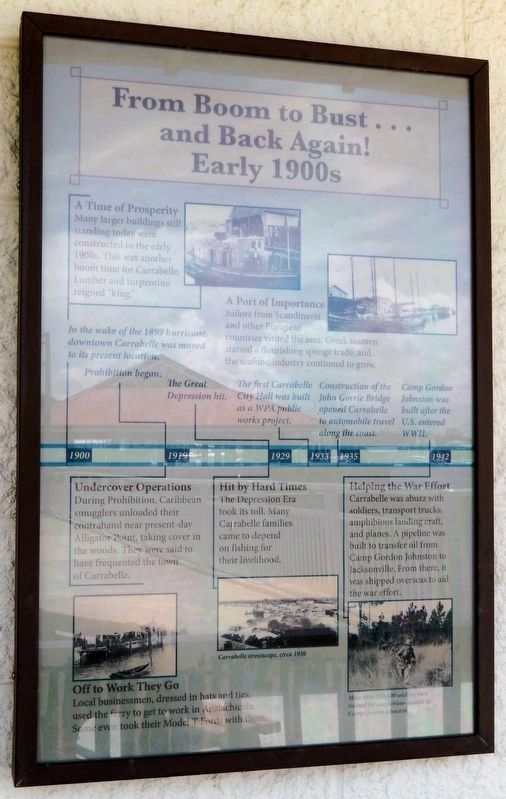
From Boom to Bust... and Back Again!
Early 1900s
| — | History Timeline | — |
Photographed by Cosmos Mariner, June 16, 2025
1. From Boom to Bust... and Back Again! Marker
1900 • In the wake of the 1899 hurricane, downtown Carrabelle was moved to its present location.
A Time of Prosperity
Many larger buildings still standing today were constructed in the early 1900s. This was another boom time for Carrabelle. Lumber and turpentine reigned “king.”
A Port of Importance
Sailors from Scandinavia and other European countries visited the area. Greek seamen started a flourishing sponge trade, and the seafood industry continued to grow.
1919 • Prohibition began.
Undercover Operations
During Prohibition, Caribbean smugglers unloaded their contraband near present-day Alligator Point, taking cover in the woods. They were said to have frequented the town of Carrabelle.
Off to Work They Go
Local businessmen, dressed in hats and ties, used the ferry to get to work in Apalachicola. Some even took their Model T Fords with them.
1929 • The Great Depression hit.
Hit by Hard Times
The Depression Era took its toll. Many Carrabelle families came to depend on fishing for their livelihood.
1933 • The first Carrabelle City Hall was built as a WPA public works project.
1935 • Construction of the John Gorrie Bridge opened Carrabelle to automobile travel along the coast.
1942 • Camp Gordon Johnston was built after the U.S. entered WWII.
Helping the War Effort
Carrabelle was abuzz with soldiers, transport trucks, amphibious landing craft, and planes. A pipeline was built to transfer oil from Camp Gordon Johnston to Jacksonville. From there, it was shipped overseas to aid the war effort.
[captions]
• Carrabelle streetscape, circa 1930
• More than 250,000 soldiers were trained for amphibious assault at Camp Gordon Johnston.
Erected 2009 by Florida Coastal Management Program, Florida Department of Environmental Protection, and National Oceanic and Atmospheric Administration.
this page online
Topics and series. This historical marker is listed in these topic lists: Bridges & Viaducts • Charity & Public Work • Industry & Commerce • War, World II. In addition, it is included in the Works Progress Administration (WPA) projects series list.
Location. 29° 50.838′ N, 84° 39.841′ W. Marker is in Carrabelle, Florida, in Franklin County. It is at the intersection of Marine Street and Avenue F South, on the right when traveling south on Marine Street. The marker is mounted on the north side of the Carrabelle Riverwalk & Wharf public restroom building. Touch for map. Marker is in this post office area: Carrabelle FL 32322, United States of America. Touch for directions.

Regionally, this marker is on the Florida Panhandle. It is also in the American South, specifically in the Deep South, and on the Gulf Coast. Globally, it is in the North Atlantic Region, North America, a Gulf of Mexico state, the Western Hemisphere, the Western World, and the Anglosphere. Historically, it finds itself in what was once New Spain, the territory of the Mississippian Culture,
Photographed by Cosmos Mariner, June 16, 2025
2. Carrabelle Riverwalk & Wharf Public Restrooms
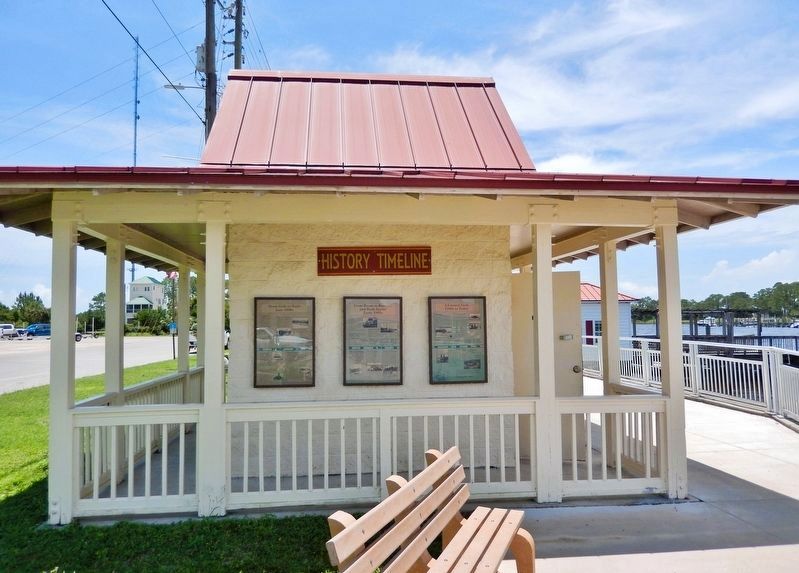
Looking south; the Carrabelle River is on the right. This marker is the center one of three interpretive panels on the north side of the building.
Other nearby markers. At least 8 other markers are within walking distance of this marker: From Sails to Rails (here, next to this marker); A Coastal Gem (here, next to this marker); The Land and Sea Provide (here, next to this marker); A Bustling Seaport (here, next to this marker); Welcome to the Carrabelle Riverwalk and Wharf (here, next to this marker); Carrabelle Historic City Hall (approx. 0.2 miles away); Georgia Florida & Alabama Railroad (approx. 0.2 miles away); The Legend of Tate's Hell (approx. 0.2 miles away). Touch for a list and map of all markers in Carrabelle.
Related markers. Click here for a list of markers that are related to this marker. Carrabelle Riverwalk & Wharf — History Timeline
Also see . . .
1. Carrabelle History Museum.
The museum is located in the Old Carrabelle City Hall, the Marvin N. Justiss Building. An anchor historical building in the heart of the historical downtown. The City conducted its business in the building for 75 years. It was named in honor of the local brick mason who created each block and brick with hand-crafted local materials. It was built as a project of the Works Progress Administration (WPA). The structure is a two-story brick vernacular style of that period.(Submitted on May 10, 2026, by Cosmos Mariner of Cape Canaveral, Florida.)
2. Camp Gordon Johnston (Wikipedia).
Excerpt: Camp Gordon Johnston opened in September 1942 as Camp Carrabelle and was later named after Colonel Gordon Johnston, a well-decorated soldier who served in the Spanish–American War in Cuba with the Rough Riders, in the Philippine–American War, and in World War I. The camp at 165,000 acres served as an amphibious training base housing around 10,000 troops at one time and rotating between 24,000 and 30,000 soldiers from 1942 through 1946. The nearby islands of Dog Island and St. George Island were used as landing points for exercises.(Submitted on May 10, 2026, by Cosmos Mariner of Cape Canaveral, Florida.)
3. John Gorrie Memorial Bridge (Wikipedia).
Excerpt: The John Gorrie Bridge carries US 98 and US 319 over the Apalachicola Bay. It connects Apalachicola, Florida, with Eastpoint, Florida. The original John Gorrie Bridge was built in 1935, replacing a ferry service between the two towns. It included a rotating section to allow passage of ships with high masts. The current bridge was built in 1988.(Submitted on May 10, 2026, by Cosmos Mariner of Cape Canaveral, Florida.)
Credits. This page was last revised on May 10, 2026. It was originally submitted on May 6, 2026, by Cosmos Mariner of Cape Canaveral, Florida. This page has been viewed 22 times since then. Photos: 1, 2. submitted on May 9, 2026, by Cosmos Mariner of Cape Canaveral, Florida.
