City of London in Greater London, England, United Kingdom — Northwestern Europe (the British Isles)
The London Wall Walk - 07
Photographed by Andrew Ruppenstein, April 25, 2026
1. The London Wall Walk - 07 Marker
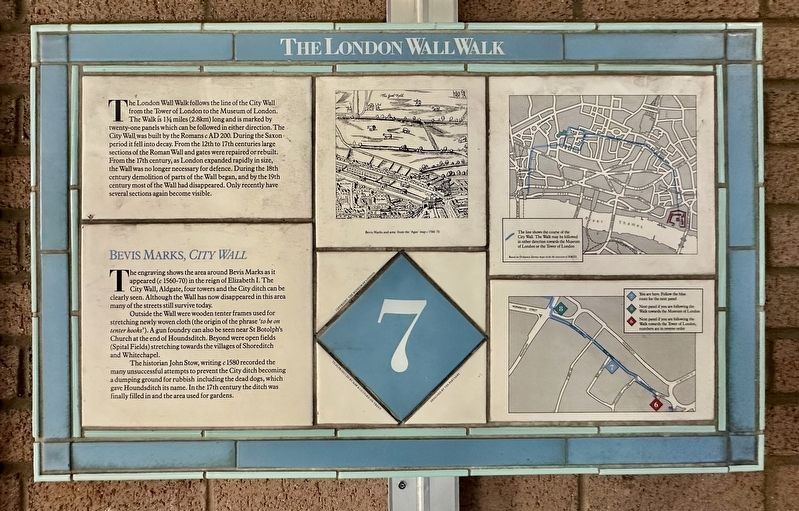
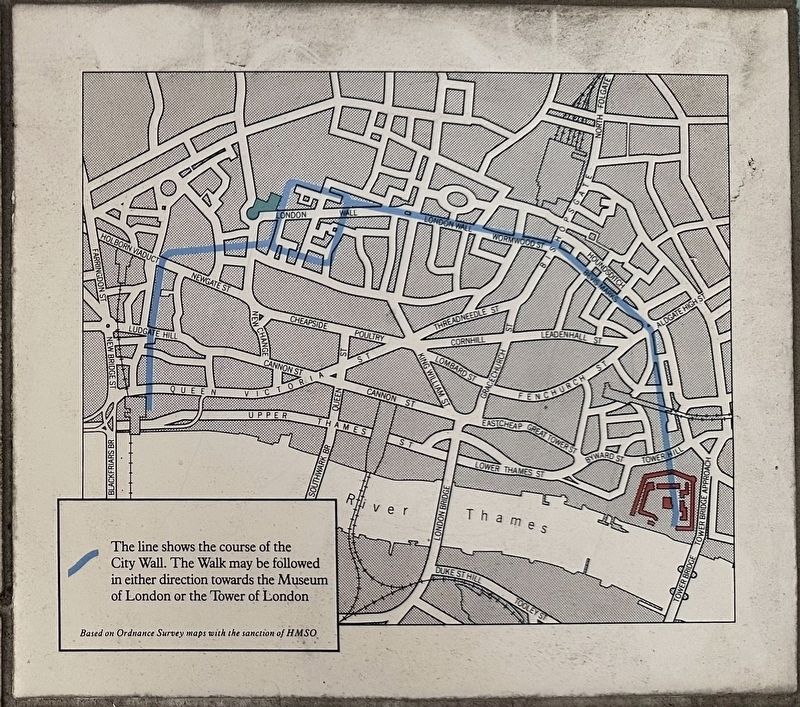
The London Wall Walk follows the line of the City Wall from the Tower of London to the Museum of London. The Walk is 134 miles (2.8km) long and is marked by twenty-one panels which can be followed in either direction. The City Wall was built by the Romans c AD 200. During the Saxon period it fell into decay. From the 12th to 17th centuries large sections of the Roman Wall and gates were repaired or rebuilt. From the 17th century, as London expanded rapidly in size, the Wall was no longer necessary for defence. During the 18th century demolition of parts of the Wall began, and by the 19th century most of the Wall had disappeared. Only recently have several sections again become visible.
Bevis Marks, City Wall
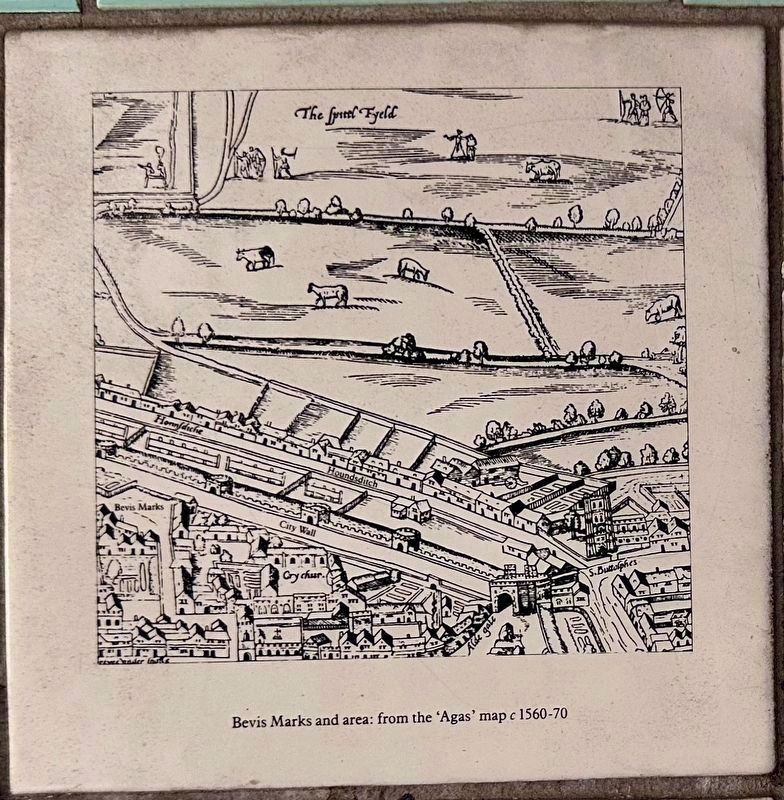
The engraving shows the area around Bevis Marks as it appeared (c 1560-70) in the reign of Elizabeth I. The City Wall, Aldgate, four towers and the City ditch can be clearly seen. Although the Wall has now disappeared in this area many of the streets still survive today.
Outside the Wall were wooden tenter frames used for stretching newly woven cloth (the origin of the phrase 'to be on tenter hooks'). A gun foundry can also be seen near St Botolph's Church at the end of Houndsditch. Beyond were open fields (Spital Fields) stretching towards
this page online
The historian John Stow, writing c 1580 recorded the many unsuccessful attempts to prevent the City ditch becoming a dumping ground for rubbish including the dead dogs, which gave Houndsditch its name. In the 17th century the ditch was finally filled in and the area used for gardens.
(Marker Number 07.)
Topics. This historical marker is listed in this topic list: Forts and Castles. A significant historical year for this entry is 1580.
Location. 51° 30.887′ N, 0° 4.739′ W. Marker is in City of London, England, in Greater London. It is at the intersection of Bevis Marks and Bury Place, on the left when traveling west on Bevis Marks. Touch for map. Marker is at or near this postal address: 10 Bevis Marks, City of London, England EC3A, United Kingdom. Touch for directions.

Regionally, this marker is in London and in the Greater South East. Globally, it is on the Atlantic Ocean, in the North Atlantic Region, in Europe, in Atlantic Europe, on one of the British Isles, in the Western World, and in the Anglosphere. Historically, it finds itself in what was once the Roman Empire.
Other nearby markers. At least 8 other markers are within walking distance of this marker: The Great Synagogue Dukes Place (about 90 meters away, measured
Photographed by Andrew Ruppenstein, April 25, 2026
2. The London Wall Walk - 07 Marker - wide view
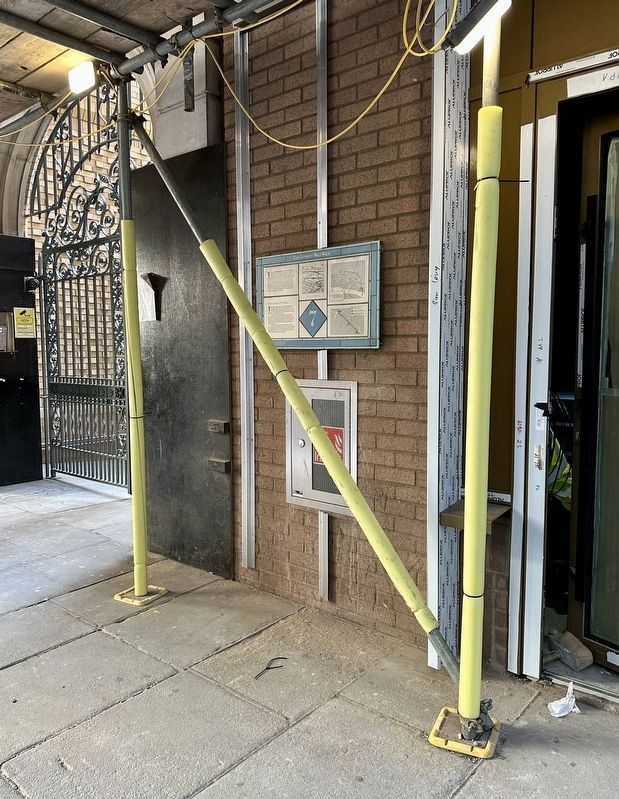
As evident by the visible scaffolding, the immediate vicinity of the marker is undergoing construction. To the left of the marker the gates of Bevis Marks Synagogue are visible.
Related markers. Click here for a list of markers that are related to this marker.
Also see . . . London Wall (Wikipedia). Excerpt:
The London Wall is a defensive wall first built by the Romans around the strategically important port town of Londinium in c. AD 200, as well as the name of a modern street in the City of London, England.(Submitted on May 6, 2026.)
Roman London was, from around 120–150, protected by a large fort, with a large garrison, that stood to its north-western side. The fort, now referred to as the Cripplegate Fort, was later incorporated into a comprehensive city-wide defence, with its strengthened northern and western sides becoming part of the Wall which was built around 200. The incorporation of the fort's walls gave the walled area its distinctive shape in the north-west part of the city.
The end of Roman rule in Britain, around 410, led to thewall falling into disrepair. It was restored in the late Anglo-Saxon period, a process generally thought to have begun under Alfred the Great after 886. Repairs and enhancements continued throughout the medieval period. The wall largely defined the boundaries of the City of London until the later Middle Ages, when population rises and the development of towns around the city blurred the perimeter.‘Agas’ map, courtesy Museum of London, 1560s3. Marker illustration: the area around Bevis Marks as it appeared (c 1560-70)
courtesy Museum of London, April 25, 2026
4. Marker map - London Wall Walk
Credits. This page was last revised on May 6, 2026. It was originally submitted on May 6, 2026, by Andrew Ruppenstein of Lamorinda, California. This page has been viewed 13 times since then. Photos: 1, 2, 3, 4. submitted on May 6, 2026, by Andrew Ruppenstein of Lamorinda, California.
