Marylebone in City of Westminster in Greater London, England, United Kingdom — Northwestern Europe (the British Isles)
General Władisław Sikorski

Photographed by Andrew Ruppenstein, April 26, 2026
1. General Władisław Sikorski -inscription
(inscription:)
General Władysław Sikorski
(1881-1943)
Prime Minister of the Polish Government
and
Commander-in-Chief of the Polish Armed Forces
7 November 1939 - 4 July 1943
(memorial plaques:)
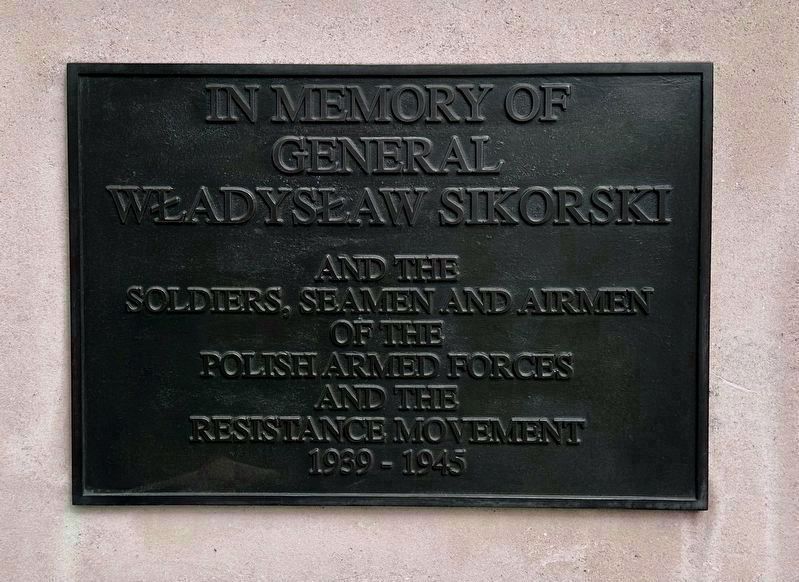
In memory of General Sikorski and the soldiers, seamen and airmen of the Polish Armed Forces and the resistance movement
1939-1945
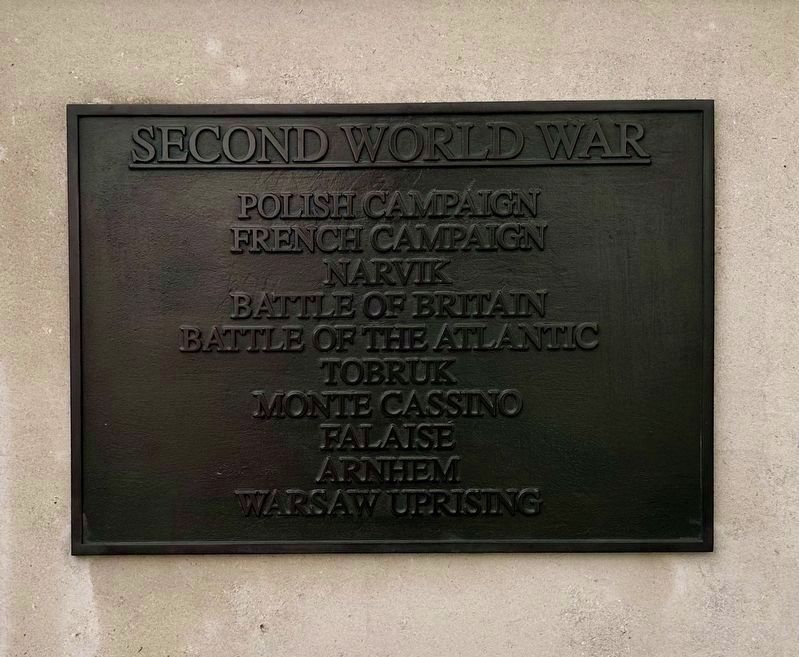
Second World War
Polish Campaign
French Campaign Narvik
Battle of Britain
Battle of the Atlantic
Tobruk
Monte Cassino
Falaise
Arnhem
Warsaw Uprising
Erected 2000.
Topics. This memorial is listed in this topic list: War, World II.
Location. 51° 31.265′ N, 0° 8.723′ W. Memorial is in City of Westminster, England, in Greater London. It is in Marylebone. It is at the intersection of Portland Place and Weymouth Street, in the median on Portland Place. Touch for map. Memorial is at or near this postal address: 49-51 Portland Place, City of Westminster, England W1B, United Kingdom. Touch for directions.

Regionally, this memorial is in London and in the Greater South East. Globally, it is on the Atlantic Ocean,
this page online
Other nearby markers. At least 8 other markers are within walking distance of this marker: Frederick Roberts, 1st Earl Roberts (within shouting distance of this marker); Thomas Gage (within shouting distance of this marker); Frances Hodgson Burnett (within shouting distance of this marker); Cedric Keith Simpson (about 120 meters away, measured in a direct line); Edward R. Murrow (about 120 meters away); Svenska Residenset i London / The Swedish Residence in London (about 150 meters away); Wilkie Collins (about 180 meters away); Kenneth Clark (about 180 meters away). Touch for a list and map of all markers in City of Westminster.
Also see . . . Władysław Sikorski (Wikipedia). Overview:
Władysław Eugeniusz Sikorski (20 May 1881 – 4 July 1943) was a Polish military and political leader. Before World War I, Sikorski established and participated in several underground organizations that promoted the(Submitted on May 7, 2026.)cause of Polish independence. He fought with distinction in the Polish Legions during World War I, and later in the newly created Polish Army during the Polish–Soviet War of 1919–1921. In the latter war, he played a prominent role in the decisive 1920 Battle of Warsaw.Photographed by Andrew Ruppenstein, April 26, 20262. General Władisław Sikorski Memorial
In the early years of the Second Polish Republic, Sikorski held government posts including prime minister (1922–1923) and minister of military affairs (1923–1924). Following Józef Piłsudski's May 1926 Coup and the installation of the Sanation government, he fell out of favor with the new régime.
During World War II, Sikorski became prime minister of the Polish government-in-exile, Commander-in-Chief of the Polish Armed Forces, and a vigorous advocate of the Polish cause in the diplomatic sphere. He supported the reestablishment of diplomatic relations between Poland and the Soviet Union, which had been severed after the September 1939 Soviet invasion of Poland. Subsequently, in April 1943, Soviet leader Joseph Stalin broke off Soviet-Polish diplomatic relations after Sikorski asked the International Red Cross to investigate the Katyn massacres.
In July 1943,a plane carrying Sikorski plunged into the sea immediately on takeoff from Gibraltar, killing all on board except the pilot. The exact circumstances of Sikorski's death have been disputed and have given rise to various theories surrounding the crash. Sikorski had been the most prestigious leader of the Polish exiles, and his death was a severe setback for the Polish cause.Photographed by Andrew Ruppenstein, April 26, 20263. General Władisław Sikorski memorial plaque

Photographed by Andrew Ruppenstein, April 26, 2026
4. General Władisław Sikorski memorial plaque

Photographed by Andrew Ruppenstein, April 26, 2026
5. General Władisław Sikorski memorial dedication
Credits. This page was last revised on May 7, 2026. It was originally submitted on May 7, 2026, by Andrew Ruppenstein of Lamorinda, California. This page has been viewed 12 times since then. Photos: 1, 2, 3, 4, 5. submitted on May 7, 2026, by Andrew Ruppenstein of Lamorinda, California.
