Berliner Innenstadt in Mitte, Germany — Northeast German Plain (The European Plain)
Knoblauchhaus & Schuberthaus
⎯⎯⎯
Knoblauch House & Schubert House
Photographed by James Hulse, March 7, 2026
1. Knoblauchhaus & Schuberthaus / Knoblauch House & Schubert House Marker

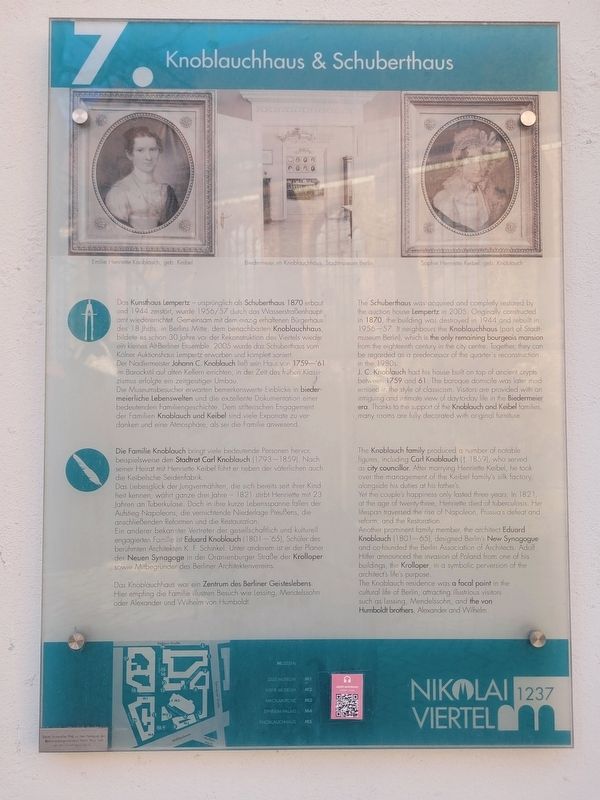
Das Kunsthaus Lempertz - ursprünglich als Schuberthaus 1870 erbaut und 1944 zerstört, wurde 1956/57 durch das Wasserstraßenhauptamt wiedererrichtet. Gemeinsam mit dem einzig erhaltenen Bürgerhaus des 18 Jhdts. in Berlins Mitte, dem benachbarten Knoblauchhaus, bildete es schon 30 Jahre vor der Rekonstruktion des Viertels wieder ein kleines Alt-Berliner Ensemble. 2005 wurde das Schuberthaus vom Kölner Auktionshaus Lempertz erworben und komplett saniert. Der Nadlermeister Johann C. Knoblauch ließ sein Haus von 1759-'61 im Barockstil auf alten Kellern errichten, in der Zeit des frühen Klassizismus erfolgte ein zeitgeistiger Umbau. Die Museumsbesucher erwarten bemerkenswerte Einblicke in biedermeierliche Lebenswelten und die exzellente Dokumentation einer bedeutenden Familiengeschichte. Dem stifterischen Engagement der Familien Knoblauch und Keibel sind viele Exponate zu verdanken und eine Atmosphäre, als sei die Familie anwesend.
Die Familie Knoblauch bringt viele bedeutende Personen hervor, beispielsweise den Stadtrat Carl Knoblauch (1793-1859). Nach seiner Heirat mit Henriette Keibel führt er neben der väterlichen auch die Keibelsche Seidenfabrik. Das Liebesglück der Jungvermählten, die sich bereits seit ihrer Kindheit kennen, währt ganze drei Jahre - 1821 stirbt Henriette mit 23 Jahren an Tuberkulose. Doch in ihre kurze Lebensspanne fallen der Aufstieg Napoleons, die vernichtende Niederlage Preußens, die anschließenden Reformen und die Restauration. Ein anderer bekannter Vertreter der gesellschaftlich und kulturell engagierten Familie ist Eduard Knoblauch (1801-'65), Schüler des berühmten Architekten K.F. Schinkel. Unter anderem ist er der Planer der Neuen Synagoge in der Oranienburger Straße der Krolloper sowie Mitbegründer des Berliner Architektenvereins.
Das Knoblauchhaus war ein Zentrum des Berliner Geisteslebens. Hier empfing die Familie illustren Besuch wie Lessing, Mendelssohn oder Alexander und Wilhelm von Humboldt.
Emilie Henriette Knoblauch, geb. Keibel
Biedermeier im Knoblauchhaus, Stadtmuseum Berlin
Sophie Henriette Keibel, geb. Knoblauch
The
this page online
The Knoblauch family produced a number of notable figures, including Carl Knoblauch († 1859), who served as city councillor. After marrying Henriette Keibel, he took over the management of the Keibel family's silk factory, alongside his duties at his father's. Yet the couple's happiness only lasted three years. In 1821, at the age of twenty-three, Henriette died of tuberculosis. Her lifespan traversed the rise of Napoleon, Prussia's defeat and reform, and the Restoration. Another prominent family member, the architect Eduard Knoblauch (1801-65), designed Berlin's New Synagogue and co-founded the Berlin Association of Architects. Adolf Hitler announced the invasion of Poland from one of his buildings, the Krolloper, in a symbolic perversion of the architect's life's purpose. The Knoblauch residence was a focal point in the cultural life of Berlin, attracting illustrious visitors such as Lessing, Mendelssohn, and the von Humboldt brothers, Alexander and Wilhelm.
Emilie Henriette Knoblauch, née Keibel
Biedermeier period in the Knoblauch House, Berlin City Museum
Sophie Henriette Keibel, née Knoblauch
Erected by Nikolai Viertel 1237. (Marker Number 7.)
Topics. This historical marker is listed in this topic list: Notable Buildings. A significant historical year for this entry is 1870.
Location. 52° 30.987′ N, 13° 24.441′ E.
Photographed by James Hulse, March 7, 2026
2. Knoblauchhaus & Schuberthaus / Knoblauch House & Schubert House Marker
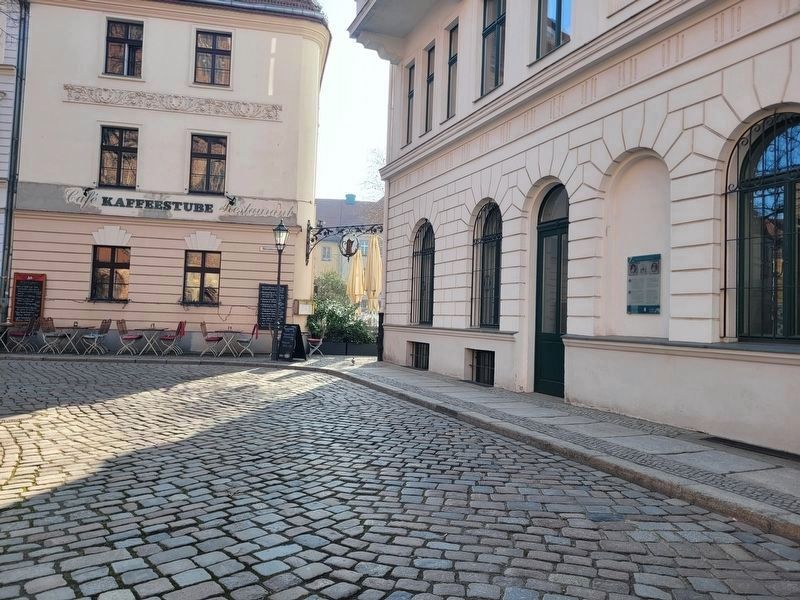
The Poststraße is located between the two buildings.

Regionally, it is in Europe, the European Union, Atlantic Europe, Central Europe, the Schengen Area, Western Europe, and the Western World. Historically, it finds itself in what was once the Holy Roman Empire, the former East Germany, and at the Berlin Wall.
Other nearby markers. At least 8 other markers are within walking distance of this marker: Geschäftshaus / Commercial Building (within shouting distance of this marker); Knoblauchhaus / Knoblauch House (within shouting distance of this marker); Riesen & Wunder (within shouting distance of this marker); Profit & Pogrom (within shouting distance of this marker); Eisernes Preußen & Tapfere Müller / Iron Prussia & Brave Müller (within shouting distance of this marker); Ephraims Mobilie / Ephraim’s Movable Palace (within shouting distance of this marker); August Eduard Grell (within shouting distance of this marker); Nikolaikirche / St. Nicholas Church (within shouting distance of this marker). Touch for a list and map of all markers in Berlin.
Photographed by James Hulse, March 7, 2026
3. Knoblauchhaus & Schuberthaus / Knoblauch House & Schubert House Marker
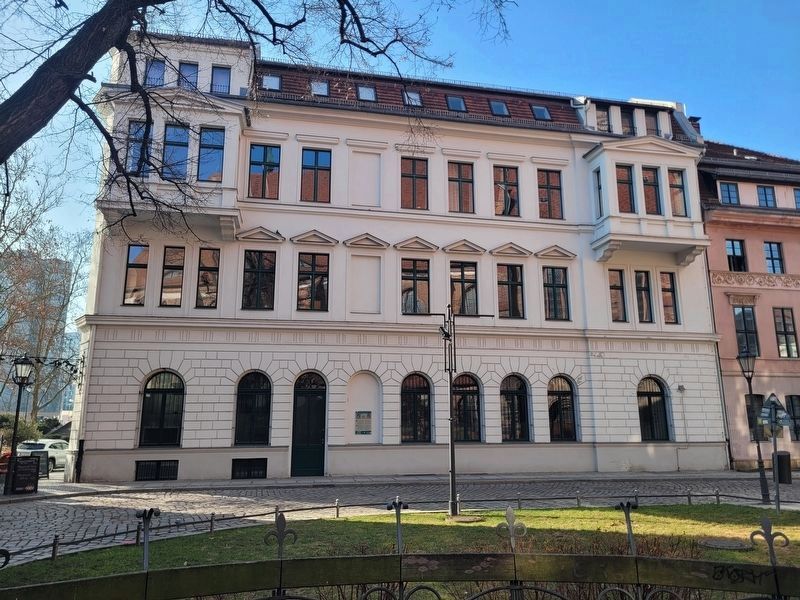
The building faces the St. Nicholas Church.
Credits. This page was last revised on May 9, 2026. It was originally submitted on May 7, 2026, by James Hulse of Medina, Texas. This page has been viewed 12 times since then. Photos: 1, 2, 3. submitted on May 9, 2026, by James Hulse of Medina, Texas.
