Berliner Innenstadt in Mitte, Germany — Northeast German Plain (The European Plain)
Ephraims Mobilie
⎯⎯⎯
Ephraim’s Movable Palace
Photographed by James Hulse, March 7, 2026
1. Ephraims Mobilie / Ephraim’s Movable Palace Marker

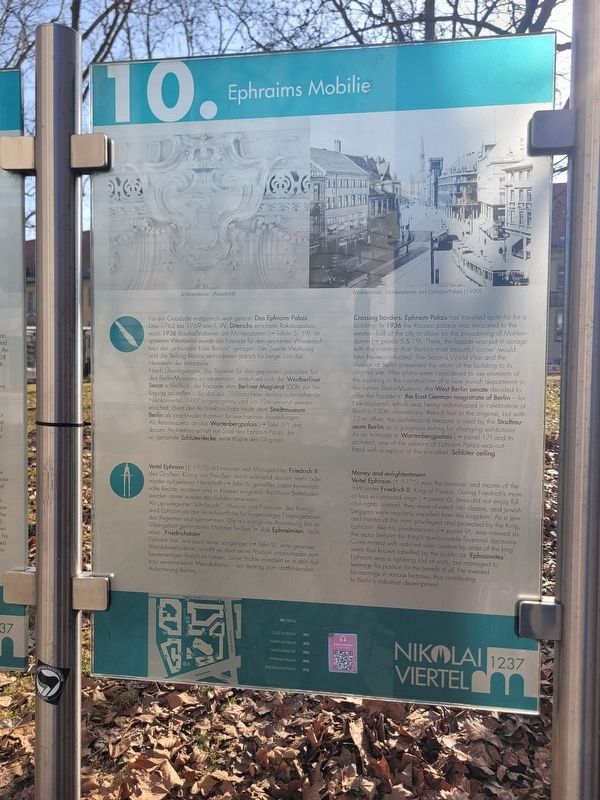
Für ein Gebäude erstaunlich weit gereist: Das Ephraim-Palais. Das 1762 bis 1769 von F.W. Diterichs errichtete Rokokopalais wich 1936 Baumaßnahmen am Mühlendamm (→ Tafeln 5, 19). Im späteren Westberlin wurde die Fassade für den geplanten Wiederaufbau der „schönsten Ecke Berlins“ gelagert. Der Zweite Weltkrieg und die Teilung Berlins verhinderten jedoch für lange Zeit die Heimkehr der Immobilie. Nach Überlegungen, die Bauteile für den geplanten jüdischen Teil des Berlin-Museums zu verwenden, entschied sich der Westberliner Senat schließlich, die Fassade dem Berliner Magistrat (DDR) zur Verfügung zu stellen - für das zur 750-Jahr-Feier Berlins auferstehende Nikolaiviertel. 1987 originalgetreu und um 12m versetzt wiedererrichtet, dient der Architekturschatz heute dem Stadtmuseum Berlin als prachtvoller Rahmen für wechselnde Ausstellungen. Als Remineszenz an das Wartenbergpalais (→ Tafel 17) und dessen Architekten erhielt ein Saal des Ephraim-Palais die so genannte Schlüterdecke, eine Kopie des Originals.
Veitel Ephraim († 1775) ist Finanzier und Münzpächter Friedrich II., des Großen, König
this page online
„Schlüterdecke“ (Ausschnitt)
Molkenmarkt, Mühlendamm und Ephraim-Palais (1930)
Crossing borders: Ephraim Palais has travelled quite far for a building. In 1936 the Rococo palace was relocated to the western half of the city to allow for the broadening of Mühlendamm (panels 5 & 19). There, the façade was put in storage
Photographed by James Hulse, March 7, 2026
2. Ephraims Mobilie / Ephraim’s Movable Palace Marker
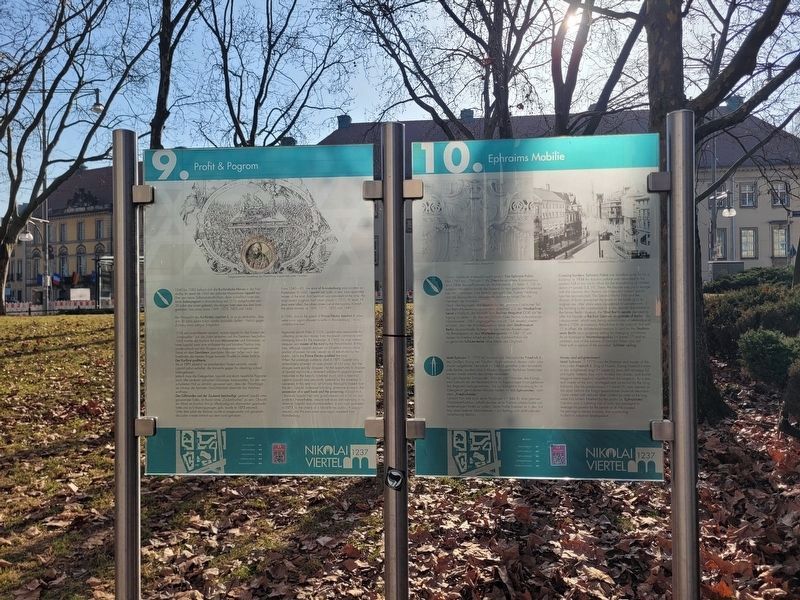
The Profit & Pogrom marker is located on the left side, and the Ephraims Mobilie marker is located on the right side.
Money and enlightentment:
Veitel Ephraim († 1775) was the financer and master of the mint under Friedrich II, King of Prussia. During Friedrich's more or less enlightened reign (→ panel 6), Jews did not enjoy full civil rights. Instead, they were divided into classes, and Jewish beggars
Photographed by James Hulse, March 7, 2026
3. Ephraims Mobilie / Ephraim’s Movable Palace Marker
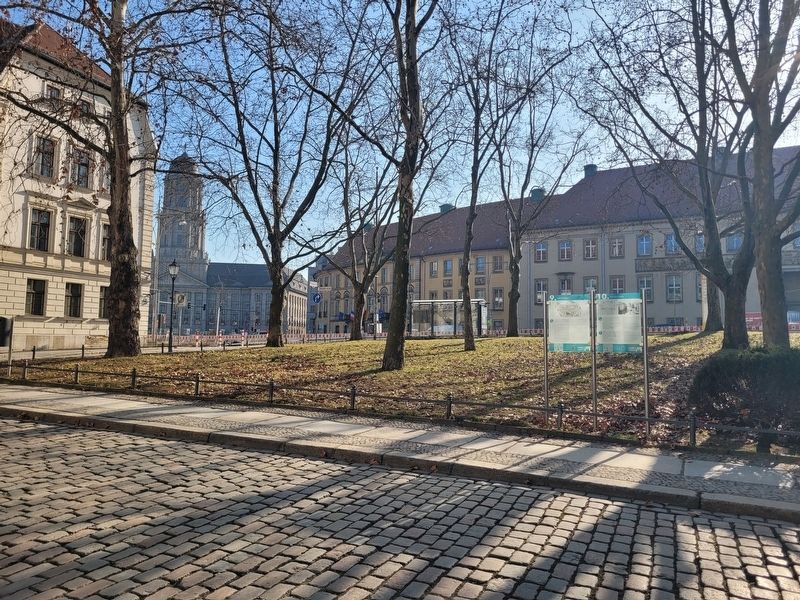
The markers are located in a small green space next to the Poststraße.
“Schlüter ceiling” (detail) Molkenmarkt, Mühlendamm, and Ephraim Palace (1930)
Erected by Nikolai Viertel 1237. (Marker Number 10.)
Topics. This historical marker is listed in this topic list: Notable Buildings. A significant historical year for this entry is 1762.
Location. 52° 30.966′ N, 13° 24.443′ E. Marker is in Berlin, in Mitte. It is in Berliner Innenstadt. It is on Poststraße just south of Nikolaikirchpl., on the left when traveling south. Touch for map. Marker is at or near this postal address: Poststraße 4/5, Berlin 10178, Germany. Touch for directions.

Regionally, it is in Europe, the European Union, Atlantic Europe, Central Europe, the Schengen Area, Western Europe, and the Western World. Historically, it finds itself in what was once the Holy Roman Empire, the former East Germany, and at the Berlin Wall.
Other nearby markers. At least 8 other markers are within walking distance of this marker: Profit & Pogrom (here, next to this marker); Ephraim-Palais / Ephraim Palace (a few steps from this marker); Geschäftshaus / Commercial Building (a few steps from this marker); Museum für Leibesübungen / Museum of Physical Exercise (within shouting distance of this marker); Riesen & Wunder (within shouting distance of this marker); Knoblauchhaus & Schuberthaus / Knoblauch House & Schubert House (within shouting distance of this marker); Knoblauchhaus / Knoblauch House (within shouting distance of this marker); Eisernes Preußen & Tapfere Müller / Iron Prussia & Brave Müller (within shouting distance of this marker). Touch for a list and map of all markers in Berlin.
Credits. This page was last revised on May 10, 2026. It was originally submitted on May 7, 2026, by James Hulse of Medina, Texas. This page has been viewed 14 times since then. Photos: 1, 2, 3. submitted on May 10, 2026, by James Hulse of Medina, Texas.
