Berliner Innenstadt in Mitte, Germany — Northeast German Plain (The European Plain)
Dynamik & Drachen
⎯⎯⎯
Dynamics & Dragons
Photographed by James Hulse, March 7, 2026
1. Dynamik & Drachen / Dynamics & Dragons Marker

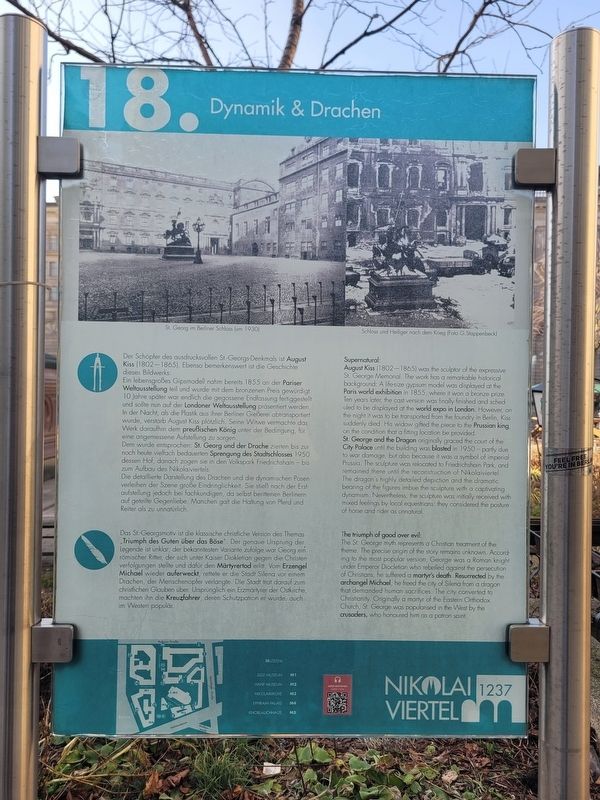
Der Schöpfer des ausdrucksvollen St.-Georgs-Denkmals ist August Kiss (1802-1865). Ebenso bemerkenswert ist die Geschichte dieses Bildwerks: Ein lebensgroßes Gipsmodell nahm bereits 1855 an der Pariser Weltausstellung teil und wurde mit dem bronzenen Preis gewürdigt. 10 Jahre später war endlich die gegossene Endfassung fertiggestellt und sollte nun auf der Londoner Weltausstellung präsentiert werden. In der Nacht, als die Plastik aus ihrer Berliner Gießerei abtransportiert wurde, verstarb August Kiss plötzlich. Seine Witwe vermachte das Werk daraufhin dem preußischen König unter der Bedingung, für eine angemessene Aufstellung zu sorgen. Dem wurde entsprochen: St. Georg und der Drache zierten bis zur noch heute vielfach bedauerten Sprengung des Stadtschlosses 1950 dessen Hof, danach zogen sie in den Volkspark Friedrichshain - bis zum Aufbau des Nikolaiviertels. Die detaillierte Darstellung des Drachen und die dynamischen Posen verleihen der Szene große Eindringlichkeit. Sie stieß nach der Erstaufstellung jedoch bei fachkundigen, da selbst berittenen Berlinern auf geteilte Gegenliebe: Manchen galt die Haltung von Pferd und Reiter als zu unnatürlich.
Das St.-Georgsmotiv ist die klassische christliche Version des Themas „Triumph des Guten über das Böse“. Der genaue Ursprung der Legende ist unklar; der bekanntesten Variante zufolge war Georg ein römischer Ritter, der sich unter Kaiser Diokletian gegen die Christenverfolgungen stellte und dafür den Märtyrertod erlitt. Vom Erzengel Michael wieder auferweckt, rettete er die Stadt Silena vor einem Drachen, der Menschenopfer verlangte. Die Stadt
this page online
St. Georg im Berliner Schloss (um 1930)
Schloss und Heiliger nach dem Krieg (Foto G. Stappenbeck)
Supernatural: August Kiss (1802-1865) was the sculptor of the expressive St. George Memorial. The work has a remarkable historical background: A life-size gypsum model was displayed at the Paris world exhibition in 1855, where it won a bronze prize. Ten years later, the cast version was finally finished and scheduled to be displayed at the world expo in London. However, on the night it was to be transported from the foundry in Berlin, Kiss suddenly died. His widow gifted the piece to the Prussian king, on the condition that a fitting location be provided. St. George and the Dragon originally graced the court of the City Palace until the building was blasted in 1950 - partly due to war damage, but also because it was a symbol of imperial Prussia. The sculpture was relocated to Friedrichshain Park, and remained there until the reconstruction of Nikolaiviertel. The dragon's highly detailed depiction and the dramatic bearing of the figures imbue the sculpture with a captivating dynamism. Nevertheless, the sculpture was initially received with mixed feelings by local equestrians: they considered the posture of horse and rider as unnatural.
The triumph of good over evil:
The St. George myth represents a Christian treatment of the theme. The precise origin of the story remains unknown. According to the most popular version, George was a Roman knight
Photographed by James Hulse, March 7, 2026
2. Dynamik & Drachen / Dynamics & Dragons Marker
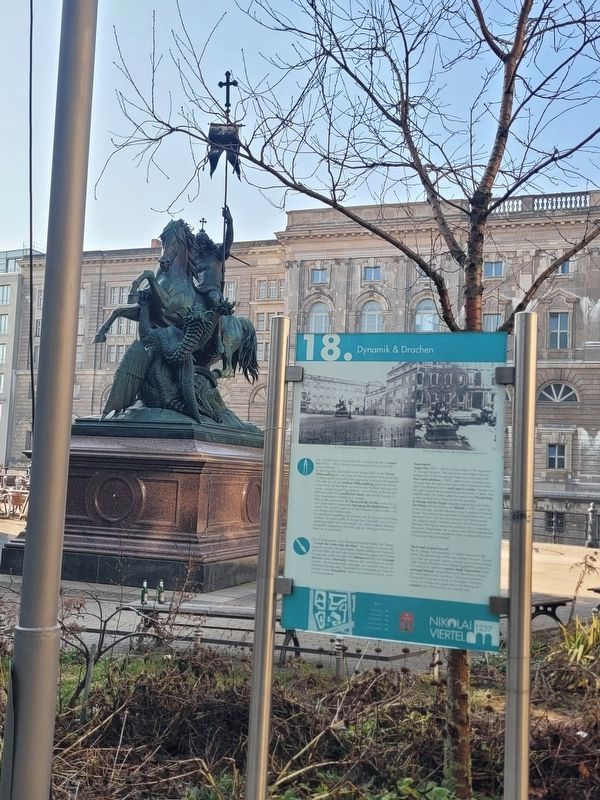
The St. George and the Dragon statue stands behind the marker.
St. George in the Berlin Palace (around 1930)
Palace and saint after the war (photo by G. Stappenbeck)
Erected by Nikolai Viertel 1237. (Marker Number 18.)
Topics. This historical marker is listed in these topic lists: Arts, Letters, Music • Religion & Religious Structures. A significant historical year for this entry is 1855.
Location. 52° 30.984′ N, 13° 24.341′ E. Marker is in Berlin, in Mitte. It is in Berliner Innenstadt. It is at the intersection of Propststraße and Spreeufer, on the right when traveling south on Propststraße. Touch for map. Marker is at or near this postal address: Propststraße 8, Berlin 10178, Germany. Touch for directions.

Regionally, it is in Europe, the European Union, Atlantic Europe, Central Europe, the Schengen Area, Western Europe, and the Western World. Historically, it finds itself in what was once the Holy Roman Empire, the former East Germany, and at the Berlin Wall.
Other nearby markers. At least 8 other markers are within walking distance of this marker: Zille, Heinrich (within shouting distance of this marker); Mühlen der Bürokratie / Mills of Bureaucracy (within shouting distance of this marker); Carl Hildebrand von Canstein (within shouting distance of this marker);
Photographed by James Hulse, March 7, 2026
3. Dynamik & Drachen / Dynamics & Dragons Marker
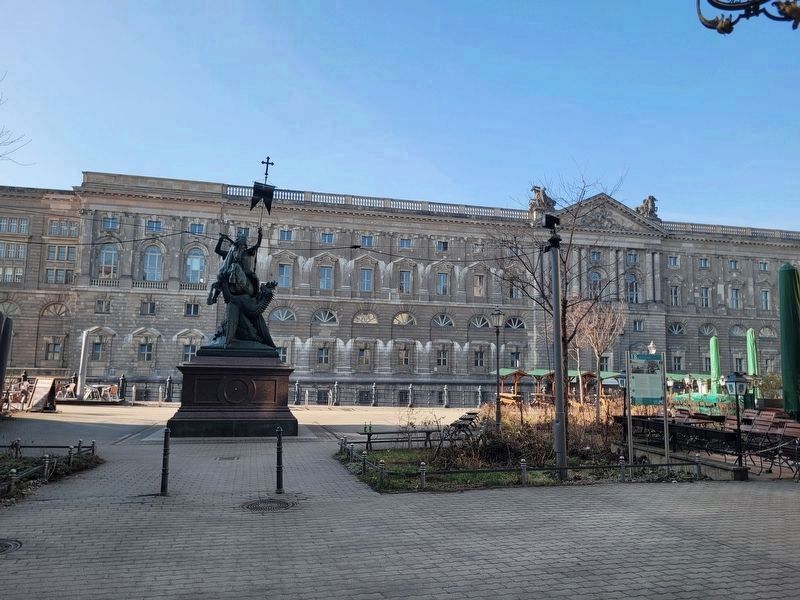
View of the marker and statue, with the Spree River next to them, not visible in the photo.
Photographed by James Hulse, March 7, 2026
4. Dynamik & Drachen / Dynamics & Dragons Marker
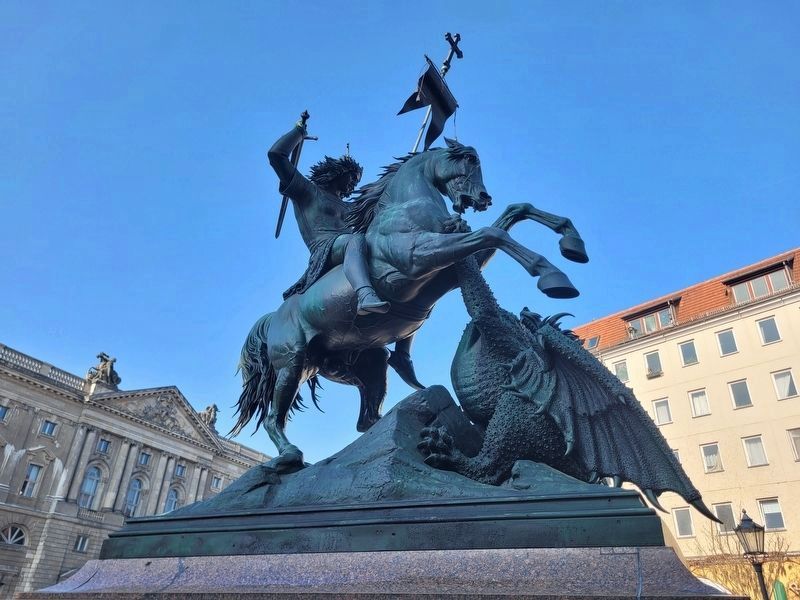
The view of the St. George and the Dragon from the south.
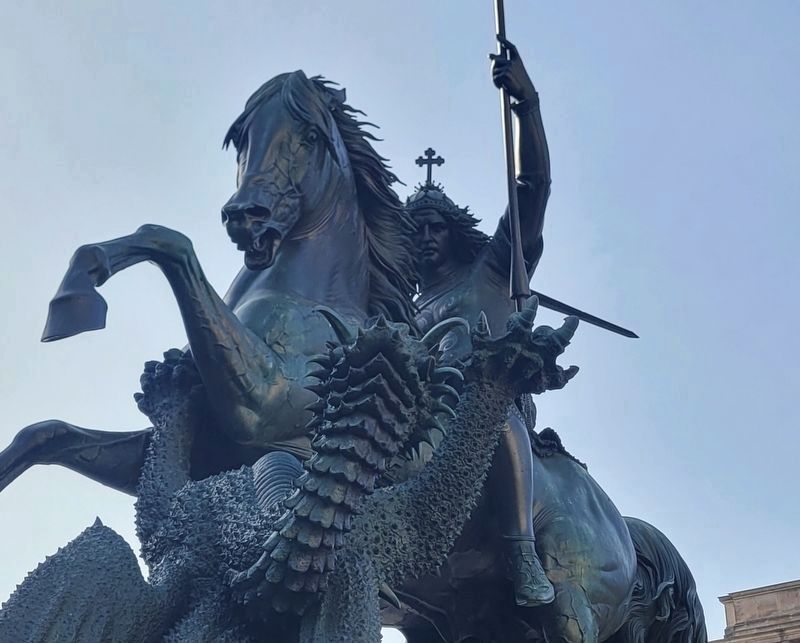
Photographed by James Hulse, March 7, 2026
5. Dynamik & Drachen / Dynamics & Dragons Marker
Closeup from the north side of the statue.
Credits. This page was last revised on May 10, 2026. It was originally submitted on May 8, 2026, by James Hulse of Medina, Texas. This page has been viewed 19 times since then. Photos: 1, 2, 3, 4, 5. submitted on May 10, 2026, by James Hulse of Medina, Texas.
