Berliner Innenstadt in Mitte, Germany — Northeast German Plain (The European Plain)
Nikolaikirche
⎯⎯⎯
St. Nicholas Church
Photographed by James Hulse, March 7, 2026
1. Nikolaikirche / St. Nicholas Church Marker

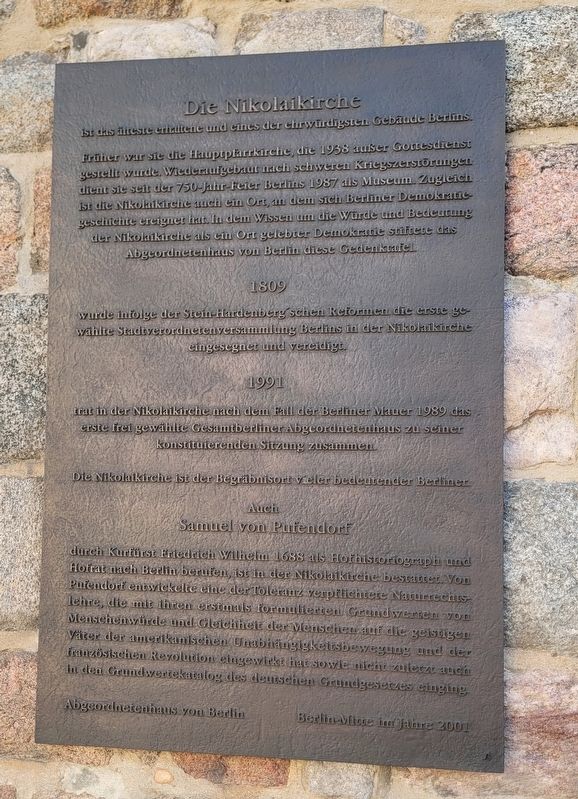
Die Nikolaikirche ist das älteste erhaltene und eines der ehrwürdigsten Gebäude Berlins.
Früher war sie die Hauptpfarrkirche, die 1958 außer Gottesdienst gestellt wurde. Wiederaufgebaut nach schweren Kriegszerstörungen, dient sie seit der 750-Jahr-Feier Berlins 1987 als Museum. Zugleich ist die Nikolaikirche auch ein Ort, an dem sich Berliner Demokratiegeschichte ereignet hat. In dem Wissen um die Würde und Bedeutung der Nikolaikirche als Ort gelebter Demokratie stiftete das Abgeordnetenhaus von Berlin diese Gedenktafel.
1809
wurde infolge der Stein-Hardenbergschen Reformen die erste gewählte Stadtverordnetenversammlung Berlins in der Nikolaikirche eingesegnet und vereidigt.
1991
trat in der Nikolaikirche nach dem Fall der Berliner Mauer 1989 das erste frei gewählte Gesamtberliner Abgeordnetenhaus zu seiner konstituierenden Sitzung zusammen.
Die Nikolaikirche ist der Begräbnisort vieler bedeutender Berliner.
Auch Samuel von Pufendorf
durch Kurfürst Friedrich Wilhelm 1688 als Hofhistoriograph und Hofrat nach Berlin berufen, ist in der Nikolaikirche bestattet. Von Pufendorf entwickelte eine der Toleranz verpflichtete Naturrechtslehre, die mit ihren erstmals formulierten Grundwerten von Menschenwürde und Gleichheit der Menschen auf die geistigen Väter der amerikanischen Unabhängigkeitsbewegung und der Französischen Revolution eingewirkt hat sowie nicht zuletzt auch in den Grundwertekatalog des deutschen Grundgesetzes einging.
St. Nicholas Church is the oldest surviving building in Berlin and one of the city’s most venerable structures.
It was formerly the
this page online
1809
As a result of the Stein-Hardenberg reforms, Berlin’s first elected city council assembly was consecrated and sworn in at St. Nicholas Church.
1991
After the fall of the Berlin Wall in 1989, the first freely elected parliament of reunified Berlin met in St. Nicholas Church for its constituent session.
St. Nicholas Church is the burial place of many notable Berliners.
Samuel von Pufendorf
who was called to Berlin in 1688 by Elector Friedrich Wilhelm as court historiographer and court councillor, is also buried in St. Nicholas Church. Von Pufendorf developed a theory of natural law committed to tolerance, whose early formulation of the fundamental values of human dignity and human equality influenced the intellectual founders of the American independence movement and the French Revolution, and ultimately also entered into the catalogue of basic values of the German Basic Law.
Erected 2001 by Berlin House of Representatives and Berlin-Mitte.
Topics. This historical marker is listed in this topic list: Religion & Religious Structures. A significant historical year for this entry is 1958.
Location. 52° 31.005′ N, 13° 24.42′ E. Marker is in Berlin, in Mitte.
Photographed by James Hulse, March 7, 2026
2. Nikolaikirche / St. Nicholas Church Marker
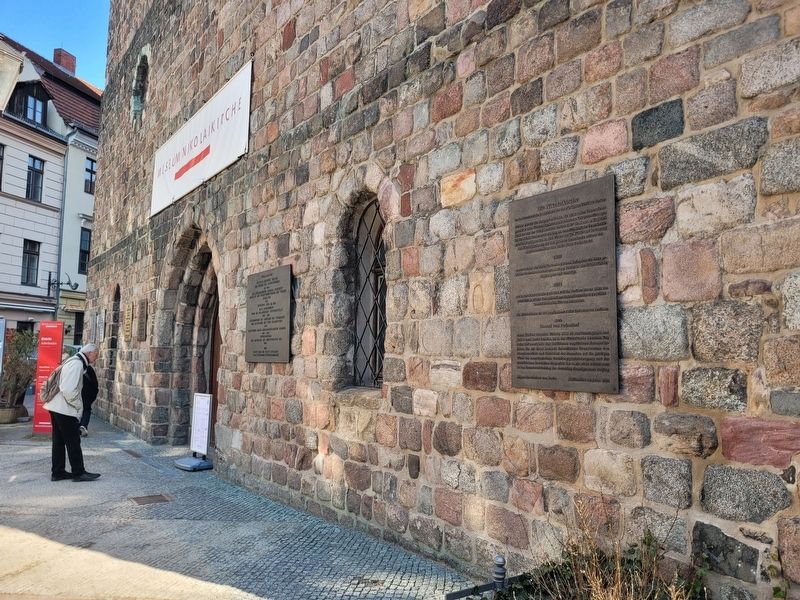
The marker is located on the right side of the entrance to the church.

Regionally, it is in Europe, the European Union, Atlantic Europe, Central Europe, the Schengen Area, Western Europe, and the Western World. Historically, it finds itself in what was once the Holy Roman Empire, the former East Germany, and at the Berlin Wall.
Other nearby markers. At least 8 other markers are within walking distance of this marker: A different marker also named Nikolaikirche / St. Nicholas Church (here, next to this marker); Berlins Hauptstadt / Berlin’s Capital (within shouting distance of this marker); Carl Hildebrand von Canstein (within shouting distance of this marker); Zille, Heinrich (within shouting distance of this marker); Knoblauchhaus & Schuberthaus / Knoblauch House & Schubert House (within shouting distance of this marker); Knoblauchhaus / Knoblauch House (within shouting distance of this marker); August Eduard Grell (within shouting distance of this marker); Berliner Originale / Berlin Originals (within shouting distance of this marker). Touch for a list and map of all markers in Berlin.
Photographed by James Hulse, March 7, 2026
3. Nikolaikirche / St. Nicholas Church Marker
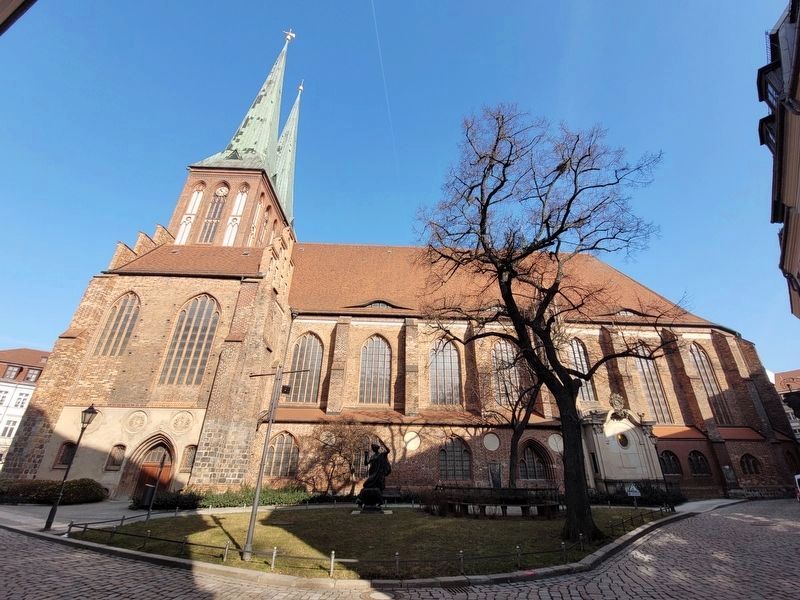
The southern view of the St. Nicholas Church.
Photographed by James Hulse, March 7, 2026
4. Nikolaikirche / St. Nicholas Church Marker
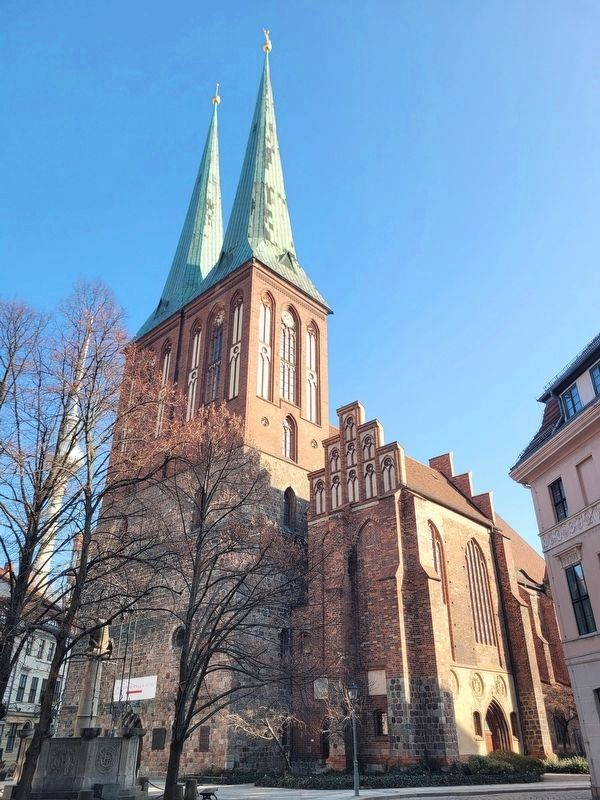
The markers are located at the base of the front of the church.
Credits. This page was last revised on May 10, 2026. It was originally submitted on May 9, 2026, by James Hulse of Medina, Texas. This page has been viewed 15 times since then. Photos: 1, 2, 3, 4. submitted on May 10, 2026, by James Hulse of Medina, Texas.
