
Minard Hall
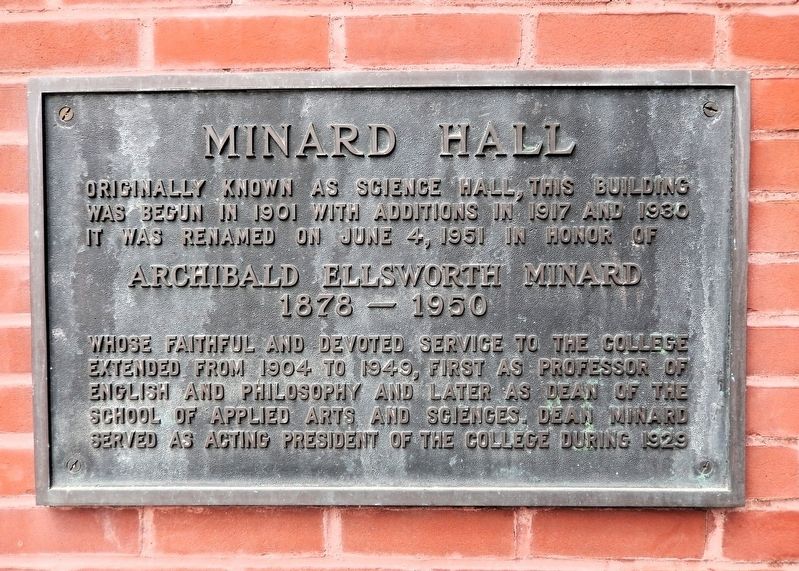
Originally known as Science Hall, this building was begun in 1901 with additions in 1917 and 1930. It was renamed on June 4, 1951 in honor of
1878-1950
whose faithful and devoted service to the college extended from 1904 to 1949, first as Professor of English and Philosophy and later as Dean of the School of Applied Arts and Sciences. Dean Minard served as Acting President of the College during 1929.
Topics and series. This historical marker is listed in these topic lists: Architecture • Education • Notable Buildings. In addition, it is included in the National Register of Historic Places (NRHP) series list. A significant historical year for this entry is 1901.
Location. 46° 53.488′ N, 96° 48.149′ W. Marker is in Fargo, North Dakota, in Cass County. It is in North Dakota State University. It is on Albrecht Boulevard 0.1 miles north of 12th Avenue North (North Dakota Route 294), on the left when traveling north. The marker mounted directly on the east/front facade of the subject building, facing Albrecht Boulevard. Touch for map. Marker is at or near this postal address: 1210 Albrecht Boulevard,
this page online

Regionally, this marker is in North Dakota’s Red River Valley. It is also in the American Lewis & Clark Corridor, on the prairies, and on the Northern Plains. Globally, it is in North America, the Western Hemisphere, the Western World, and the Anglosphere. Historically, it finds itself in what was once Rupert’s Land and also the Louisiana Purchase.
Other nearby markers. At least 8 other markers are within one mile of this marker, measured as the crow flies: N.D.A.C. Carnegie Library (about 500 feet away, measured in a direct line); Churchill Residence Hall (approx. ¼ mile away); First Lutheran Church & Cathedral of St. Mary (approx. 0.9 miles away); The Ford Building (approx. one mile away); Ford Building & BNSF Railroad (approx. one mile away); ROCO & Powers Hotel (approx. one mile away); Eddie and Hildegarde Kraus (approx. one mile away); Theaters of Fargo (approx. 1.1 miles away). Touch for a list and map of all markers in Fargo.
Regarding Minard Hall. Contributing property, North Dakota State University District, National Register of Historic

From the National Register Nomination prepared by Norene A. Roberts, 11/5/1982:
The North Dakota State University Historic District comprises a large portion of the original 1891 campus. The chronology of the campus falls into three periods 1890-1910, 1911-1948, 1949-present. Among eight surviving buildings from the first generation of campus construction, six are of pivotal importance, four of which are executed in the classical revival style. Nearly all the buildings in the district have had interior alterations as the functions of the buildings were altered and adapted to the growing needs of the university. However, there are few alterations which mar the exterior appearance of the buildings.The North Dakota State University District contains a concentration of examples of the work of Fargo's finest practicing architects between the years 1890 and 1949. The work of William C. Albrant, the Hancock Brothers, Milton Earl Beebe, Orff and Joralemon, and William F. Kurke can be found scattered from Montana to Minnesota but is nowhere concentrated altogether as at the North Dakota State University campus. In addition, these campus buildings are associated with the University's achievements in education, research, and agricultural science, the effects of which were felt far beyond the Red River Valley.
Science Hall — Minard Hall (1901, 1917-18, 1930) Classical Revival. Originally planned to be built in three stages as building funds became available, the south wing was erected in 1901 from plans by William C. Albrant. It is two stories above a raised basement, yellow brick American bond, with sandstone trim, red grout, red brick pilasters and beltcourses; and semi-circular bays at the center of each facade. It originally housed Biology, Horticulture, and Geology.
Following the death in 1905 of Albrant, the central portion was erected in 1917-18 from plans by Frederick W. Keith. The 1917-18 addition has a central entry terminating in a gable with returned eaves and a Palladian window. The central entry facing east is flanked with engaged pilasters decorated with an egg and dart motif with pressed metal Roman ionic capitals. It is yellow brick with Bedford stone trim. Science hall was completed in 1930 with the addition of the north wing from plans by William F. Kurke, who generally followed the proportions, semi-circular bays, and details of the original 1901 building.
Also see . . .
1. Minard Hall (North Dakota State University).

Excerpt: Minard Hall, originally named Science Hall, was to be built in three stages as building funds became available. It was noted in the 1902-03 NDAC Catalog that this first section cost about $25,000. “This new building is 68x80 feet in size of ground plan, three stories high and furnishes commodious quarters for the departments of biology, geology, horticulture and mathematics. The entire building is finished with quarter-sawed oak, is well lighted and ventilated and is one of the most artistic buildings on campus.”(Submitted on May 13, 2026, by Cosmos Mariner of Cape Canaveral, Florida.)
2. Archibald Minard (Fargo History Project).
Excerpt: Archibald Minard impacted NDAC (NDSU) in many different ways and over a long period of time. Minard was born in Nova Scotia on January 18th, 1878. When he was 11 years old, he moved to the United States with his parents. Upon earning his bachelor’s and master’s degrees at Harvard, he became a professor of English and Philosophy at NDAC in 1904. Minard worked his way up to becoming the head of the English Department. When D.L. Coulter resigned as president in 1929, Minard was named acting president from July to September 1929. During that time and until 1949, he served as the Dean of the School of Applied Arts and Sciences. After 1949, when he retired as dean, he continued to teach philosophy. As a token of gratitude, NDSU renamed Science Hall to Minard Hall in 1951.(Submitted on May 13, 2026, by Cosmos Mariner of Cape Canaveral, Florida.)Fun fact about Archibald Minard is that in 1908, he helped create the school song that we still use today. The university had been in existence for 18 years and still did not have a school song. He wanted to incorporate the school colors, yellow and green, with North Dakota’s landscape and characteristics. Minard thought he could use his song as well for the State’s song. Minard wrote the lyrics and then took the song to Clarence Putnam, the head of the music department at the time. “The Yellow And The Green” did become the University’s official school song, but it did make it as the state’s song as Minard would have hoped.
3. North Dakota State University District (Wikipedia).
Excerpt: North Dakota State University District is a 36-acre historic district on the campus of North Dakota State University, in Fargo, North Dakota, that was listed on the National Register of Historic Places in 1986. Also known as North Dakota Agricultural College, it was built in Late 19th and 20th Century Revivals, Moderne, and Late Victorian architectural styles. Important contributing buildings include Minard Hall (Science Hall), built 1901.(Submitted on May 12, 2026, by Cosmos Mariner of Cape Canaveral, Florida.)
Credits. This page was last revised on May 13, 2026. It was originally submitted on May 9, 2026, by Cosmos Mariner of Cape Canaveral, Florida. This page has been viewed 14 times since then. Photos: 1, 2, 3. submitted on May 12, 2026, by Cosmos Mariner of Cape Canaveral, Florida.
