
Altavista in Campbell County, Virginia — The American South (Mid-Atlantic)
The Fauntleroy Home Destroyed and Rebuilt
| — | Avoca Museum | — |

Photographed by C. Ryan Dodson, May 9, 2026
1. Mr. Fauntleroy, I think you have built one of the nicest residences in this section of the country. Marker
"Mr. Fauntleroy, I think you have built one of the nicest residences...in this section of the country." JMB LewisIn October of 1900, the home of Thomas and Mary Anna Dearing Fauntleroy was completely destroyed by a catastrophic and quickly-spreading fire that purportedly originated with a kerosene lamp. It was the second house named Avoca on that site to be ruined by such a disaster—the previous being destroyed in 1879. The Fauntleroys immediately began searching for an architect to oversee the construction of their new home on the site of the previous two houses. The architectural design contract was awarded to Lynchburg's John Minor Bolts Lewis and the building subcontract was given to J.T. McLaughlin, also of Lynchburg. The final bill for McLaughlin's work was $5,988, which was $2,000 over budget.
In March of 1901, the construction phase was initiated and the house was finalized by the end of October. Avoca bears several of the customary elements of Queen Anne residence architecture. Among these are the house's prominent gables, wraparound porch, asymmetry and its majestic tower. Eclecticism was the order of
this page online
Lewis was a native of Culpeper and graduated from the University of Virginia's architecture school in 1891. Following his completion of the Fauntleroy home, Lewis successfully completed the construction of buildings on the campus of Woodberry Forest School, the Lynchburg Hospital (which stood in the Garland Hill neighborhood), the Lynchburg Cotton Mill, and several upscale residences in Lynchburg. In the year following the fulfillment of the Avoca contract, he entered into a partnership with William R. Burnham in the architecture firm of Lewis & Burnham. He resumed individual proprietorship from 1912 - 1918 and eventually accepted the presidency of a Lynchburg. manufacturing company.
J.M.B. Lewis's private residence at 1314 Clay Street in Lynchburg (also built in 1901) stands today as a shining example of his skill. One of his more notable feats was designing the interior of the Academy of Music building in Lynchburg. In its heyday, the Academy hosted notables such as Ethel Barrymore, Mary Pickford, and Douglas Fairbanks. Lewis died on April 17, 1950 at the age of 82. He is buried in Lynchburg's

Photographed by C. Ryan Dodson, May 9, 2026
2. Mr. Fauntleroy ... Marker
(Captions)
J.M.B.Lewis, Architect
The Lynchburg News (October, 1900). Note the incorrect spelling of the house name.
Avoca (ca 1900)
The Lynchburg News (October 27, 1901)
Thomas & Mary Anna D. Fauntleroy
Owners of Avoca (ca.1900)
Erected by Avoca Museum.
Topics. This historical marker is listed in these topic lists: Architecture • Education. A significant historical month for this entry is October 1901.
Location. 37° 7.83′ N, 79° 16.222′ W. Marker is in Altavista, Virginia, in Campbell County. It can be reached from Avoca Lane west of Main Street (Business U.S. 29), on the right when traveling west. The Marker is located on the grounds of the Avoca Museum. Touch for map. Marker is at or near this postal address: 1514 Main Street, Altavista VA 24517, United States of America. Touch for directions.

Regionally, this marker is in the Piedmont and in Central Virginia. It is also in the American South and specifically in the Upper South. Globally, it is in North America, the Western Hemisphere, the Western World, and the Anglosphere. Historically, it finds itself in what was once the

Photographed by C. Ryan Dodson, May 9, 2026
3. Mr. Fauntleroy ... Marker
Other nearby markers. At least 8 other markers are within walking distance of this marker: These millstones (here, next to this marker); Stocks & Pillories (here, next to this marker); Powell Educational Center (a few steps from this marker); Privy (Latin for private) (a few steps from this marker); Victorian Garden (within shouting distance of this marker); Milk House (within shouting distance of this marker); The John E. Sue M. Jackson Visitor's Center (within shouting distance of this marker); The Dickerson Family Garden (within shouting distance of this marker). Touch for a list and map of all markers in Altavista.
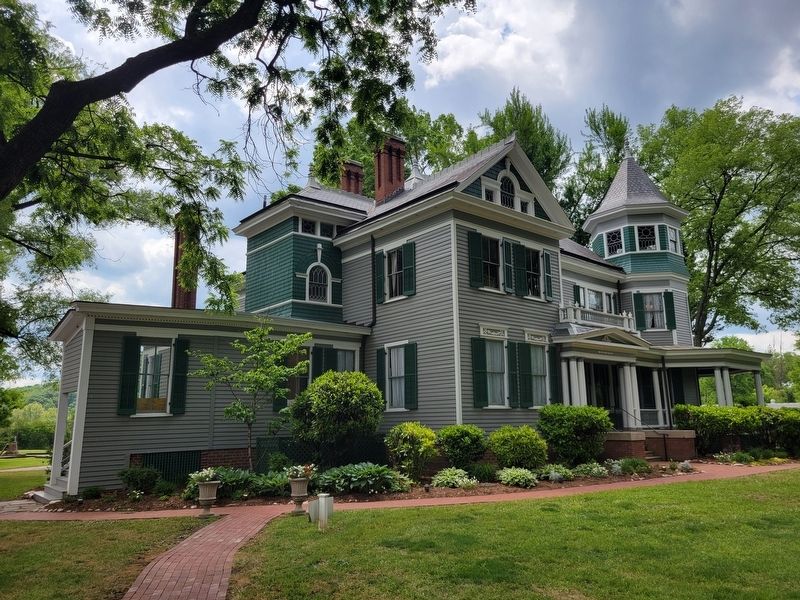
Photographed by C. Ryan Dodson, May 9, 2026
4. Avoca

Photographed by C. Ryan Dodson, May 9, 2026
5. Avoca
Avoca bears several of the customary elements of Queen Anne residence architecture. Among these are the house's prominent gables, wraparound porch, asymmetry and its majestic tower.

Photographed by C. Ryan Dodson, May 9, 2026
6. Avoca
Avoca bears several of the customary elements of Queen Anne residence architecture.
Credits. This page was last revised on May 19, 2026. It was originally submitted on May 11, 2026, by C. Ryan Dodson of Danville, Virginia. This page has been viewed 15 times since then. Photos: 1, 2, 3, 4, 5, 6. submitted on May 11, 2026, by C. Ryan Dodson of Danville, Virginia. • Bernard Fisher was the editor who published this page.
