Siloam Springs in Benton County, Arkansas — The American South (West South Central)
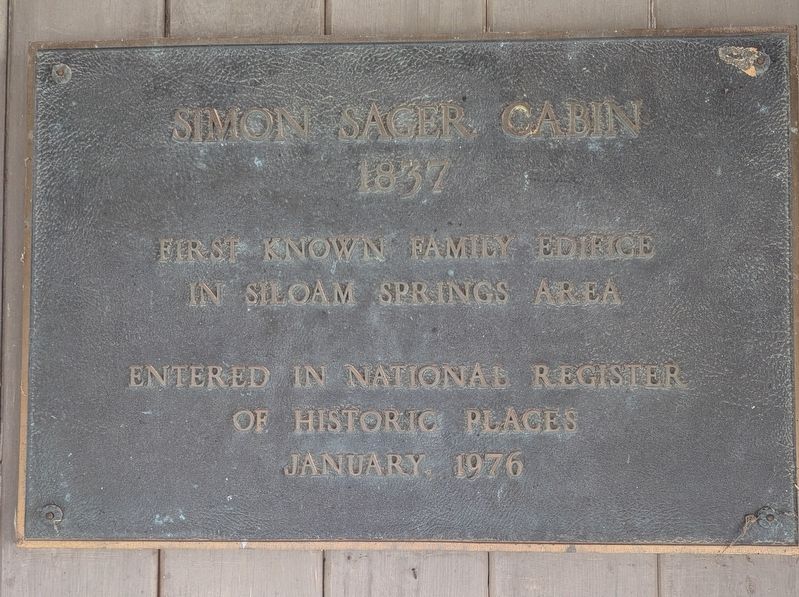
Simon Sager Cabin 1837
February 24, 2026
1. Simon Sager Cabin Marker
First known family edifice in Siloam Springs area
Entered in National Register of Historic Places
January, 1976
Topics. This historical marker is listed in this topic list: Settlements & Settlers. A significant historical year for this entry is 1837.
Location. 36° 11.48′ N, 94° 33.502′ W. Marker is in Siloam Springs, Arkansas, in Benton County. It can be reached from North Eagle Drive. Located within the campus of John Brown University. Touch for map. Marker is at or near this postal address: 250 N Eagle Drive, Siloam Springs AR 72761, United States of America. Touch for directions.

Regionally, this marker is in Northwest Arkansas, on the Ozark Plateau, in the Cherokee Heritage Region, and in Osage Territory. It is also in the American South, specifically in the Upper South, and in the Ozarks. Globally, it is in North America, the Western Hemisphere, the Western World, and the Anglosphere. Historically, it finds itself in what was once the territory of the Mississippian Culture, the Louisiana Purchase, one of the Confederate States of America, and the Antebellum South.
Other nearby markers. At least
this page online
Also see . . . Simon Sager Cabin National Register of Historic Places Nomination Form. The Simon Sager Cabin was added to the National Register of Historic Places on January 30, 1976. The nomination form details the historical significance of the cabin.
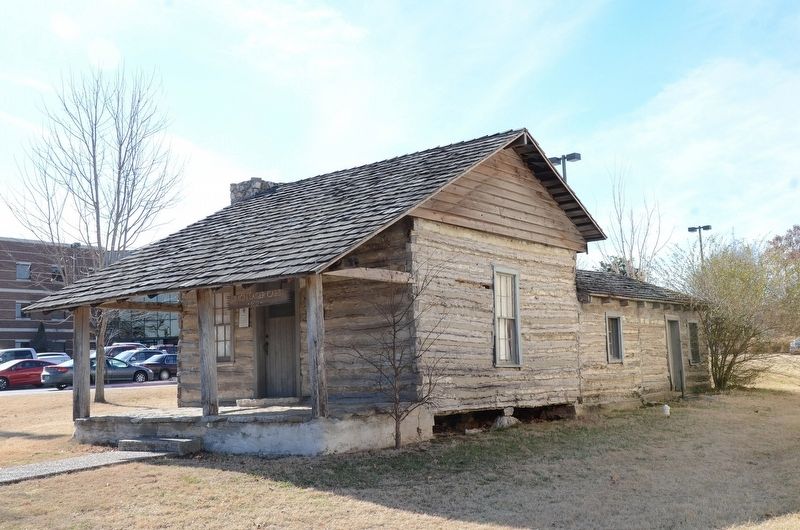
The Sager Cabin is believed to have been the first permanent residence ever constructed in the Siloam Springs area. In the mid-1830's Simon Sager, a German immigrant, moved his family to Arkansas' extreme northwest corner, homesteaded land and built the cabin which still bears his name.(Submitted on May 12, 2026.)
The cabin Sager built was a two-room structure of hand-hewn timbers joined with chamfernotching. Lime chinking, recently restored, was used between the squared timbers and in the large stone fireplace. The front room has a high ceiling, which is unusual in this rustic architectural style. Otherwise, the cabin typifies the simple pioneer homes built in early nineteenth-century Arkansas. In the 1850 census Sager identified himself as a cabinet-maker, and the sound construction of his cabin attests to his ability.Photographed by Valis55 (via Wikimedia Commons under CC 3.0 license)2. Simon Sager Cabin, John Brown University campus Siloam SpringsThe marker is visible here just to the left of the door.

Photographed by Marc Hayot, May 17, 2026
3. Simon Sager Cabin 1837 Marker
Credits. This page was last revised on May 27, 2026. It was originally submitted on May 12, 2026. This page has been viewed 20 times since then. Photos: 1, 2. submitted on May 12, 2026. 3. submitted on May 22, 2026, by Marc Hayot of Siloam Springs, Arkansas. • Andrew Ruppenstein was the editor who published this page.
