Fitzroy in Yarra, Victoria, Australia — Oceania
Saint Vincent de Paul
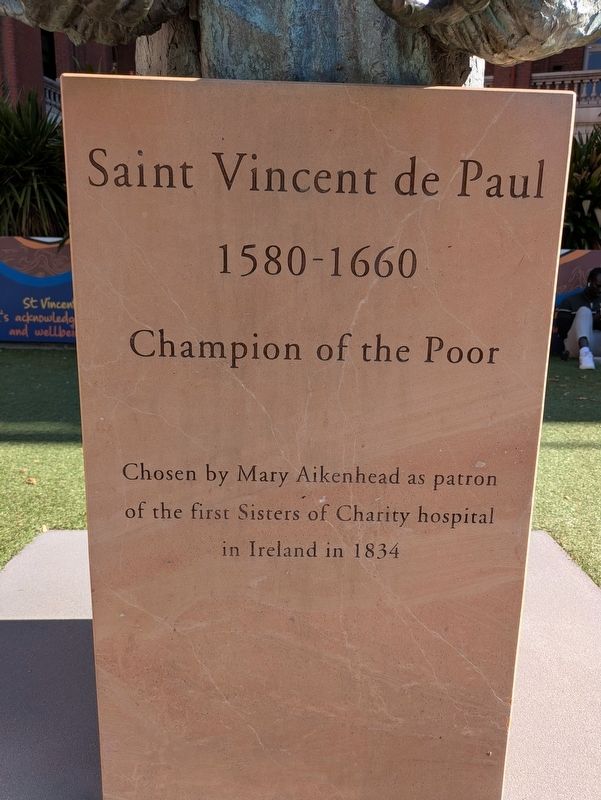
Photographed by Dean Barton-Ancliffe, May 11, 2026
1. Saint Vincent de Paul Marker
1580-1660
Champion of the Poor
Chosen by Mary Aikenhead as patron
of the first Sisters of Charity hospital
in Ireland in 1834
Topics. This historical marker is listed in these topic lists: Charity & Public Work • Religion & Religious Structures. A significant historical year for this entry is 1834.
Location. 37° 48.444′ S, 144° 58.517′ E. Marker is in Fitzroy, Victoria, in Yarra. It can be reached from Victoria Parade (Victoria Route 45) 0.1 kilometers west of Princes Street and Fitzroy Street. The marker is located in the courtyard of the St Vincent's Hospital. This area has public access. Touch for map. Marker is at or near this postal address: 41 Victoria Parade, Fitzroy VIC 3065, Australia. Touch for directions.

Regionally, it is in Oceania, in Australasia, in the Pacific Ocean, in South Pacific, on the Pacific Rim, in the Western World, and in the Anglosphere. Historically, it finds itself in what was once a British colony.
Other nearby markers. At least 8 other markers are within walking distance of this marker: Eastern Hill Fire Station (about 120 meters away, measured
this page online
Also see . . .
1. Vincent de Paul. Wikipedia
Vincent de Paul, CM (24 April 1581 – 27 September 1660) was a French Catholic priest who dedicated himself to serving the poor and is best known for founding the Congregation of the Mission and the Daughters of Charity.(Submitted on May 12, 2026, by Dean Barton-Ancliffe of Rowville, Victoria.)
After being ordained a priest in 1600, de Paul was kidnapped and enslaved for two years in Tunis and returned to Europe after escaping in 1607. He then served as a parish priest and in the French royal court before dedicating himself to the poor, founding the Ladies of Charity in 1617. In 1622, de Paul was appointed as chaplain to the galley slaves in Paris.
De Paul founded the Congregation of the Mission, also known as the Vincentians orLazarists, in 1625. Its members, with vows of poverty, chastity, obedience, and stability, were to devote themselves entirely to the people in smaller towns and villages. Vincent was zealous in conducting retreats for clergy at a time when the local clergy's morals were flagging. He was a pioneer in seminary education and also founded the Daughters of Charity in 1633. He is the namesake of the Vincentian Family of organisations, which includes, among other groups, both of the religious communities he founded.Photographed by Dean Barton-Ancliffe, May 11, 20262. Saint Vincent de Paul Sculpture and Marker
De Paul was renowned for his compassion, humility and generosity, and was canonised in 1737. He is venerated as a saint in both the Catholic Church and the Anglican Communion.
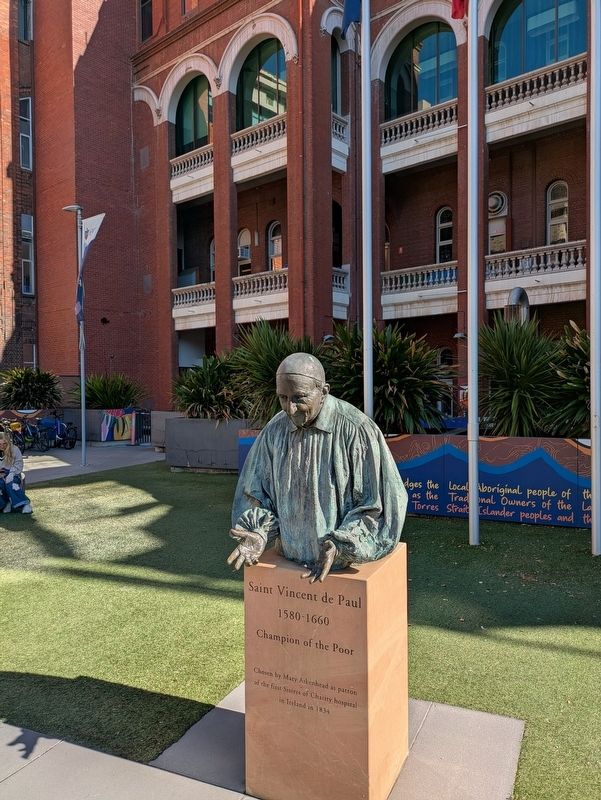
2. St Vincent's Hospital, Melbourne. Wikipedia
St Vincent's Hospital was opened in 1893 as a Catholic hospital owned and operated by the Sisters of Charity. Initially conceived as a branch of the Sydney institution of the same name, the hospital was intended to be a charitable institution, which was hoped would help bolster Melbourne's minimal health care. This idea was given avid support by Melbourne's Catholic Archbishop Dr Thomas Carr, who welcomed the idea of a hospital to take care of the 'poor and sick and abandoned children... the young girls of poor parents and servants...' These ideals corresponded directly with prevalent Victorian ideas of benevolence, which were particularly popular with the middle classes.(Submitted on May 12, 2026, by Dean Barton-Ancliffe of Rowville, Victoria.)
3. Mary Aikenhead. Wikipedia
Mother Mary Frances Aikenhead (19 January 1787 – 22 July 1858) was born in Daunt's Square off Grand Parade, Cork, Ireland. Described as one of nursing's greatest leaders, she was the founder of the Catholic religious institute, the Religious Sisters of Charity, the Sisters of Charity of Australia, and of St. Vincent's Hospital in Dublin.(Submitted on May 12, 2026, by Dean Barton-Ancliffe of Rowville, Victoria.)
Credits. This page was last revised on May 13, 2026. It was originally submitted on May 12, 2026, by Dean Barton-Ancliffe of Rowville, Victoria. This page has been viewed 11 times since then. Photos: 1, 2. submitted on May 12, 2026, by Dean Barton-Ancliffe of Rowville, Victoria. • Andrew Ruppenstein was the editor who published this page.
