Poste Adélard-Godbout
Le plus vieux poste en service au Canada


Du poste Central-1
au poste Adélard-Godbout
Pour souligner le 50e anniversaire du décès d'Adélard Godbout, ex-premier ministre du Québec, la Commission de toponymie, sur une proposition d'Hydro-Québec, a officialisé le nom Poste Adélard-Godbout pour désigner le poste électrique Central-1.
Adélard Godbout est né à Saint-Éloi le 24 septembre 1892. En juin 1936, M. Godbout succède à Louis-Alexandre Taschereau et devient le 15e premier ministre du Québec. Il est défait le 17 août de la même année mais reprendra le poste de premier ministre de 1939 à 1944.
C'est sous son administration que la nationalisation du « trust » de l'électricité, réclamée depuis une quinzaine d'années par de nombreux individus et groupes, devient réalité. Inscrite au programme électoral des libéraux lors des élections de 1939, cette mesure se concrétise lorsque le gouvernement Godbout dépose en mars 1944 un projet de loi prévoyant l'étatisation de trois entreprises productrices d'électricité : la Montreal Light, Heat and Power Consolidated et ses filiales, la Beauharnois Light, Heat and Power Company et la Montreal Island Power Company.
this page online
Une histoire de gaz, d'électricité et d'éclairage des rues
Le 14 septembre 1840, la Ville de Montréal crée le Comité d'éclairage et lui confie la responsabilité de l'éclairage public. A cette époque, l'éclairage municipal est assuré par des compagnies gazières, principalement la Montreal Gas Company. Dans les années 1880, toutefois, les fournisseurs de gaz voient poindre de nouveaux concurrents avec l'émergence de producteurs d'électricité.
Ainsi, la Royal Electric Company naît en 1884 et obtient deux ans plus tard le contrat d'éclairage des rues du Vieux-Montréal actuel. L'entreprise, qui exploite des centrales au charbon, s'installe à l'intersection sud-ouest des rues Queen et Wellington. Le 27 décembre 1888, son mandat est étendu à l'ensemble des rues de Montréal.
Souhaitant s'affranchir des fluctuations du prix du charbon, la Royal Electric Company décide de se lancer dans la production d'hydroélectricité.

A • Édifice Law (Royal Electric Company)
B • Poste Adélard-Godbout
C • Salle de manœuvre du poste Adélard-Godbout (bâtiment à 120 kV)
D • Poste Central-2
A • Édifice Law (Royal Electric Company)
B • Poste Adélard-Godbout
C • Control room of the Adélard-Godbout station (120 kV building)
D • Poste Central-2
Le mariage du gaz et de l'électricité : les débuts d'un puissant monopole
Le 28 mars 1901, la fusion de la Royal Electric Company et de la Montreal Gas Company sous la dénomination Montreal Light Heat and Power Company (MLHPC) rend possible le déploiement d'un réseau de distribution organisé et homogène. En 1903, la nouvelle entreprise rachète la Lachine Rapids. En 1926, après de nombreuses autres acquisitions, la MLHPC, appelée depuis 1918 la Montreal Light Heat and Power Consolidated, devient un monopole de fait, ce qui met fin à près de cinquante ans de concurrence sur le marché montréalais de l'électricité. En 1944, le gouvernement du Québec nationalise l'actif de la MLHPC et en confie la gestion à la Commission hydroélectrique de Québec.
Un réseau qui évolue... une vocation qui se confirme
Dans les années qui suivent sa création, la MLHPC ajoute de nouveaux équipements
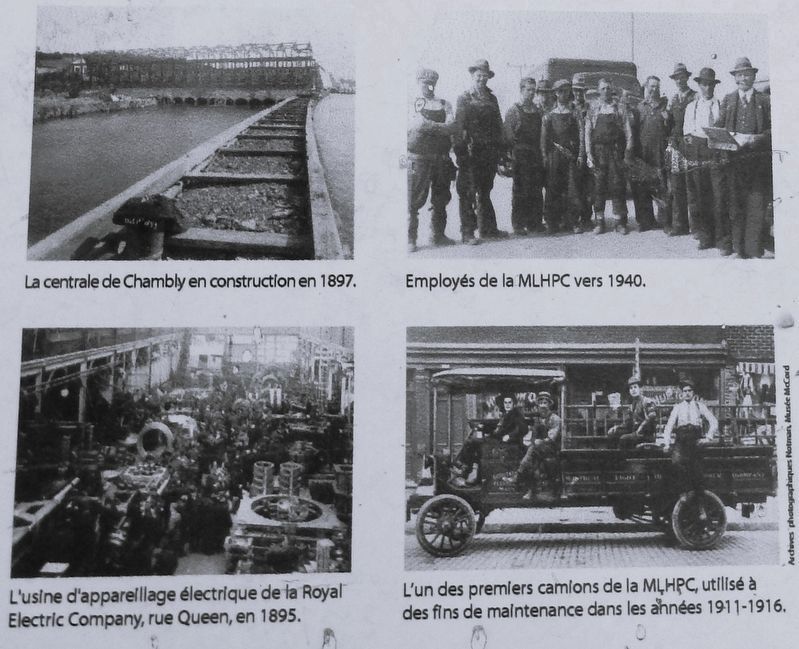
• L'usine d'appareillage électrique de ta Royal Electric Company, rue Queen, en 1895.
• Employés de la MLHPC vers 1940.
• L'un des premiers camions de la MLHPC, utilisé à des fins de maintenance dans les almées 1911-1916.
• The electrical equipment factory of the Royal Electric Company, Queen Street, in 1895.
• Employees of the MLHPC around 1940.
• One of the first MLHPC trucks, used for maintenance purposes in the years 1911-1916.
Entre 1925 et 1940, on relie les postes de la région métropolitaine pour former une première boucle à 60 kV. Entre 1945 et 1954, un nouveau bâtiment accueille la deuxième boucle métropolitaine à 120 kV. En 1967, on construit le poste Central-2 entre les rues Queen et King pour héberger l'appareillage d'un nouveau réseau de distribution à 12 kV.
Le poste Adélard-Godbout un exemple du patrimoine architectural de Montréal
L'architecte Maurice Perrault a réalisé les plans de cet immeuble de style néoclassique. Décorée d'éléments en pierre grise, la façade principale possède des ouvertures cintrées et circulaires. Des contreforts

En comparant le poste actuel avec la photo ci-contre, on remarque que des blocs de verre ont remplacé les fenêtres originales et que le fronton et les éléments formant le toit du bâtiment ont subi des modifications.
Entre 2000 et 2005, on a réalisé d'importants travaux de modernisation au poste Adélard-Godbout tout en préservant sa valeur patrimoniale.
[captions]
• Lettre de d’accompagnement de la soumission de la Royal Company pour L’éclairage des rues, en date du 15 avril 1886.
• Contrat de fourniture d’équipements électriques pur le poste, en date du 19 novembre 1901.
From the Central-1 substation
to the Adélard-Godbout substation
To mark the 50th anniversary of the death of Adélard Godbout, former Prime Minister of Quebec, the Commission of Toponymy, on a proposal from Hydro-Québec, officially named the Central-1 electrical substation Adélard-Godbout Substation.

Adélard Godbout was born in Saint-Éloi on September 24, 1892. In June 1936, Mr. Godbout succeeded Louis-Alexandre Taschereau and became the 15th Prime Minister of Quebec. He was defeated on August 17 of the same year but would return to the office of Prime Minister from 1939 to 1944.
It was under his administration that the nationalization of the electricity "trust," demanded for about fifteen years by many individuals and groups, became a reality. Included in the Liberal electoral program during the 1939 elections, this measure was realized when the Godbout government submitted in March 1944 a bill providing for the nationalization of three electricity-producing companies: Montreal Light, Heat and Power Consolidated and its subsidiaries, Beauharnois Light, Heat and Power Company and Montreal Island Power Company. One month later, on April 14, Law 17 creating the Quebec Hydro-Electric Commission, which will become Hydro-Québec, is passed. For Adélard Godbout, it is the most important law adopted by the legislative assembly since 1867.
A Story of Gas, Electricity, and Street Lighting
On September 14, 1840, the City of Montreal created

Thus, the Royal Electric Company was founded in 1884 and two years later obtained the contract to light the streets of present-day Old Montreal. The company, which operated coal-fired power plants, settled at the southwest corner of Queen and Wellington streets. On December 27, 1888, its mandate was extended to all the streets of Montreal.
Wishing to free itself from the fluctuations in the price of coal, the Royal Electric Company decided to venture into hydroelectric production. It would take nearly ten years to find a suitable site, near the Chambly rapids. In 1897, at the very moment the construction of the Chambly plant began, the Lachine Rapids Hydraulic & Land company inaugurated a hydroelectric plant at the Lachine rapids.
The marriage of gas and electricity: the beginnings of a powerful monopoly
On March 28, 1901, the merger of the Royal Electric Company and the Montreal Gas Company under the name Montreal Light Heat and Power Company (MLHPC) made the deployment of an organized and homogeneous distribution network possible. In 1903, the new company purchased the Lachine Rapids. In 1926, after many other acquisitions, MLHPC, known since 1918 as the Montreal Light Heat and Power Consolidated, became a de facto monopoly, putting an end to nearly fifty years of competition in the Montreal electricity market. In 1944, the government of Quebec nationalized the assets of MLHPC and entrusted its management to the Quebec Hydro-Electric Commission.
A network that evolves... a vocation that is confirmed
In the years following its creation, the MLHPC adds new equipment to the facilities of the former Royal Electric Company, this time north of Wellington Street. In 1901 begins the construction of the Central-1 substation (renamed Poste Adélard-Godbout), which is set to play a key role in the distribution of electricity in Montreal. Starting in 1910, electricity produced by the Lachine and Chambly power plants will be transported to this substation at voltages of 12 kV and 25 kV for conversion and distribution on a network initially operated at 4 kV, then at 12 kV.
Between 1925 and 1940, the substations in the metropolitan area were connected to form a first 60 kV loop. Between 1945 and 1954, a new building housed the second 120 kV metropolitan loop. In 1967, the Central-2 substation was built between Queen and King streets to accommodate the equipment of a new 12 kV distribution network.
The Adélard-Godbout Substation: an Example of Montreal's Architectural Heritage
The architect Maurice Perrault created the plans for this neoclassical-style building. Decorated with gray stone elements, the main facade features arched and circular openings. Paired buttresses with semicircular arches define the central bay, which is topped with a lowered-arch pediment framed by two volutes. In addition, there are two-step buttresses and two cornice consoles on each side of the central bay.
Comparing the current building with the photo opposite, one can notice that glass blocks have replaced the original windows and that the pediment and the elements forming the roof of the building have undergone modifications.
Between 2000 and 2005, significant modernization work was carried out at the Adélard-Godbout substation while preserving its heritage value.
[captions]
• Cover letter for the submission of the Royal Company for street lighting, dated April 15, 1886.
• Contract for the supply of electrical equipment for the station, dated November 19, 1901.
Erected by Hydro-Québec.
Topics. This historical marker is listed in these topic lists: Architecture • Government & Politics • Industry & Commerce. A significant historical year for this entry is 1901.
Location. 45° 29.832′ N, 73° 33.34′ W. Marker is in Montréal, Québec. It is in Cité Multimedia. It is at the intersection of Rue Wellington and Rue Prince, on the right when traveling south on Rue Wellington. Touch for map. Marker is at or near this postal address: 733 Rue Wellington, Montréal QC H3C 1T6, Canada. Touch for directions.

Regionally, this marker is in Central Canada. Globally, it is in North America, the Western Hemisphere, and the Western World. Historically, it finds itself in what was once a British colony, the Viceroyalty of New France, the Haudenosaunee (Iroquois) Confederacy, and Rupert’s Land.
Other nearby markers. At least 8 other markers are within walking distance of this marker: Adélard Godbout (a few steps from this marker); Le site des écluses nos 1 et 2 / The site of locks 1 and 2 (approx. 0.2 kilometers away); Un Monde de Silos / A World of Elevators (approx. 0.2 kilometers away); Un petit monde en soi / A World Unto Itself (approx. 0.3 kilometers away); Une ville en profonde mutation / Transformation of a City (approx. 0.3 kilometers away); Le berceau de l'industrie / Cradle of Canadian Industry (approx. 0.3 kilometers away); Trois Siecles D'histoire / Three Centuries of History (approx. 0.3 kilometers away); L'époque revolue des canalers / The Era of the Canaler (approx. 0.3 kilometers away). Touch for a list and map of all markers in Montréal.
Related markers. Click here for a list of markers that are related to this marker. Poste Adélard-Godbout
Also see . . . Poste Adélard-Godbout (Wikipedia).
Excerpt: The Poste Adélard-Godbout is a 120 kV electrical substation in Montreal. Canada's oldest substation, it has been in continuous operation since 1901. It contains two stories above ground and one below ground. It has a facade in clay brick with grey stone ornaments.(Submitted on May 18, 2026, by Cosmos Mariner of Cape Canaveral, Florida.)Designed by Maurice Perrault, it was built between 1901 and 1904. Initially it received 12 kV current from the now defunct Lachine hydroelectric generating station. Later it received 25 kV from a generating station in Chambly (demolished in 1964).
It was built by the Montreal Light, Heat & Power Company (MLHPC) and became the property of Hydro-Québec in 1944 during the nationalization of Quebec's electrical infrastructure.
Originally Poste Central-1, in 2007 it was renamed after former Premier of Quebec Adélard Godbout on the 50th anniversary of his death.
Credits. This page was last revised on May 19, 2026. It was originally submitted on May 14, 2026, by Cosmos Mariner of Cape Canaveral, Florida. This page has been viewed 18 times since then. Photos: 1, 2, 3, 4, 5, 6. submitted on May 18, 2026, by Cosmos Mariner of Cape Canaveral, Florida.
