
Old Town in Alexandria, Virginia — The American South (Mid-Atlantic)
The Federal District and Alexandria
Photographed by Devry Becker Jones (CC0), May 14, 2026
1. The Federal District and Alexandria Marker
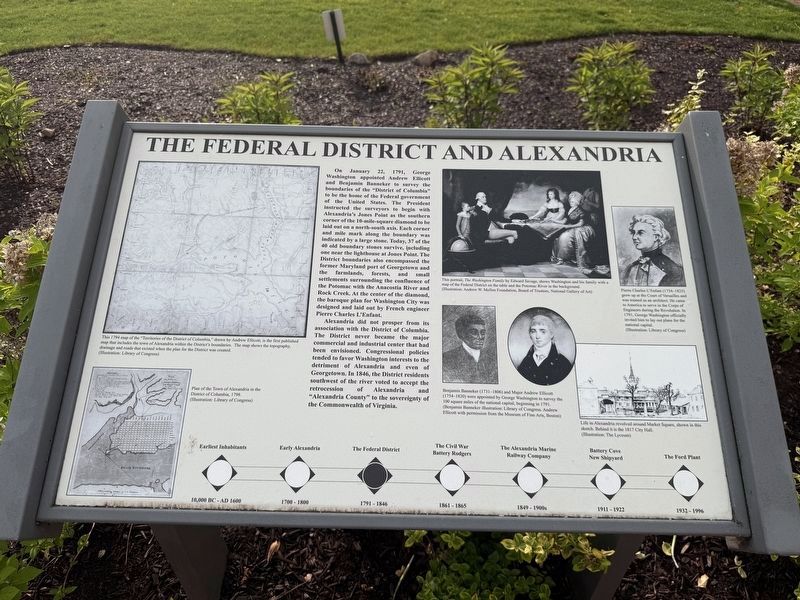
On January 22, 1791, George Washington appointed Andrew Ellicott and Benjamin Banneker to survey the boundaries of the "District of Columbia," to be the home of the Federal government of the United States. The President instructed the surveyors to begin with Alexandria's Jones Point as the southern corner of a 10-mile square diamond to be laid out on a north-south axis. Each corner and mile mark along the boundary was indicated by a large stone. Today, 37 of the 40 old boundary stones survive, including one near the lighthouse at Jones Point. The District boundaries also encompassed the former Maryland port of Georgetown and the farmlands, forests and small settlements surrounding the confluence of the Potomac with the Anacostia River and Rock Creek. At the center of the diamond, the boroque plan for Washington City was designed and laid out by French engineer Pierre Charles L'Enfant.
Alexandria did not prosper from its association with the District of Columbia. The District never became the major commercial and industrial center that had been envisioned. Congressional policies tended to favor Washington interests
this page online
[Captions:]
This 1794 map of the "Territories of the District of Columbia," drawn by Andrew Ellicott, is the first published map that includes the town of Alexandria within the District's boundaries. The map shows the topography, drainage and roads that existed when the plan for the District was created.
(Illustration: Library of Congress)
Plan of the Town of Alexandria in the District of Columbia, 1798.
(Illustration: Library of Congress)
This portrait, The Washington Family by Edward Savage, shows Washington and his family with a map of the Federal District on the table and the Potomac River in the background.
(Illustration: Andrew W. Mellon Foundation, Board of Trustees, National Gallery of Art)
Pierre Charles L'Enfant (1754-1825) grew up at the Court of Versailles and was trained as an architect. He came to America to serve in the Corps of Engineers during the Revolution. In 1791, George Washington officially invited him to lay out plans for the national capital.
(Illustration: Library of Congress)
Benjamin Banneker (1731-1806) and Major Andrew Ellicott (1754-1820) were appointed by George Washington to survey the 100 square miles of the national capital, beginning in 1791. (Benjamin Banneker illustration: Library of Congress. Andrew Ellicott with permission from the Museum of Fine Arts, Boston)
Life in Alexandria revolved around Market Square, shown in this sketch. Behind it is the 1817 City Hall.
(Illustration: The Lyceum)
Erected by Fords
Photographed by Devry Becker Jones (CC0), May 14, 2026
2. The Federal District and Alexandria Marker
Topics and series. This historical marker is listed in these topic lists: Industry & Commerce • Political Subdivisions. In addition, it is included in the Virginia, The City of Alexandria series list. A significant historical date for this entry is January 22, 1791.
Location. 38° 47.815′ N, 77° 2.415′ W. Marker is in Alexandria, Virginia. It is in Old Town. It can be reached from Fords Landing Way north of Wharf Street, on the right when traveling north. Touch for map. Marker is at or near this postal address: 702 Fords Landing Way, Alexandria VA 22314, United States of America. Touch for directions.

Regionally, this marker is in the Washington Metropolitan Area and in Northern Virginia. It is also in the American South, specifically in the Upper South, in the Mid-Atlantic, and on the Eastern Seaboard. Globally, it is in the North Atlantic Region, North America, the Western Hemisphere, the Western World, and the Anglosphere. Historically, it finds itself in what was once the territory of the Mississippian Culture, one of the original Thirteen Colonies, one of the Confederate States of America, and the Antebellum South.
Other nearby markers. At least 8 other markers are within walking distance of this marker: Early Alexandria and Keith's Wharf (here, next to this marker); The Civil War and Battery Rodgers (here, next to this marker); Battery Cove Filled: A New Shipyard (here, next to this marker); The Alexandria Marine Railway (here, next to this marker); The Earliest Inhabitants (a few steps from this marker); a different marker also named The Alexandria Ford Plant (within shouting distance of this marker); Guarding the Potomac (about 600 feet away, measured in a direct line); Zion Baptist Church (about 800 feet away). Touch for a list and map of all markers in Alexandria.
Other markers no longer nearby. The Federal District and Alexandria (has been replaced with this marker); a different marker also named Early Alexandria and Keith's Wharf (was here, next to this marker but has been replaced with another marker now near it); a different marker also named The Civil War and Battery Rodgers (was here, next to this marker but has been replaced with another marker now near it); a different marker also named Battery Cove Filled: A New Shipyard (was a few steps from this marker but has been replaced with another marker now near it); a different marker also named The Earliest Inhabitants (was a few steps from this marker but has been replaced with another marker now near it); The Alexandria Ford Plant (was within shouting distance of this marker but has been replaced with another marker now near it).
Credits. This page was last revised on May 14, 2026. It was originally submitted on May 14, 2026, by Devry Becker Jones of Washington, District of Columbia. This page has been viewed 19 times since then. Photos: 1, 2. submitted on May 14, 2026, by Devry Becker Jones of Washington, District of Columbia.
