Old Montreal in Montréal, Québec — Central Canada (French-Canadian)
Autour de la Craig
Photographed by Cosmos Mariner, May 21, 2024
1. Autour de la Craig Marker

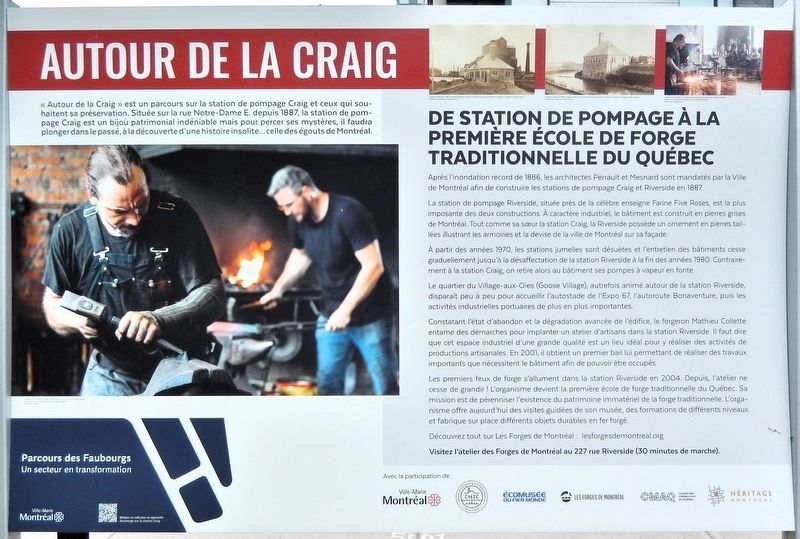
« Autour de la Craig » est un parcours sur la station de pompage Craig et ceux qui souhaitent sa préservation. Située sur la rue Notre-Dame E. depuis 1887, la station de pompage Craig est un bijou patrimonial indéniable mais pour percer ses mystères, il faudra plonger dans le passé, å la découverte d'une histoire insolite... celle des égouts de Montréal.
De station de pompage à la première école de forge traditionnelle du Québec
Après l'inondation record de 1886, les architectes Perrault et Mesnard sont mandatés par la Ville de Montréal afin de construire les stations de pompage Craig et Riverside en 1887.
La station de pompage Riverside, située près de la célèbre enseigne Farine Five Roses, est la plus imposante des deux constructions. À caractère industriel, le bâtiment est construit en pierres grises de Montréal. Tout comme sa sœur la station Craig, la Riverside possède un ornement en pierres taillées illustrant les armoiries et la devise de la ville de Montréal sur sa façade.
À partir des années 1970, les stations jumelles sont désuètes et l'entretien des bâtiments cesse graduellement jusqu'à la désaffectation
this page online
Le quartier du Village-aux-Oies (Goose Village), autrefois animé autour de la station Riverside, disparaît peu à peu pour accueillir l'autostade de l'Expo 67, l'autoroute Bonaventure, puis les activités industrielles portuaires de plus en plus importantes.
Constatant l'état d'abandon et la dégradation avancée de l'édifice, le forgeron Mathieu Collette entame des démarches pour implanter un atelier d'artisans dans la station Riverside. Il faut dire que cet espace industriel d'une grande qualité est un lieu idéal pour y réaliser des activités de productions artisanales. En 2001, il obtient un premier bail lui permettant de réaliser des travaux importants que nécessitent le bâtiment afin de pouvoir être occupés.
Les premiers feux de forge s'allument dans la station Riverside en 2004. Depuis, l'atelier ne cesse de grandir ! L'organisme devient la première école de forge traditionnelle du Québec. Sa mission est de pérenniser l'existence du patrimoine immatériel de la forge traditionnelle. L'organisme
Photographed by Cosmos Mariner, May 21, 2024
2. Autour de la Craig Marker
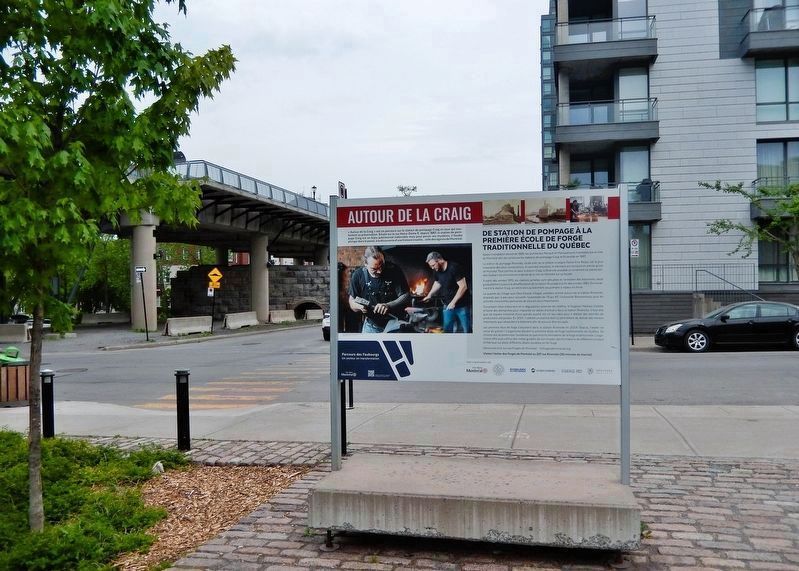
Looking north from the north end of Dalhousie Park. Rue St-Hubert crosses in the background. Rue de la Porte de Quebec continues on the left, as well as the elevated portion of Rue Notre Dame Est.
Découvrez tout sur Les Forges de Montréal : lesforgesdemontreal.org
Visitez l'atelier des Forges de Montréal au 227 rue Riverside (30 minutes de marche).
[captions]
• La station Riverside in 1887
• L'organisme Les Forges de Montréal
“Around the Craig” is a tour of the Craig pumping station and those who wish for its preservation. Located on Notre-Dame Est since 1887, the Craig pumping station is an undeniable heritage gem, but to uncover its mysteries, one will have to dive into the past, discovering an unusual story... that of Montreal's sewers.
From pumping station to the first traditional blacksmithing school in Quebec
After the record flood of 1886, architects Perrault and Mesnard were commissioned by the City of Montreal to build the Craig and Riverside pumping stations in 1887.
The Riverside pumping station, located near the famous Farine Five Roses sign, is the more imposing of the two buildings. Industrial in character, the building is constructed of gray Montreal stone. Like its sister, the Craig station, the Riverside features carved stone ornamentation depicting the coat of arms and the motto of the City of Montreal on its facade.
From the 1970s onwards, the twin stations became obsolete, and maintenance of the buildings gradually ceased until the Riverside station was decommissioned at the end of the 1980s. Unlike the Craig station, the building then had its cast-iron steam pumps removed.
The Village-aux-Oies (Goose Village) neighborhood, once lively around the Riverside station, gradually disappeared to make way for the Expo ‘67 Autostade, the Bonaventure highway, and then increasingly important port industrial activities.
Observing the state of abandonment and advanced deterioration of the building, the blacksmith Mathieu Collette began steps to establish a crafts workshop in the Riverside station. It must be said that this high-quality industrial space is an ideal place to carry out artisanal production activities. In 2001, he obtained a first lease allowing him to carry out the major work the building required to be occupied.
The first forge fires were lit in the Riverside station in 2004. Since then, the workshop has continued to grow! The organization is becoming the first traditional blacksmithing school in Quebec. Its mission is to ensure the survival of the intangible heritage of traditional blacksmithing. The organization now offers guided tours of its museum, training at different levels, and on-site produces various durable wrought iron objects.
Discover everything about Les Forges de Montréal: lesforgesdemontreal.org
Visit the Les Forges de Montréal workshop at 227 Riverside Street (30-minute walk).
Erected by Ville-Marie Montréal and Héritage Montréal.
Topics. This historical marker is listed in these topic lists: Architecture • Education • Industry & Commerce. A significant historical year for this entry is 1887.
Location. 45° 30.735′ N, 73° 33.055′ W. Marker is in Montréal, Québec. It is in Old Montreal. It is at the intersection of Rue St-Hubert and Rue de la Porte de Quebec, on the right when traveling east on Rue St-Hubert. The marker is along the sidewalk at the north end of Dalhousie Park. Touch for map. Marker is at or near this postal address: 364 Rue St-Hubert, Montréal QC H2Y 4B3, Canada. Touch for directions.

Regionally, this marker is in Central Canada. Globally, it is in North America, the Western Hemisphere, and the Western World. Historically, it finds itself in what was once a British colony, the Viceroyalty of New France, the Haudenosaunee (Iroquois) Confederacy, and Rupert’s Land.
Other nearby markers. At least 8 other markers are within walking distance of this marker: First Transcontinental Train (about 90 meters away, measured in a direct line); Cartier Residences (about 150 meters away); Parc Fleury-Mesplet (about 150 meters away); Jean Barbot dit Boisdoré Lived Here in 1712 (about 240 meters away); Square Viger (approx. 0.2 kilometers away); Joseph Papineau (approx. 0.3 kilometers away); Immeuble de l'association des débardeurs / Building of the Longshoremen Association (approx. 0.3 kilometers away); Palais de L'intendance / Intendance Palace (approx. 0.3 kilometers away). Touch for a list and map of all markers in Montréal.
Also see . . . Les Forges de Montréal. Website homepage (Submitted on May 18, 2026, by Cosmos Mariner of Cape Canaveral, Florida.)
Credits. This page was last revised on July 28, 2026. It was originally submitted on May 16, 2026, by Cosmos Mariner of Cape Canaveral, Florida. This page has been viewed 18 times since then. Photos: 1, 2. submitted on May 18, 2026, by Cosmos Mariner of Cape Canaveral, Florida.
