Snow Lake in Desha County, Arkansas — The American South (West South Central)
Snow Lake: Transformed by the Rail

Photographed by Jimmy Emerson, May 13, 2026
1. Snow Lake Marker
Large-scale farm and businesses were established here during the early 1800s, when people relied heavily on riverboats for transportation. As a formal community, Snow Lake was established with the arrival of the railroad in the early 1900s, and its founding marks a transition from riverboats to trains. Thornton Clark & Company which dealt in real estate, capitalized on the new rail line by negotiating the construction of a depot on its private land. This depot and surrounding area remained unnamed for a while until Annie Thornton, a local resident with ties to Thornton Clark & Company, suggested the name Snow Lake-a nod to a nearby body of water featuring snowy white flowers.
Compared to boats, the rail line was faster for passengers and freight -an advantage for all residents. Advancing the area further was the fact that Thornton Clark & Company cleverly constructed stores and housing for railroad workers arriving at this emerging town.
Reliable By Rail
In 1905, the Snow Lake post office opened, and the community witnessed the inaugural freight train route from Helena and McGehee. The
this page online
A Major Center of Operations
Snow Lake grew and transformed after 25 years of rail. The main line via spur lines, connected communities to logging and farming operations. Eventually over 30 buildings were constructed here that were associated with the railroad. Into the 1920s, trains coming through Snow Lake were loaded with coal and water for steam power locomotives. The surrounding Delta landscape was quite swampy. Bridges were necessary to cross water-logged areas, numerous workers who maintained these bridges resided in Snow Lake in bunk cars. All of these improvements aided commerce in Snow Lake. A platform was put in to load baled cotton from places such as the C. M. Stevens Cotton Gin that operated at Snow Lake in the 1920s.
Safety By Rail
The
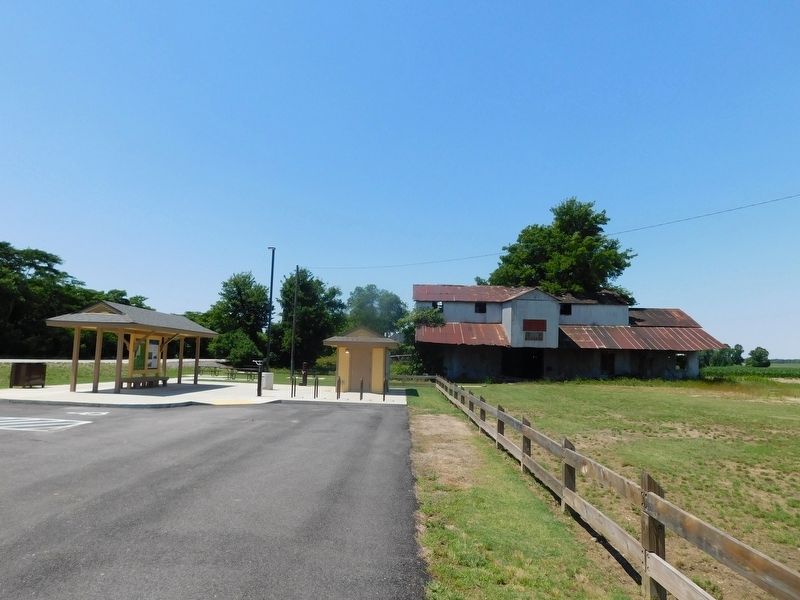
Photographed by Jimmy Emerson, May 13, 2026
2. Snow Lake Marker at Snow Lake Station on the Delta Heritage Trail State Park
Snow Lake Today
Transformation continues here with the ending of rail service and the creation of Delta Heritage Trail State Park. Start the journey on the trail reflecting on the sounds, sights, and aromas one might expect to experience in the early boom days of the railroad. Imagine the scent of smoke from a steam powered locomotive and the sound of shoveled coal. Consider the legacy of this rail line as you examine one of the many bridges along the trail, most of which rest on the original wooden rail trestles. Gaze out over today's landscape and reflect on what emotions passengers experienced on a train, rushing away as the area filled with floodwaters.
Text under the baled cotton: Bales of cotton waiting to be loaded on train at Snow Lake in the 1960s. Photograph taken by Ernie Deane, Snow Lake, Ark., October 14, 1963 [Britt and Purtle, view I] Ernie Deane Collection, Call number: ECD1766-6, Arkansas State Archives Archival Vault
Text under bottom left picture: Cotton being brought to gin in Snow Lake in the 1960s.
Photograph taken by Ernie Deane, Snow Lake, Ark., October 14, 1963 [Gin, view 2] Ernie Deane Collection, Call number: ECD1766-5, Arkansas State Archives Archival Vault
Text under the train picture: "Missouri Pacific train, high on it's embankment, fords the floodwaters in 1927 at Snow Lake" Photograph taken by unknown, Snow Lake, Ark., 1927, Disaster photograph collection, Call number bc_pho_11_07291,Butler Center for Arkansas Studies at Central Arkansas Library System.
Topics. This historical marker is listed in these topic lists: Bridges & Viaducts • Disasters • Railroads & Streetcars • Settlements & Settlers. A significant historical year for this entry is 1905.
Location. 34° 3.62′ N, 91° 1.388′ W. Marker is in Snow Lake, Arkansas, in Desha County. It is on Arkansas 44, on the right when traveling east. Touch for map. Marker is at or near this postal address: 1597 AR-44, Snow Lake AR 72379, United States of America. Touch for directions.

Regionally, this marker is in the Arkansas Delta, in the Mississippi Alluvial Plain, and in the Quapaw Homeland. It is also in the American South, specifically in the Deep South, in the Upper South, in the Mississippi Delta, in the Piney Woods, and in the Great River Road Region. Globally, it is in North America, the Western Hemisphere, the Western World, and the Anglosphere. Historically, it finds itself in what was once the Viceroyalty of New France, the territory of the Mississippian Culture, the Louisiana Purchase, one of the Confederate States of America, and the Antebellum South.
Other nearby markers. At least 5 other markers are within 15 miles of this marker, measured as the crow flies: Snow Lake Station (within shouting distance of this marker); Laconia Circle: Before the Railroad (within shouting distance of this marker); a different marker also named Snow Lake Station (within shouting distance of this marker); Otis Clay (approx. 10.2 miles away in Mississippi); Grace Episcopal Church (approx. 14.1 miles away in Mississippi).
More about this marker. Located at the Delta Heritage Trail State Parks, Snow Lake Station at the end of Arkansas 44
Credits. This page was last revised on May 17, 2026. It was originally submitted on May 17, 2026, by Jimmy Emerson of Dalton, Georgia. This page has been viewed 20 times since then. Photos: 1, 2. submitted on May 17, 2026, by Jimmy Emerson of Dalton, Georgia. • Andrew Ruppenstein was the editor who published this page.
