El Poble-sec in Barcelona, Catalonia, Spain — Southwestern Europe (Iberian Peninsula)
El baluard de Santa Amàlia
⎯⎯⎯
The Santa Amàlia Bastion
Photographed by Andrew Ruppenstein, April 29, 2022
1. El Baluard de Santa Amàlia / The Santa Amàlia Bastion Marker

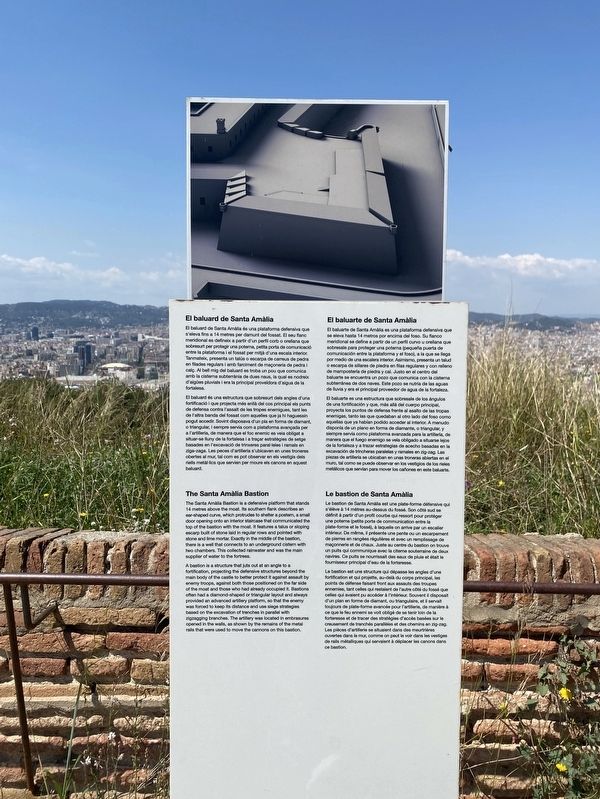
El baluard de Santa Amália és una plataforma defensiva que s'eleva fins a 14 metres per damunt del fossat. El seu flanc meridional es defineix a partir d'un perfil corb o orellana que sobresurt per protegir una poterna, petita porta de comunicació entre la plataforma i el fossat per mitjà d'una escala interior. Tanmateix, presenta un talús o escarpa de carreus de pedra en filades regulars i amb farciment de maçoneria de pedra i calç. Al bell mig del baluard es troba un pou que comunica amb la cisterna subterrània de dues naus, la qual es nodreix d'aigües pluvials i era la principal proveïdora d'aigua de la fortalesa.
El baluard és una estructura que sobresurt dels angles d'una fortificació i que projecta més enllà del cos principal els punts de defensa contra l'assalt de les tropes enemigues, tant les de l'altra banda del fossat com aquelles que ja hi haguessin pogut accedir. Sovint disposava d'un pla en forma de diamant, o triangular, i sempre servia com a plataforma avançada per a l'artilleria, de manera que el foc enemic es veia obligat a situar-se lluny de la fortalesa i a traçar estratègies de setge basades en l'excavació de trinxeres paral·leles i ramals en ziga-zaga. Les peces d'artilleria s'ubicaven en unes troneres obertes al mur,
this page online
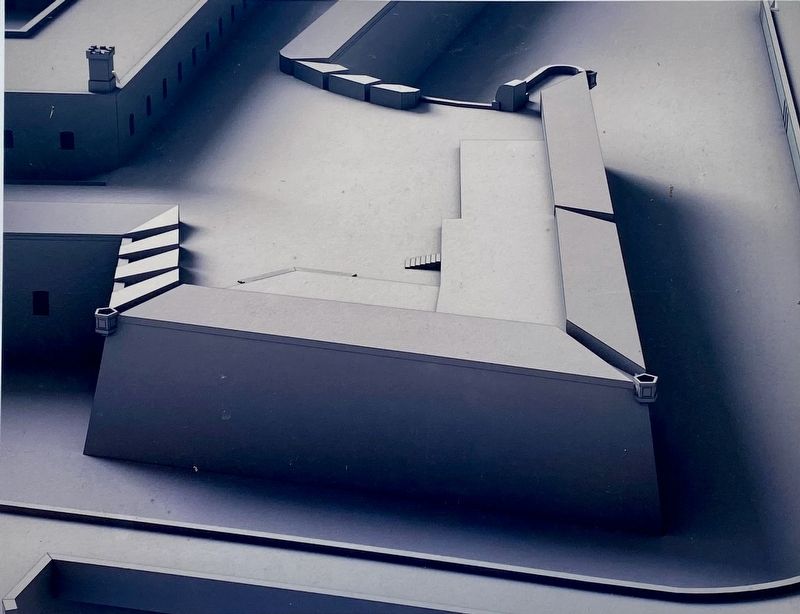
The Santa Amália Bastion is a defensive platform that stands 14 metres above the moat. Its southern flank describes an ear-shaped curve, which protrudes to shelter a poster, a small door opening onto an interior staircase that communicated the top of the bastion with the moat. It features a talus or sloping escarp built of stone laid in regular rows and pointed with stone and lime mortar. Exactly in the middle of the bastion, there is a well that connects to an underground cistern with two chambers. This collected rainwater and was the main supplier of water to the fortress.
A bastion is a structure that juts out at an angle to a fortification, projecting the defensive structures beyond the main body of the castle to better protect it against assault by enemy troops, against both those positioned on the far side of the moat and those who had already occupied it. Bastions often had a diamond-shaped or triangular layout and always provided an advanced artillery platform, so that the enemy was forced to keep its distance and use siege strategies based on the excavation of trenches in parallel with zigzagging branches. The artillery was located in embrasures opened
Photographed by Andrew Ruppenstein, April 29, 2022
2. El baluard de Santa Amàlia / The Santa Amàlia Bastion Marker - wide view
El baluarte de Santa Amàlia
El baluarte de Santa Amàlia es una plataforma defensiva que se eleva hasta 14 metros por encima del foso. Su flanco meridional se define a partir de un perfil curvo u orellana que sobresale para proteger una poterna (pequeña puerta de comunicación entre la plataforma y el foso), a la que se llega por medio de una escalera interior. Asimismo, presenta un talud o escarpa de sillares de piedra en filas regulares y con relleno de mampostería de piedra y cal. Justo en el centro del baluarte se encuentra un pozo que comunica con la cisterna subterránea de dos naves. Este pozo se nutría de las aguas de lluvia y era el principal proveedor de agua de la fortaleza.
El baluarte es una estructura que sobresale de los ángulos de una fortificación y que, más allá del cuerpo principal, proyecta los puntos de defensa frente al asalto de las tropas enemigas, tanto las que quedaban al otro lado del foso como aquellas que ya habían podido acceder al interior. A menudo disponía de un plano en forma de diamante, o triangular, y siempre servía como plataforma avanzada para la artillería, de manera que el fuego enemigo se veía obligado a situarse lejos de la fortaleza y a
Photographed by Andrew Ruppenstein, April 29, 2022
3. Marker illustration: The Santa Amàlia Bastion
Le bastion de Santa Amália est une plate-forme défensive qui s'élève à 14 mètres au-dessus du fossé. Son côté sud se définit à partir d'un profil courbe qui ressort pour protéger une poterne (petite porte de communication entre la plate-forme et le fossé), à laquelle on arrive par un escalier intérieur. De même, il présente une pente ou un escarpement de pierres en rangées régulières et avec un remplissage de maçonnerie et de chaux. Juste au centre du bastion on trouve un puits qui communique avec la citerne souterraine de deux navires. Ce puits se nourrissait des eaux de pluie et était le fournisseur principal d'eau de la forteresse.
Le bastion est une structure qui dépasse les angles d'une fortification et qui projette, au-delà du corps principal, les points de défense faisant front aux assauts des troupes ennemies, tant celles qui restaient de l'autre côté du fossé que celles qui avaient pu accéder à l'intérieur. Souvent il disposait d'un plan en forme de diamant, ou
Photographed by Andrew Ruppenstein, April 29, 2022
4. View of Barcelona, looking north from the Santa Amàlia Bastion
Topics. This historical marker is listed in this topic list: Forts and Castles.
Location. 41° 21.863′ N, 2° 9.984′ E. Marker is in Barcelona, Cataluña (Catalonia). It is in El Poble-sec. It can be reached from Carrer del Castell. Touch for map. Marker is at or near this postal address: Carrer del Castell s/n, Barcelona, Cataluña 08038, Spain. Touch for directions.

Regionally, it is in the North Atlantic Region, in Europe, in the European Union, in Atlantic Europe, on the Iberian Peninsula, in the Schengen Area, in a coastal Mediterranean country, and in the Western World. Historically, it finds itself in what was once the Roman Empire.
Other nearby markers. At least 8 other markers are within walking distance of this marker: La Ciutat Bombardejada / The Bombardment of the City (here, next to this marker); Catalan Flag raised (a few steps from this marker); La bandera i el Castell / The flag and the castle (a few steps from this marker); L’orellot de Santa Amàlia / The Santa Amàlia Orillon (within shouting distance of this marker); L'afusellament del president Lluís Companys / The Execution of President Lluís Companys (within shouting distance of this marker); Montjuic Castle (within shouting distance of this marker); Méchain Etablí les Coordenades de Barcelona / Méchain Establishes the Coordinates of Barcelona (about 90 meters away, measured in a direct line); El Pont d’accés i la façana / The Entrance Bridge and the Façade (about 90 meters away). Touch for a list and map of all markers in Barcelona.
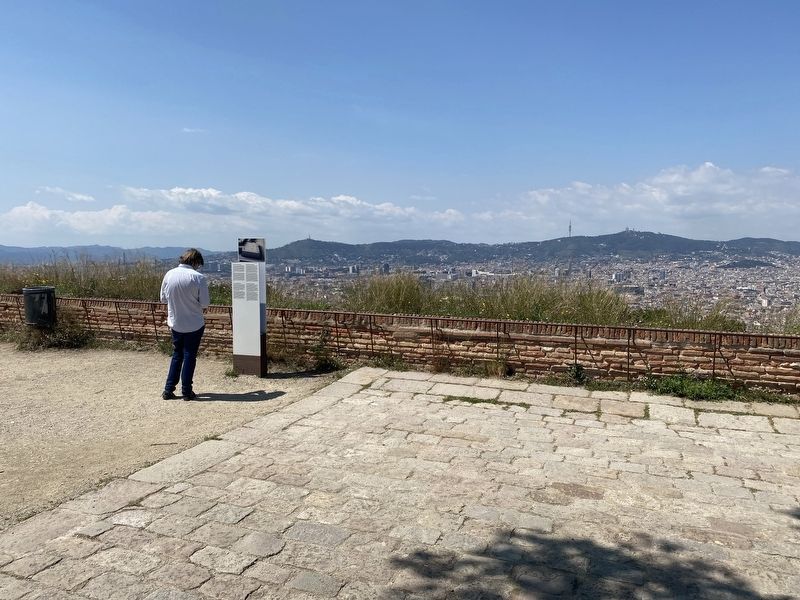
More about this marker. The is on the north side of the bastion.
Also see . . . Montjuïc Castle (Wikipedia). Overview:
Montjuïc Castle (Catalan: Castell de Montjuïc, Spanish: Castillo de Montjuich) is an old military fortress, with roots dating back from 1640, built on top of Montjuïc hill in Barcelona, Catalonia, Spain. It currently serves as a Barcelona municipal facility.(Submitted on May 19, 2026.)
Credits. This page was last revised on May 19, 2026. It was originally submitted on May 19, 2026, by Andrew Ruppenstein of Lamorinda, California. This page has been viewed 20 times since then. Photos: 1, 2, 3, 4. submitted on May 19, 2026, by Andrew Ruppenstein of Lamorinda, California.
