
Sentrum in Oslo, Norway — Northern Europe (a Nordic Country in Scandinavia)
Ære og Fortvilelse 1857-1864
⎯⎯⎯
Honour and Despair, 1857-1864
Photographed by Andrew Ruppenstein, June 24, 2025
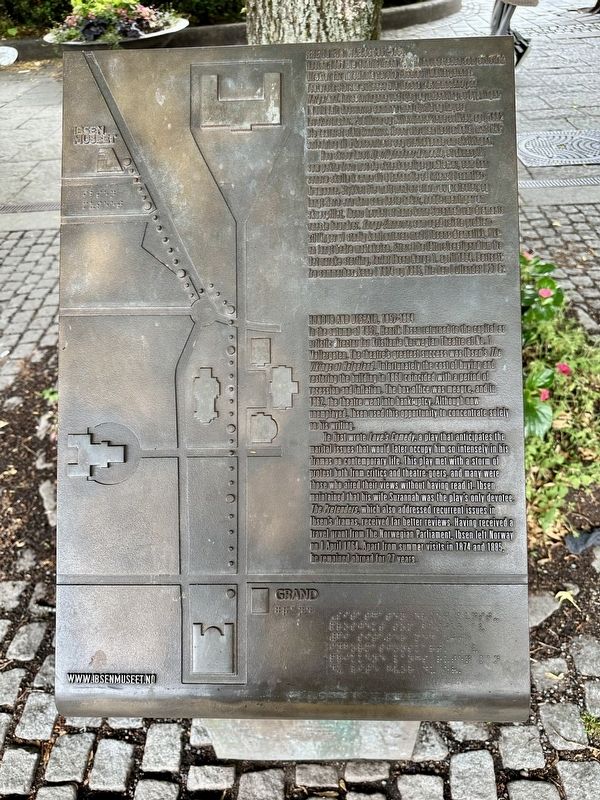
1. Ære og Fortvilelse 1857-1864 / Honour and Despair, 1857-1864 Marker

Høsten 1857 ble Henrik Ibsen kalt til hovedstaden som artistisk direktør for Kristiania norske teater i Møllergaten 1. Teaterets største suksess ble Ibsens Hærmændene pa Helgeland. Investeringene ved kjøp og utbredring av bygningen i 1860 falt dessverre sammen med dyrtid og høyere levekostnader. Publikum og billettinntektene sviktet, og i 1862 ble teatret slått konkurs. Ibsen sto uten fast arbeid, men fikk anledning til å konsentrere seg utelukkende om skrivingen.
Han skrev først Kjarlighedens Komedie, et skuespill som pekte frem mot de ekteskapelige problemer, som han senere skulle komme til å behandle så intenst i samtidsdramaene. Stykket ble møtt med en storm av protester, og langt flere enn dem som leste bøker, hadde meninger om skuespillet. Ibsen hevdet at hans kone Suzannah var dramaets eneste beundrer. Kongs-Emnerne, som også reiste problemstillinger vi stadig konfronteres med i Ibsens dramatikk, fikk en langt bedre mottakelse. Etter å ha fått reisestipendium fre Det norske storting, forlot Ibsen Norge 1. april 1864. Bortsett fra sommerbesøkene i 1874 og 1885, ble
this page online
Honour and Despair, 1857-1864
In the autumn of 1857, Henrik Ibsen returned to the capital as artistic director for Kristiania Norwegian Theatre at No. 1 Møllergaten. The theatre's greatest success was Ibsen's The Vikings at Helgeland. Unfortunately the cost of buying and restoring the building in 1860 coincided with a period of recession and inflation. The box-office was meagre, and in 1862, the theatre went into bankruptcy. Although now unemployed, Ibsen used this opportunity to concentrate solely on his writing.
He first wrote Love's Comedy, a play that anticipates the marital issues that would later occupy him so intensely in his dramas on contemporary life. This play met with a storm of protest both from critics and theatre-goers, and many were those who aired their views without having read it. Ibsen maintained that his wife Suzannah was the play's only devotee. The Pretenders, which also addressed recurrent issues in Ibsen's dramas, received far better reviews. Having received a travel grant from The Norwegian Parliament. Ibsen left Norway 1 April 1864. Apart from summer visits in 1874,

Photographed by Andrew Ruppenstein, June 24, 2025
2. Ære og Fortvilelse 1857-1864 / Honour and Despair, 1857-1864 Marker - wide view
Erected by Ibsen Museum.
Topics. This historical marker is listed in these topic lists: Arts, Letters, Music • Entertainment. A significant historical year for this entry is 1857.
Location. 59° 54.904′ N, 10° 44.047′ E. Marker is in Oslo. It is in Sentrum. It is on Karl Johans gate, on the left when traveling west. Touch for map. Marker is in this post office area: Oslo 0162, Norway. Touch for directions.

Regionally, it is in the North Atlantic Region, on the Atlantic Arc, in Europe, in Atlantic Europe, in Scandinavia, in the Nordic Countries, in the Schengen Area, and in the Western World.
Other nearby markers. At least 8 other markers are within walking distance of this marker: Ruseløkken (within shouting distance of this marker); Frivillig Eksil / Voluntary Exile (about 90 meters away, measured in a direct line); Lærearene / Learning the Craft, 1850-1857 (about 90 meters away); Brødrene Hals’ Pianofortefabrik / Hals Brothers Piano Factory (about 90 meters away); Hotel Continental (about 120 meters away); Lukket på Grunn av Glede / Closed Due to Joy (about 150 meters away);

Photographed by Andrew Ruppenstein, June 24, 2025
3. Statue of Henrik Ibsen in front of the National Theatre (about 100 meters from marker site)
More about this marker. This is one of eight Ibsen-related markers running from the Storting to Ibsen’s former home (now the Ibsen museum).
Also see . . . Henrik Ibsen (Wikipedia). Overview:
Henrik Johan Ibsen (20 March 1828 – 23 May 1906) was a Norwegian playwright. He is considered one of the world's pre-eminent writers of the 19th century and is often referred to as "the father of modern drama". He pioneered theatrical realism but also wrote lyrical epic works. His major works include Brand, Peer Gynt, Emperor and Galilean, A Doll's House, Ghosts, An Enemy of the People, The Wild Duck, Rosmersholm, Hedda Gabler, The Master Builder, and When We Dead Awaken. In 2014 Ibsen was considered the most frequently performed dramatist in the world after Shakespeare. Store norske leksikon describes him as "the center of the Norwegian literary canon".(Submitted on May 19, 2026.)
Credits. This page was last revised on May 19, 2026. It was originally submitted on May 19, 2026, by Andrew Ruppenstein of Lamorinda, California. This page has been viewed 20 times since then. Photos: 1, 2, 3. submitted on May 19, 2026, by Andrew Ruppenstein of Lamorinda, California.
