
Douglas (Bronzeville) in Chicago in Cook County, Illinois — The American Midwest (Great Lakes)
Dr. J.B. Martin
1885-1973
| — | Bronzeville Walk of Fame | — |

Photographed by Sean P. Flynn, May 13, 2026
1. Dr. J.B. Martin Marker
Erected 1996.
Topics and series. This historical marker is listed in these topic lists: African Americans • Sports. In addition, it is included in the Bronzeville Walk of Fame series list. A significant historical year for this entry is 1885.
Location. 41° 50.2′ N, 87° 37.057′ W. Marker is in Chicago, Illinois, in Cook County. It is in Douglas (Bronzeville). It is at the intersection of South Dr. Martin Luther King Drive and East 32nd Street, on the right when traveling south on South Dr. Martin Luther King Drive. The marker is embedded into the sidewalk at the northwest corner of MLK Drive and 32nd Street. Touch for map. Marker is at or near this postal address: 3158 South Dr Martin Luther King Drive, Chicago IL 60616, United States of America. Touch for directions.

Regionally, this marker is in the American Midwest. Globally, it is in North America, on the Great Lakes, in the Western Hemisphere, in the Western World, and in the Anglosphere. Historically, it finds itself in what was once the Viceroyalty of New France, the territory of the Mississippian Culture,
this page online
Other nearby markers. At least 8 other markers are within walking distance of this marker: John Lee Williamson (a few steps from this marker); Ferdinand Lee Barnett (within shouting distance of this marker); Ida B. Wells-Barnett (within shouting distance of this marker); Theresa Needham (within shouting distance of this marker); Robert W. Roloson Houses (about 300 feet away, measured in a direct line); Ernest Griffin (about 400 feet away); Ferdinand "Jelly Roll" Morton (about 400 feet away); Theodore K. Lawless (about 500 feet away). Touch for a list and map of all markers in Chicago.
Another marker is no longer nearby. Douglas Plaza (was about 500 feet away but has been permanently removed).
Regarding Dr. J.B. Martin. The Mississippi-born J.B. Martin was a dentist and drug store owner who was one of the leading figures in Negro League baseball during its final decades. He was well known in Memphis, where he grew up and where he owned a Negro League team called the Memphis Red Sox. The Red Sox were unique among most Negro League teams because they had their own stadium, with an adjoining hotel
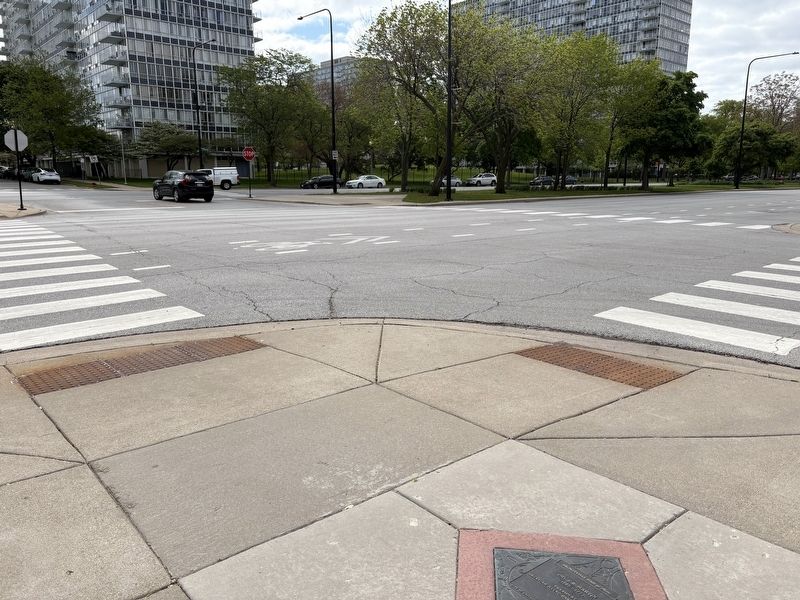
Photographed by Sean P. Flynn, May 13, 2026
2. Dr. J.B. Martin Marker
Martin had come to Chicago in 1937 after acquiring the Chicago American Giants, one of the most famous Negro League teams. The team endured struggles into the 1940s, especially after the integration of Major League Baseball, but stayed active until 1952. In 1946, Martin became the first African American trustee on Cook County's Sanitary District Board. He died in 1973 at age 87.
Also see . . .
1. J.B. Martin. From the Negro Leagues Baseball eMuseum. (Submitted on May 21, 2026, by Sean P. Flynn of Oak Park, Illinois.)
2. Chicago American Giants. This Negro Leagues Baseball Museum webpage is about the Chicago American Giants, who were owned by J.B. Martin from around 1937 until they disbanded in the early 1950s.
Excerpt: "After dropping out of the Negro National League to play as an independent team in 1936, the American Giants prospered again under new ownership as Dr. J.B. Martin took control of the team, and the American Giants became a charter member of the Negro American League in 1937. Although the franchise encountered many difficulties during the 1940s, the ballclub remained in the league even after it had ceased to be of major-league caliber."(Submitted on May 21, 2026, by Sean P. Flynn of Oak Park, Illinois.)
Credits. This page was last revised on May 21, 2026. It was originally submitted on May 20, 2026, by Sean P. Flynn of Oak Park, Illinois. This page has been viewed 19 times since then. Photos: 1, 2. submitted on May 20, 2026, by Sean P. Flynn of Oak Park, Illinois.
