Manzanar National Historic Site near Independence in Inyo County, California — The American West (Pacific Coastal)
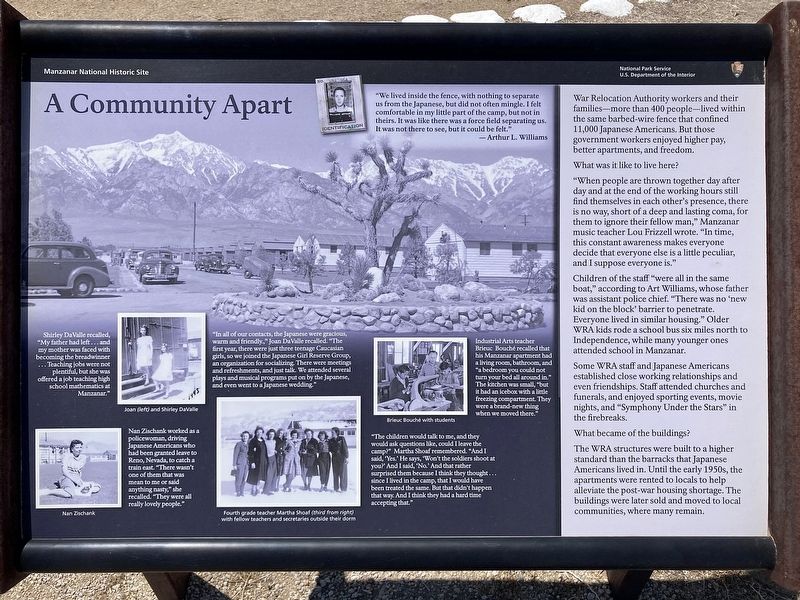
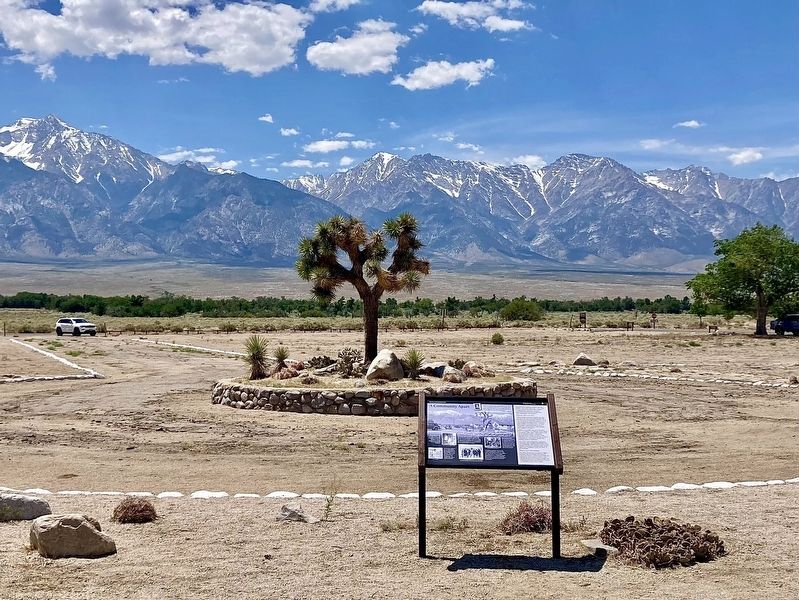
A Community Apart
Manzanar Relocation Center
Photographed by Craig Baker, May 13, 2026
1. A Community Apart Marker
War Relocation Authority workers and their families - more than 400 people - lived within the same barbed-wire fence that confined 11,000 Japanese Americans. But those government workers enjoyed higher pay, better apartments, and freedom.
What was it like to live here?
"When people are thrown together day after day and at the end of the working hours still find themselves in each other's presence, there is no way, short of a deep and lasting coma, for them to ignore their fellow man," Manzanar music teacher Lou Frizzell wrote. "In time, this constant awareness makes everyone decide that everyone else is a little peculiar, and I suppose everyone is."
Children of the staff "were all in the same boat," according to Art Williams, whose father was assistant police chief. "There was no 'new kid on the block' barrier to penetrate. Everyone lived in similar housing." Older WRA kids rode a school bus six miles north to Independence, while many younger ones attended school in Manzanar.
Some WRA staff and Japanese Americans established close working relationships and even friendships.
this page online
What became of the buildings?
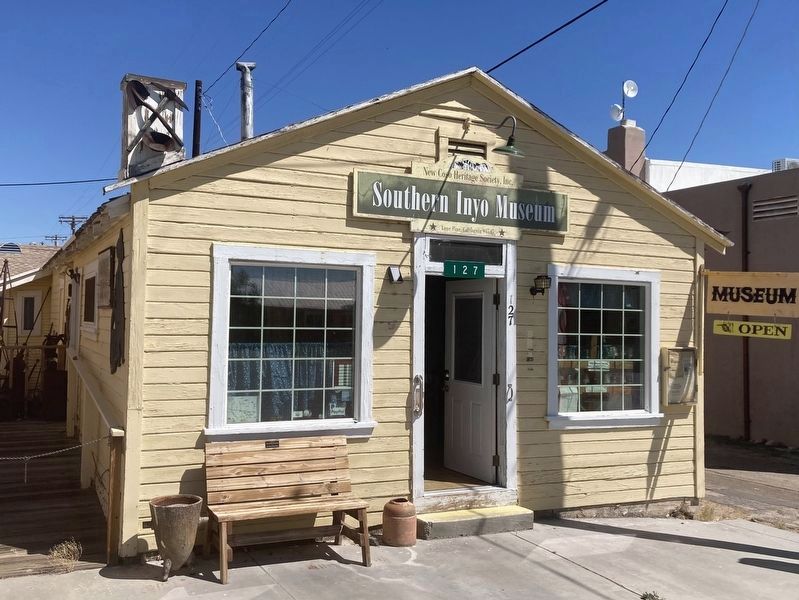
The WRA structures were built to a higher standard than the barracks that Japanese Americans lived in. Until the early 1950s, the apartments were rented to locals to help alleviate the post-war housing shortage. The buildings were later sold and moved to local communities, where many remain.
Shirley DaValle recalled, "My father had left... and my mother was faced with becoming the breadwinner... Teaching jobs were not plentiful, but she was offered a job teaching high school mathematics at Manzanar."
Nan Zischank worked as a policewoman, driving Japanese Americans who had been granted leave to Reno, Nevada, to catch a train east. "There wasn't one of them that was mean to me or said anything nasty," recalled. "They were all really lovely people."
"In all of our contacts, the Japanese were gracious, warm and friendly," Joan DaValle recalled. "The first year, there were just three teenage Caucasian girls, so we joined
Photographed by Craig Baker, May 13, 2026
2. A Community Apart Marker
Industrial Arts teacher Brieuc Bouché recalled that his Manzanar apartment had a living room, bathroom, and "a bedroom you could not turn your bed all around in." The kitchen was small, "but it had an icebox with a little freezing compartment. They were a brand-new thing when we moved there."
"The children would talk to me, and they would ask questions like, could I leave the camp?" Martha Shoaf remembered. "And I said, 'Yes.' He says, 'Won't the soldiers shoot at you?' And I said, 'No' And that rather surprised them because I think they thought... since I lived in the camp, that I would have been treated the same. But that didn't happen that way. And I think they had a hard time accepting that."
"We lived inside the fence, with nothing to separate us from the Japanese, but did not often mingle. I felt comfortable in my little part of the camp, but not in theirs.
Photographed by Craig Baker, May 13, 2026
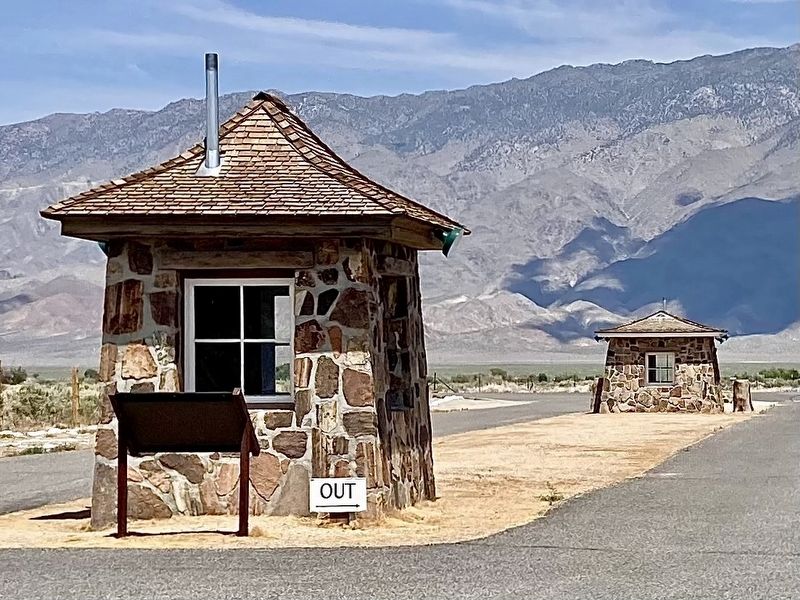
3. Nearby Sentry Buildings
-Arthur L. Williams
Erected by National Park Service.
Topics. This historical marker is listed in these topic lists: Asian Americans • War, World II.
Location. 36° 43.505′ N, 118° 8.746′ W. Marker is near Independence, California, in Inyo County. It is in Manzanar National Historic Site. It can be reached from Manzanar Reward Road west of U.S. 395. Touch for map. Marker is at or near this postal address: 5001 US-395, Independence CA 93526, United States of America. Touch for directions.

Regionally, this marker is in the Sierra Nevada. It is also in the American Mountain West. Globally, it is in North America, on the Ring of Fire, on the Pacific Rim, in the Western Hemisphere, in the Western World, and in the Anglosphere. Historically, it finds itself in what was once New Spain and also Mexico’s Alta California.
Other nearby markers. At least 8 other markers are within walking distance of this marker: Managing Manzanar (within shouting distance of this marker);
Photographed by Craig Baker, May 14, 2026
4. Southern Inyo Museum
Former Manzanar building, relocated to Lone Pine.
Credits. This page was last revised on May 21, 2026. It was originally submitted on May 20, 2026, by Craig Baker of Sylmar, California. This page has been viewed 28 times since then. Photos: 1, 2, 3, 4. submitted on May 20, 2026, by Craig Baker of Sylmar, California.
