Windsor in Essex County, Ontario — Central Canada (North America)
River Canard Bridge
⎯⎯⎯
Pont de la Rivière aux Canards

Photographed by Tim Boyd, May 15, 2026
1. River Canard Bridge/Pont de la Rivière aux Canards Marker

River Canard Bridge
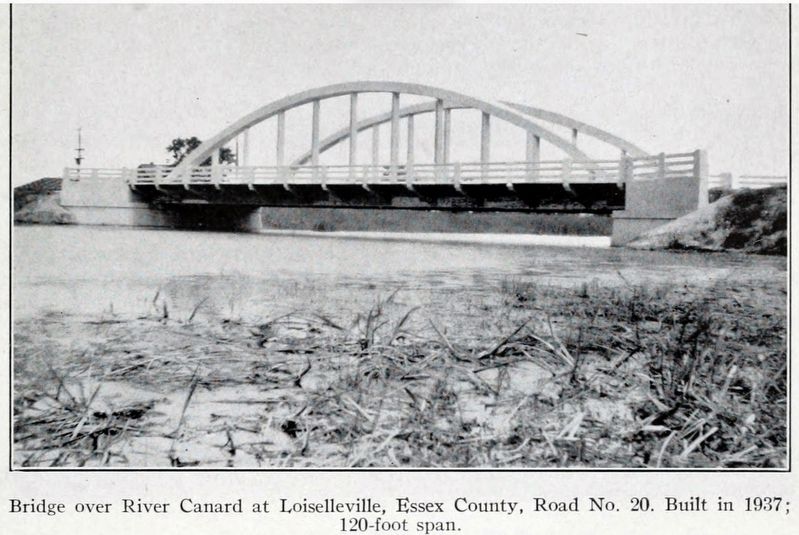
Built in 1937 as part of the Ontario government's Depression-era public works program, the construction of this bridge was funded jointly by the Province and Essex County and provided essential unemployment relief. A significant crossing point on the River Canard since the 18th century, the bridge links the Amherstburg and LaSalle communities. The increase of motorized vehicle traffic necessitated stronger transportation infrastructure and this reinforced concrete bowstring or tied-arch bridge replaced previous wood and steel truss bridges that came before it. The bridge is an example of early 20th-century concrete engineering in Ontario. The design combined structural efficiency and aesthetic appeal, and it quickly became the pride of the community. Measuring 36.3 metres long (119 feet) an 7.32 metres wide (24 feet), its defining features include a single-spanned parabolic arch with 11 vertical concrete hangers per side, concrete balustrade railings and a cantilever sidewalk. This bridge and the neighbouring St. Joseph Roman Catholic Church are connected landmarks of the historical hamlet
this page online
Lancée en 1937 sur financement de la province et du comté d'Essex, la construction du pont actuel est menée dans le cadre du programme de travaux publics mis en œuvre par le gouvernement de l'Ontario pendant la Grande Dépression. Elle jouera un rôle essentiel dans la lutte contre le chômage. Reliant Amherstburg à LaSalle, le pont est un point de franchissement stratégique de la rivière aux Canards depuis le 18e siècle. Mais l'essor de l'automobile impose de consolider les infrastructures de transport. Succédant aux ponts en treillis de bois puis d'acier qui se tenaient autrefois en cet endroit, le nouveau pont, à poutres bow-string ou pont en are avec tirant est réalisé en béton armé et illustre le savoir-faire dont l'Ontario fait preuve dans la maîtrise de ce matériau au début du 20e siècle. Alliant efficience structurelle et exigence esthétique, l'ouvrage suscite d'emblée la fierté de

Photographed by Tim Boyd, May 15, 2026
2. River Canard Bridge/Pont de la Rivière aux Canards Marker
Facing south
Erected 2025 by Ontario Heritage Trust.
Topics. This historical marker is listed in this topic list: Bridges & Viaducts. A significant historical year for this entry is 1937.
Location. 42° 11.219′ N, 83° 4.264′ W. Marker is in Windsor, Ontario, in Essex County. It is at the intersection of Townline Road and Malden Road, on the right when traveling south on Townline Road. Touch for map. Marker is at or near this postal address: 9350 Malden

Photographed by Tim Boyd, May 15, 2026
3. River Canard from the Bridge, 2026

Regionally, this marker is in the Southwest Ontario Area and in Southwestern Ontario. It is also in Central Canada. Globally, it is in North America, on the Great Lakes, in the Western Hemisphere, in the Western World, and in the Anglosphere. Historically, it finds itself in what was once a British colony, the Viceroyalty of New France, the Haudenosaunee (Iroquois) Confederacy, and Rupert’s Land.
Other nearby markers. At least 8 other markers are within 6 kilometers of this marker, measured as the crow flies: A different marker also named River Canard Bridge / Pont de la Rivière aux Canards (about 90 meters away, measured in a direct line); Skirmishes at the Canard River / Escarmouches près de la Rivière Canard (approx. 3 kilometers away); The Wyandot (approx. 5.9 kilometers away); Fighting Island 1838 (approx. 6.3 kilometers away); Eighteenth-Century Grist Mill Site (approx. 6.4 kilometers away in the U.S.); Mansion House and Survey Tree (approx. 6.5 kilometers away in the U.S.); The Freedom Tree (approx. 6.6 kilometers away in the U.S.); America's First Bessemer Steel Mill
May 21, 2026
4. The new River Canard Bridge in 1937
Source: Government of Ontario (public domain)
More about this marker. The is an identical marker at the south end of the bridge
Credits. This page was last revised on May 21, 2026. It was originally submitted on May 21, 2026, by Tim Boyd of Hamilton, Ontario. This page has been viewed 16 times since then. Photos: 1, 2, 3, 4. submitted on May 21, 2026, by Tim Boyd of Hamilton, Ontario. • Andrew Ruppenstein was the editor who published this page.
