Halfweg in Haarlemmermeer, North Holland, Netherlands — Northwestern Europe
19th Century Section of the Sugar Factory
| — | Gemeentelijk Monument | — |
Photographed by Andrew Ruppenstein, March 18, 2025
1. 19th Century Section of the Sugar Factory Marker

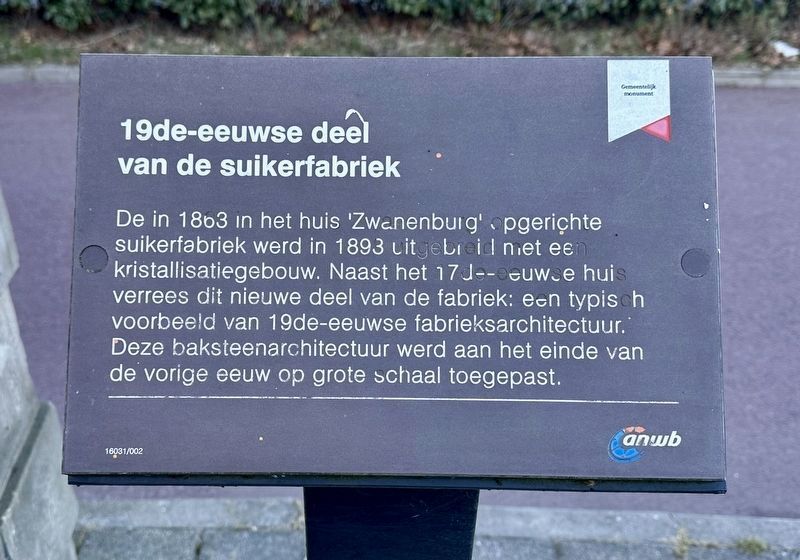
De in 1863 in het huis 'Zwanenburg' opgerichte suikerfabriek werd in 1893 uitgebreid met een kristallisatiegebouw. Naast het 17de-eeuwse huis verrees dit nieuwe deel van de fabriek: een typisch voorbeeld van 19de-eeuwse fabrieksarchitectuur. Deze baksteenarchitectuur werd aan het einde van de vorige eeuw op grote schaal toegepast.
The 19th-Century Section of the Sugar Factory
The sugar factory, established in 1863 within the 'Zwanenburg' house, was expanded in 1893 with the addition of a crystallization building. This new section of the factory—a quintessential example of 19th-century industrial architecture—was erected alongside the 17th-century house. This style of brick architecture was widely employed during the late 19th century.
Erected by the ANWB. (Marker Number 16031/002.)
Topics. This historical marker is listed in these topic lists: Architecture • Industry & Commerce. A significant historical year for this entry is 1863.
Location. 52° 23.125′ N, 4° 44.862′ E. Marker is in Halfweg, Noord-Holland (North Holland), in Haarlemmermeer.
this page online

Regionally, it is in Europe, the European Union, Atlantic Europe, the Benelux Low Countries, the Schengen Area, Western Europe, and the Western World. Historically, it finds itself in what was once the Holy Roman Empire.
Other nearby markers. At least 8 other markers are within walking distance of this marker: Haarlemmerstraatweg 15-31 (about 150 meters away, measured in a direct line); Sluizen, Sluiseiland en Spoorbrug / Sluices and Railway Bridge (about 180 meters away); Huis ter Hart (about 210 meters away); IJsteeg / Ij Alley (approx. 0.3 kilometers away); Stoomgemaal Halfweg / Halfweg Steam Pumping Station (approx. 0.3 kilometers away); Raadhuis / Town Hall (approx. 0.3 kilometers away); Voormalige Tuinderswoning / Former Gardener's House (approx. 0.4 kilometers away); Vaart / Haarlem canal and towpath (approx. half a kilometer away). Touch for a list and map of all markers in Halfweg.
Also see . . . Suikerfabriek (Historisch Halfweg, in Dutch).
Photographed by Andrew Ruppenstein, March 18, 2025
2. 19th Century Section of the Sugar Factory Marker - wide view
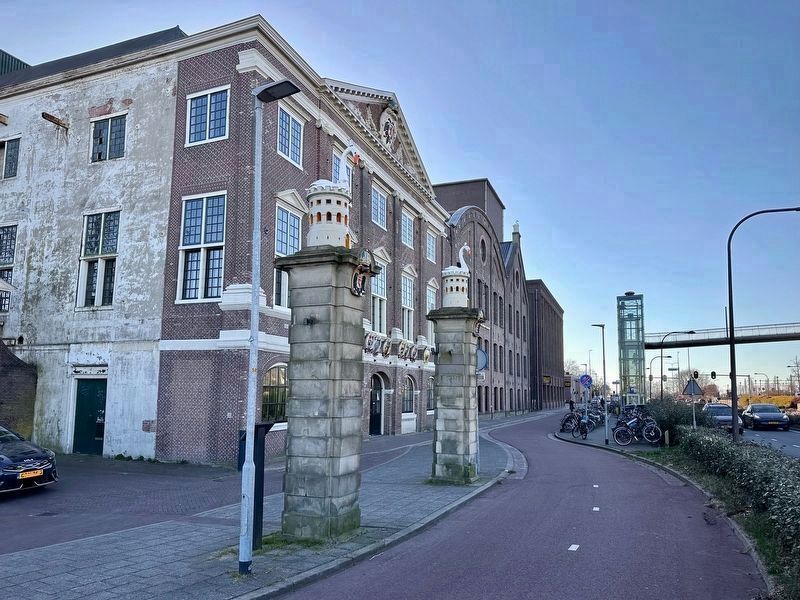
The marker stand is visible here directly behind the light pole. The building closer to the viewer (framed by the swan-pillars) is the former water board administration building, which later did house some of the factory’s offices. The actual factory buildings are visible further down.
…The complex possesses a distinctive character, due in particular to the combination of a seventeenth-century office building and nineteenth-century factory architecture.(Submitted on May 21, 2026.)
The sugar silos, built in 1964, are visible from afar and serve as prominent landmarks in the landscape—especially following the metamorphosis they have undergone. Diamond-shaped windows have been installed in their walls and clad in aluminum; at night, they are illuminated.
Hundreds of people have worked at the factory. Beet processing took place for only a brief period each year, from September to December. Initially, children also worked at the factory. A large workforce was required to unload the sugar beets, load the limestone kilns, and transport the sugar.
Until 1970, many people from Brabant traveled to Halfweg every year to work. They lived and ate on the factory grounds. After 1961, the beets were unloaded from the trucks using water cannons. The transport of the sugar itself also became gradually automated.
In 1992, sugar production came to an end.
Credits. This page was last revised on May 21, 2026. It was originally submitted on May 21, 2026, by Andrew Ruppenstein of Lamorinda, California. This page has been viewed 8 times since then. Photos: 1, 2. submitted on May 21, 2026, by Andrew Ruppenstein of Lamorinda, California.
