Dayton in Lyon County, Nevada — The American Mountains (Southwest)
The Mill
| — | Sutro Tunnel Historical Site | — |
Friends of the Sutro Tunnel, May 21, 2026
1. The Mill
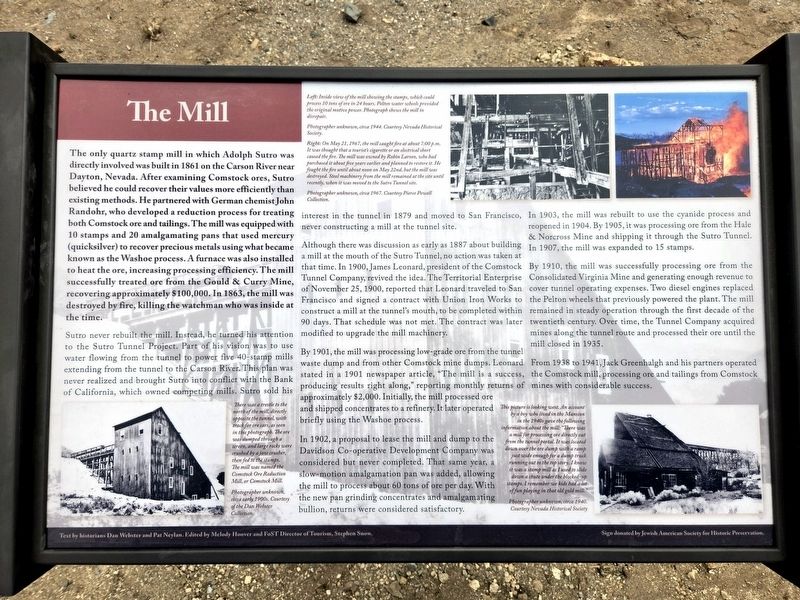
The only quartz stamp mill in which Adolph Sutro was directly involved was built in 1861 on the Carson River near Dayton, Nevada. After examining Comstock ores, Sutro believed he could recover their values more efficiently than existing methods. He partnered with German chemist John Randohr, who developed a reduction process for treating both Comstock ore and tailings. The mill was equipped with 10 stamps and 20 amalgamating pans that used mercury (quicksilver) to recover precious metals using what became known as the Washoe process. A furnace was also installed to heat the ore, increasing processing efficiency. The mill successfully treated ore from the Gould & Curry Mine, recovering approximately $100,000. In 1863, the mill was destroyed by fire, killing the watchman who was inside at the time.
Sutro never rebuilt the mill. Instead, he turned his attention to the Sutro Tunnel Project. Part of his vision was to use water flowing from the tunnel to power five 40-stamp mills extending from the tunnel to the Carson River. This plan was never realized and brought Sutro into conflict with the Bank of California,
this page online
Although there was discussion as early as 1887 about building a mill at the mouth of the Sutro Tunnel, no action was taken at that time. In 1900, James Leonard, president of the Comstock president of the Comstock Tunnel Company, revived the idea. The Territorial Enterprise of November 25, 1900, reported that Leonard traveled to San Francisco and signed a contract with Union Iron Works to construct a mill at the tunnel's mouth, to be completed within 90 days. That schedule was not met. The contract was later modified to upgrade the mill machinery.
By 1901, the mill was processing low-grade ore from the tunnel waste dump and from other Comstock mine dumps. Leonard stated in a 1901 newspaper article, "The mill is a success, producing results right along," reporting monthly returns of approximately $2,000. Initially, the mill processed ore and shipped concentrates to a refinery. It later operated briefly using the

Photographed by Jerry Klinger
2. The Mill Marker
In 1902, a proposal to lease the mill and dump to the Davidson Co-operative Development Company was considered but never completed. That same year, a slow-motion amalgamation pan was added, allowing the mill to process about 60 tons of ore per day. With the new pan grinding concentrates and amalgamating bullion, returns were considered satisfactory.
In 1903, the mill was rebuilt to use the cyanide process and reopened in 1904. By 1905, it was processing ore from the Hale & Norcross Mine and shipping it through the Sutro Tunnel. In 1907, the mill was expanded to 15 stamps.
By 1910, the mill was successfully processing ore from the Consolidated Virginia Mine and generating enough revenue to cover tunnel operating expenses. Two diesel engines replaced the Pelton wheels that previously powered the plant. The mill remained in steady operation through the first decade of the twentieth century. Over time, the Tunnel Company acquired mines along the tunnel route and processed their ore until the mill closed in 1935.
From 1938 to 1941, Jack Greenhalgh and his partners operated the Comstock mill,

Photographed by Jerry Klinger
3. The Mill Marker
Text by historians Dan Webster and Pat Neylan. Edited by Melody Hoover and FoST Director of Tourism, Stephen Snow.
Sign donated by the Jewish American Society for Historic Preservation
Erected 2026 by Jewish Ameican Society for Historic Preservation.
Topics and series. This historical marker is listed in this topic list: Industry & Commerce. In addition, it is included in the Jewish American Society for Historic Preservation. series list.
Location. 39° 16.787′ N, 119° 34.98′ W. Marker is in Dayton, Nevada, in Lyon County. It is on Sutro Tunnel Road. Marker is approximately 200' SW of the Mule Barn. Touch for map. Marker is in this post office area: Dayton NV 89403, United States of America. Touch for directions.

Regionally, this marker is in the Sierra Nevada and in Greater Reno Area. It is also in the American Mountain West. Globally, it is in North America, the Western Hemisphere, the Western World, and the Anglosphere. Historically, it finds itself in what was once New Spain and also Mexico’s Alta California.
Other nearby markers. At least 8 other markers are within 3 miles of this marker, measured as the crow flies: The Mule Barn (here, next to this marker); The Sutro Tunnel - Machine Shop (within shouting distance of this marker); Sutro: The Town (about 300 feet away, measured in a direct line); Sutro Tunnel (about 400 feet away); The Mansion (about 700 feet away); Sutro (approx. 1.1 miles away); Lifeblood of the Mills (approx. 2.8 miles away); Camels in Dayton (approx. 2.9 miles away). Touch for a list and map of all markers in Dayton.
More about this marker. Marker is in Dayton, Nevada, in Lyon County. It is on Sutro Tunnel Road. Marker is located within the grounds of the Sutro Tunnel restoration. The marker is part of a nine marker historical interpretive series.
Also see . . .
1. Friends of the Sutro Tunnel. Before Adolph Sutro could complete his great work of the Sutro Tunnel he had to first win the hearts, minds and pocket books of the people invested in the Comstock Lode. He knew that a drainage adit would solve all of the problems facing the mines of the Comstock, just as it had been done the world over. His greatest difficulty wasn't convincing the need of such a thing it was to overcome the objections of the bankers that controlled nearly the entirety of the mines. The Sutro Tunnel would cut the banks profits and help the miners. Neither of which William Sharon and William Ralston wanted to happen. (Submitted on May 21, 2026, by Jerry Klinger of Boynton Beach, Florida.)
2. Adolph Sutro (1830–1898). "As Mark Twain wrote years after Sutro’s death in 1898: “Twenty years ago I knew Adolph Sutro well...a fine, manly beautiful character. And I have always found something of Sutro in all the Jews whom I have personally known since. A part of Sutro is sufficient equipment for an average man.” (Submitted on May 21, 2026, by Jerry Klinger of Boynton Beach, Florida.)
3. Adolf Sutro's Tunnel is Restored and Open to the Public 2023 (Youtube, 22:18).
Video:(Submitted on May 21, 2026, by Jerry Klinger of Boynton Beach, Florida.)
Built in 1875, the Adolf Sutro Tunnel was once one of the longest and most famous tunnels in the world that was built to drain the Famous Comstock Lode of water in Virginia City, Nevada. After years of neglect, the tunnel was restored and reopened to the public thanks to the hard work of many volunteers and local organizations.
4. Take a Look Inside a 4-Mile-Long Nevada Tunnel That Protected Silver Miners.
When completed in 1878, the Sutro Tunnel was nothing short of an engineering marvel: Work crews, consisting of immigrants from around the world, had dug and blasted through the terrain and constructed a roughly 17-foot-wide-by-20-foot-tall tunnel. Larger rooms were interspersed throughout the passage, all the way from the mouth of the tunnel near Dayton, Nevada, to the Savage Mine under Virginia City, Nevada. More than 4 million gallons of water flowed daily through wooden flumes, and later metal pipes, while mules pulled carts along tracks, transporting silver ore out of the tunnel. Ventilation shafts spaced throughout provided access to fresh air. The Sutro Tunnel was such a wonder that former President Ulysses S. Grant took a joyride through it in 1879.(Submitted on May 22, 2026, by Jerry Klinger of Boynton Beach, Florida.)
Credits. This page was last revised on September 4, 2026. It was originally submitted on May 21, 2026, by Jerry Klinger of Boynton Beach, Florida. This page has been viewed 51 times since then. Photos: 1, 2. submitted on May 21, 2026, by Jerry Klinger of Boynton Beach, Florida. 3. submitted on August 31, 2026, by Jerry Klinger of Boynton Beach, Florida. • Andrew Ruppenstein was the editor who published this page.
