Dayton in Lyon County, Nevada — The American Mountains (Southwest)
Sutro Tunnel
| — | Sutro Tunnel Historic Site | — |

Photographed by Jerry Klinger
1. Sutro Tunnel Marker
Sutro Tunnel
The concept of a water-drainage tunnel driven into a mountainside was not new, but Adolph Sutro’s vision and tenacity elevated it to an unprecedented scale. After a fire destroyed his Dayton, Nevada, stamp mill in 1863, the Jewish entrepreneur devoted his energy to draining the Comstock Lode and transporting ore to mills more safely and efficiently. The tunnel would also ventilate the lower mine levels, reducing stale air and oppressive heat.
Sutro was hailed as a mining “savior,” but leaders of the Bank of California, including William Sharon and William Ralston, the “Bank Ring”- opposed the project. Despite obstacles, Sutro prevailed.
Work began on October 19, 1869, marked by a ceremonial first pick by Sutro. Initial funding came from the Miners’ Union after the deadly 1869 Yellow Jacket Mine fire. If the tunnel had existed, it could have provided an escape route.
The Sutro Tunnel operated successfully until 1942, when the War Production Board’s Limitation Order L-208, issued during World War II, halted nearly all mining. This order freed resources but devastated mining communities.
Head Engineer:
this page online
Total Length: 3.88 miles reaching the 1640-foot level of the Savage Mine on July 18, 1878. By completion, some mines extended hundreds of feet deeper. To accelerate construction after the invention of pneumatic drills, Sutro ordered five vertical shafts to intersect the tunnel, increasing the number of drilling faces from one to eleven. Three shafts succeeded; two did not.
Necessary Laterals:
North: Over 4,000 feet – South: over 8,000 feet
These laterals connected 24 major producing mines. If all mines were pumped simultaneously, the tunnel could handle 3-4 million gallons of water per 24-hour period.
Lives Lost: Twelve men died during construction - a remarkable safety record for the era.
On April 2, 1879, amid rising waters in the mines, an agreement was signed with 24 operations. The mines loaned funds to Sutro to finish the laterals. The tunnel had 90 days to be ready for drainage. Loans were interest-free, with fees reduced until repayment. Drainage fees dropped to $1 per ton – shocking investors.
To ensure compliance, Sutro constructed
May 20, 2026
2. Sutro Tunnel Marker
Miscellaneous Facts
. In 1889, storms cut off transportation to Virginia City; food and supplies were delivered through the Sutro Tunnel.
. The last ore shipped to the 1900s mill around 1935.
. Water drainage ceased in 1942 following President Roosevelt’s executive order banning precious metal mining.
. In 1959, Senator Alan Bible, initiated a study to build a nuclear linear accelerator inside the tunnel; it was ultimately constructed at Stanford University. Houston Minerals explored reopening the tunnel in the late 1970s and built a water control dam, but abandoned the effort by 1980. Inspired by Sutro’s vision, restoration of the tunnel’s initial sections began in 2023 under Simerson Construction, rekindling public interest in one of the nineteenth century’s most important engineering achievements.
Top two images:
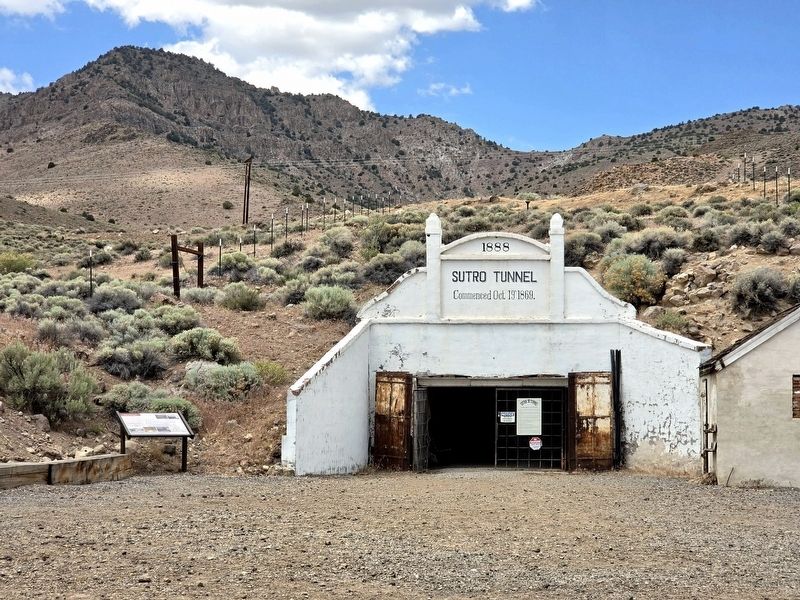
Left: This colorized image from Adolph Sutro’s 1874 lecture depicts workers at the tunnel portal before the façade was constructed.

Friends of the Sutro Tunnel
3. Sutro Tunnel Marker
Photograph by unknown, 1874. Courtesy of Cliff Jennings and the Huntington Library.
Right: A simple portal façade was added in 1888 to improve the tunnel’s appearance. Photograph by unknown, 1870’s, Courtesy of the Dan Webster Collection. Bottom three images, L-R: Portal façade constructed in 1888. Adjacent buildings formerly housed offices, later ice storage, and a “candle house” that supplied candles, lanterns, mule equipment and black powder used during tunnel construction. Before Restoration. Photograph by Julie Michler, 2021. Courtesy of the Julie Michler Collection. In 2023, Simerson Construction reopened a major collapse using innovative safety methods and rebuilt the timber structure in keeping with Sutro’s original design. Shown here, the crew prepares to install the “Turtle,” a protective framework to serve as a safe working canopy during stabilization. Photograph dated 2023. Text by historians Dan Webster and Pat Neylan. Edited by Melody Hoover and FoST Director of Tourism, Stephen Snow. Sign donated by the Jewish American Society for Historic Preservation
Erected 2026 by Jewish American Society for Historic Preservation.
Topics and series. This historical marker is listed in this topic list: Industry & Commerce. In addition, it is included in the Jewish American Society for Historic Preservation. series list. A significant historical date for this entry is October 19, 1869.
Location. 39° 16.801′ N, 119° 35.053′ W. Marker is in Dayton, Nevada, in Lyon County. It can be reached from Sutro Tunnel Road. Marker is in Dayton, Nevada, in Lyon County. It is on Sutro Tunnel Road. Marker is located within the grounds of the Sutro Tunnel restoration. The marker is 40 feet from the Tunnel portico adjacent to the Tunnel facade on the left. Touch for map. Marker is in this post office area: Dayton NV 89403, United States of America. Touch for directions.

Regionally, this marker is in the Sierra Nevada and in Greater Reno Area. It is also in the American Mountain West. Globally, it is in North America, the Western Hemisphere, the Western World, and the Anglosphere. Historically, it finds itself in what was once New Spain and also Mexico’s Alta California.
Other nearby markers. At least 8 other markers are within 3 miles of this marker, measured as the crow flies: The Sutro Tunnel - Machine Shop (within shouting distance of this marker); The Mule Barn (about 400 feet away, measured in a direct line); The Mill (about 400 feet away); Sutro: The Town (about 500 feet away); The Mansion (about 600 feet away); Sutro (approx. 1.1 miles away); Lifeblood of the Mills (approx. 2.8 miles away); Camels in Dayton (approx. 2.9 miles away). Touch for a list and map of all markers in Dayton.
More about this marker. The marker is part of the interpretive marker series of the Historic Sutro Tunnel site.
Also see . . .
1. Friends of the Sutro Tunnel. Before Adolph Sutro could complete his great work of the Sutro Tunnel he had to first win the hearts, minds and pocket books of the people invested in the Comstock Lode. He knew that a drainage adit would solve all of the problems facing the mines of the Comstock, just as it had been done the world over. His greatest difficulty wasn't convincing the need of such a thing it was to overcome the objections of the bankers that controlled nearly the entirety of the mines. The Sutro Tunnel would cut the banks profits and help the miners. Neither of which William Sharon and William Ralston wanted to happen. (Submitted on May 22, 2026, by Jerry Klinger of Boynton Beach, Florida.)
2. Take a Look Inside a 4-Mile-Long Nevada Tunnel That Protected Silver Miners.
When completed in 1878, the Sutro Tunnel was nothing short of an engineering marvel: Work crews, consisting of immigrants from around the world, had dug and blasted through the terrain and constructed a roughly 17-foot-wide-by-20-foot-tall tunnel. Larger rooms were interspersed throughout the passage, all the way from the mouth of the tunnel near Dayton, Nevada, to the Savage Mine under Virginia City, Nevada. More than 4 million gallons of water flowed daily through wooden flumes, and later metal pipes, while mules pulled carts along tracks, transporting silver ore out of the tunnel. Ventilation shafts spaced throughout provided access to fresh air. The Sutro Tunnel was such a wonder that former President Ulysses S. Grant took a joyride through it in 1879.(Submitted on May 22, 2026, by Jerry Klinger of Boynton Beach, Florida.)
3. Adolph Sutro (1830–1898).
As Mark Twain wrote years after Sutro’s death in 1898: “Twenty years ago I knew Adolph Sutro well...a fine, manly beautiful character. And I have always found something of Sutro in all the Jews whom I have personally known since. A part of Sutro is sufficient equipment for an average man.”(Submitted on May 22, 2026, by Jerry Klinger of Boynton Beach, Florida.)
Credits. This page was last revised on September 4, 2026. It was originally submitted on May 22, 2026, by Jerry Klinger of Boynton Beach, Florida. This page has been viewed 48 times since then. Photos: 1, 2. submitted on May 22, 2026, by Jerry Klinger of Boynton Beach, Florida. 3. submitted on August 31, 2026, by Jerry Klinger of Boynton Beach, Florida. • Andrew Ruppenstein was the editor who published this page.
