Conroe in Montgomery County, Texas — The American South (West South Central)
Coahuila y Tejas Flag
1821-1836
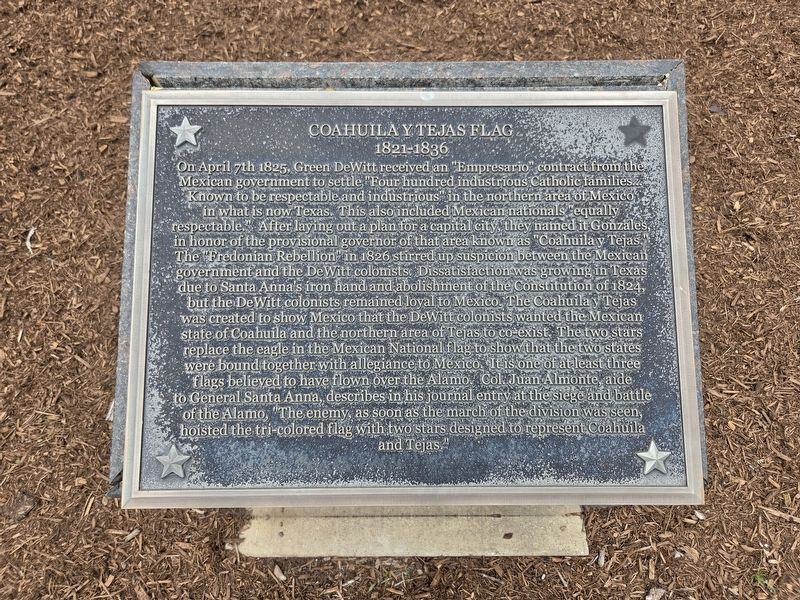
Photographed by James Hulse, May 19, 2026
1. Coahuila y Tejas Flag Marker
On April 7th 1825, Green DeWitt received an "Empresario" contract from the Mexican government to settle "Four hundred industrious Catholic families. Known to be respectable and industrious" in the northern area of Mexico in what is now Texas. This also included Mexican nationals "equally respectable. After laying out a plan for a capital city, they named it Gonzales, in honor of the provisional governor of that area known as "Coahuila y Tejas." The "Fredonian Rebellion" in 1826 stirred up suspicion between the Mexican government and the DeWitt colonists. Dissatisfaction was growing in Texas due to Santa Anna's iron hand and abolishment of the Constitution of 1824, but the DeWitt colonists remained loyal to Mexico. The Coahuila y Tejas was created to show Mexico that the DeWitt colonists wanted the Mexican state of Coahuila and the northern area of Tejas to co-exist. The two stars replace the eagle in the Mexican National flag to show that the two states were bound together with allegiance to Mexico. It is one of at least three flags believed to have flown over the Alamo. Col. Juan Almonte, aide to General Santa Anna, describes in his journal entry at the siege and battle of the Alamo, "The enemy, as soon as the march of the division was seen, hoisted the tri-colored flag with two stars designed to represent Coahuila and Tejas."
Erected 2011 by Friends of the Flag Foundation.
Topics. This historical marker is listed in this topic list: War, Texas Independence. A significant historical date for this entry is April 7, 1825.
Location. 30° 18.64′ N, 95° 28.108′ W. Marker is in Conroe, Texas, in Montgomery County. It is
this page online

Regionally, this marker is in the Houston Metropolitan Area. It is also on the American Gulf Coast. Globally, it is in North America, a Gulf of Mexico state, the Western Hemisphere, the Western World, and the Anglosphere. Historically, it finds itself in what was once New Spain, the Republic of Texas, one of the Confederate States of America, and the Antebellum South.
Other nearby markers. At least 8 other markers are within walking distance of this marker: Texian (here, next to this marker); 1824 Tri-Color Flag (here, next to this marker); Flag of the Texas Navy (here, next to this marker); Alabama Red Rovers (a few steps from this marker); a different marker also named The Texian (a few steps from this marker); Dr. Charles Bellinger Stewart (a few steps from this marker); New Orleans Greys (a few steps from this marker); Gonzales Flag (a few steps from this marker). Touch for a list and map of all markers in Conroe.
Also see . . .
1. The FLAGS:. Texas Flag Park
Represented in the park are 13 significant flags flown during the Texas Revolution as Texas became a sovereign nation. With over 50 to choose from, 13 were selected to symbolize the 13 colonies of Texas at the time and the 13 day siege at the Alamo. Historian Jim Walker worked tirelessly with Stephen Hardin and Stephen Moore, noted Texas authors and historians, in choosing(Submitted on May 23, 2026, by James Hulse of Medina, Texas.)the flags.Photographed by James Hulse2. Coahuila y Tejas Flag and MarkerThe marker is located at the base of the flag.

2. Coahuila y Tejas. Wikipedia
Coahuila y Tejas, officially the Estado Libre y Soberano de Coahuila y Tejas (lit. 'Free and Sovereign State of Coahuila and Texas'), was one of the constituent states of the newly established United Mexican States under its 1824 Constitution.(Submitted on May 23, 2026, by James Hulse of Medina, Texas.)

Photographed by James Hulse, May 19, 2026
3. Coahuila y Tejas Flag Marker
The view of several of the flags with the Texian Statue in the foreground.

Public Domain - Wikipedia Commons
4. Coahuila y Tejas Flag
Credits. This page was last revised on May 23, 2026. It was originally submitted on May 22, 2026, by James Hulse of Medina, Texas. This page has been viewed 24 times since then. Photos: 1, 2, 3, 4. submitted on May 23, 2026, by James Hulse of Medina, Texas.
