Lancaster Historic Neighborhood District in Dallas County, Texas — The American South (West South Central)
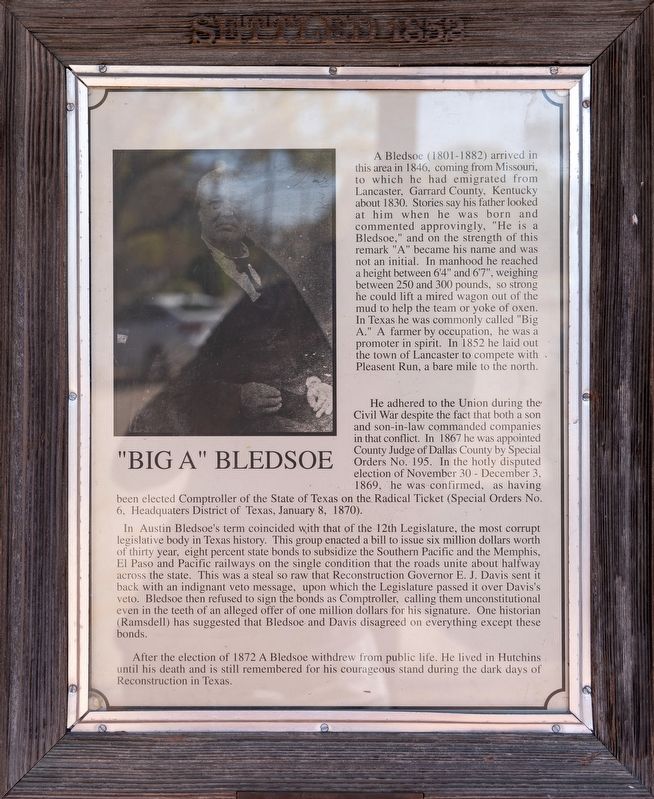
"Big A" Bledsoe
Settled 1852
Photographed by Mansfieldphoto.com, March 22, 2026
1. "Big A" Bledsoe Marker
A Bledsoe (1801-1882) arrived in this area in 1846, coming from Missouri, to which he had emigrated from Lancaster, Garrard County, Kentucky about 1830. Stories say his father looked at him when he was born and commented approvingly, "He is a Bledsoe," and on the strength of this remark "A" became his name and was not an initial. In manhood he reached a height between 6'4" and 6'7", weighing between 250 and 300 pounds, so strong he could lift a mired wagon out of the mud to help the team or yoke of oxen. In Texas he was commonly called "Big A." A farmer by occupation, he was a promoter in spirit. In 1852 he laid out the town of Lancaster to compete with Pleasent Run, a bare mile to the north.
He adhered to the Union during the Civil War despite the fact that both a son and son-in-law commanded companies in that conflict. In 1867 he was appointed County Judge of Dallas County by Special Orders No. 195. In the hotly disputed election of November 30 - December 3, 1869, he was confirmed, as having been elected Comptroller of the State of Texas on the Radical Ticket (Special Orders No. 6. Headquaters District of Texas, January
this page online
In Austin Bledsoe's term coincided with that of the 12th Legislature, the most corrupt legislative body in Texas history. This group enacted a bill to issue six million dollars worth of thirty year, eight percent state bonds to subsidize the Southern Pacific and the Memphis, El Paso and Pacific railways on the single condition that the roads unite about halfway across the state. This was a steal so raw that Reconstruction Governor E. J. Davis sent it back with an indignant veto message, upon which the Legislature passed it over Davis's veto. Bledsoe then refused to sign the bonds as Comptroller, calling them unconstitutional even in the teeth of an alleged offer of one million dollars for his signature. One historian (Ramsdell) has suggested that Bledsoe and Davis disagreed on everything except these bonds.
After the election of 1872 A Bledsoe withdrew from public life. He lived in Hutchins until his death and is still remembered for his courageous stand during the dark days of Reconstruction in Texas.
Topics. This historical marker is listed in this topic list: Settlements & Settlers. A significant historical date for this entry is January 8, 1846.
Location. 32° 35.553′ N,
Photographed by Mansfieldphoto.com, March 22, 2026
2. "Big A" Bledsoe Marker
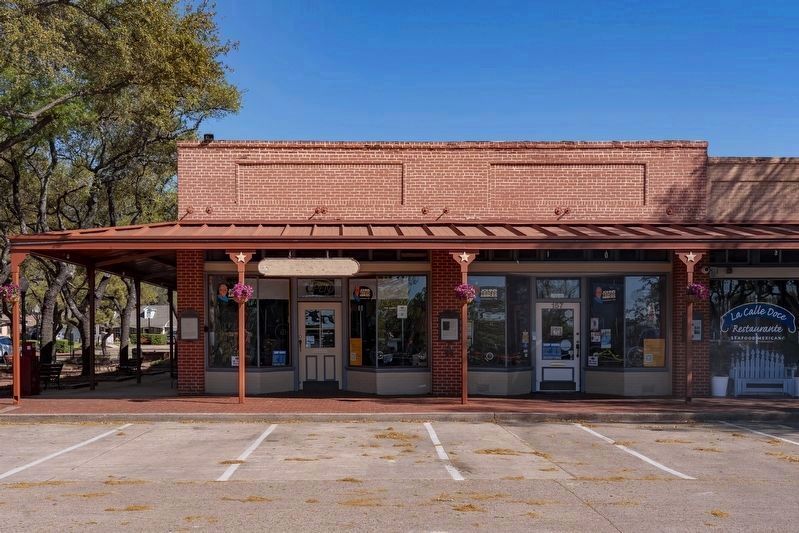
The marker is the middle marker of the building of the 3 markers

Regionally, this marker is in the Prairies & Lakes Region and in the Dallas-Fort Worth Metropolitan Area. Globally, it is in North America, a Gulf of Mexico state, the Western Hemisphere, the Western World, and the Anglosphere. Historically, it finds itself in what was once New Spain, the Republic of Texas, one of the Confederate States of America, and the Antebellum South.
Other nearby markers. At least 8 other markers are within walking distance of this marker: M.M. Miller and Pleasant Run (here, next to this marker); The Town Square (here, next to this marker); Early Churches (a few steps from this marker); Indians (a few steps from this marker); Steel Dust (a few steps from this marker); Disasters (a few steps from this marker); Hardscrabble (a few steps from this marker); Early Growth (within shouting distance of this marker). Touch for a list and map of all markers in Lancaster.
Credits. This page was last revised on May 26, 2026. It was originally submitted on May 24, 2026, by James Hulse of Medina, Texas. This page has been viewed 22 times since then. Photos: 1, 2. submitted on May 26, 2026, by James Hulse of Medina, Texas.
