King's Island in Limerick in County Limerick, Munster, Ireland — Irish South-West ((Éire) North Atlantic Ocean)
The Bishop’s Palace
| — | Medieval Limerick… on King’s Island | — |
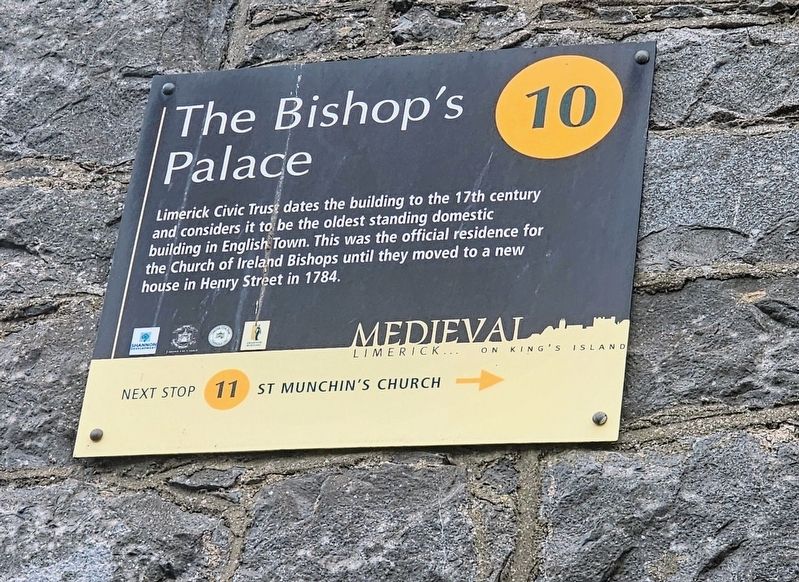
Photographed by Ian Lefkowitz, May 13, 2026
1. The Bishop’s Palace Marker
(Marker Number 10.)
Topics. This historical marker is listed in this topic list: Religion & Religious Structures. A significant historical year for this entry is 1784.
Location. 52° 40.223′ N, 8° 37.509′ W. Marker is in Limerick, Munster, in County Limerick. It is on King's Island. It is at the intersection of Castle Street and Church Street, on the right when traveling west on Castle Street. Touch for map. Marker is at or near this postal address: 9 Castle Street, Limerick, Munster, Ireland. Touch for directions.

Regionally, this marker is in the Ancient East. Globally, it is on the Atlantic Ocean, in the North Atlantic Region, in Europe, on the Island of Ireland, on the Celtic Fringe, in the European Union, in Atlantic Europe, on one of the British Isles, in the Western World, and in the Anglosphere.
Other nearby markers. At least 8 other markers are
this page online
Also see . . . The former Bishop’s Palace, the oldest complete domestic building in Limerick (Patrick Comerford).
This former bishop’s palace is among the earliest examples of a formal classical design in Limerick, and is one of the most important houses in Limerick City. It is the only example in Limerick of Palladian architecture in a domestic building, and it has been attributed to the architect and artist Francis Bindon (1690-1765).(Submitted on May 24, 2026, by Ian Lefkowitz of New York, New York.)
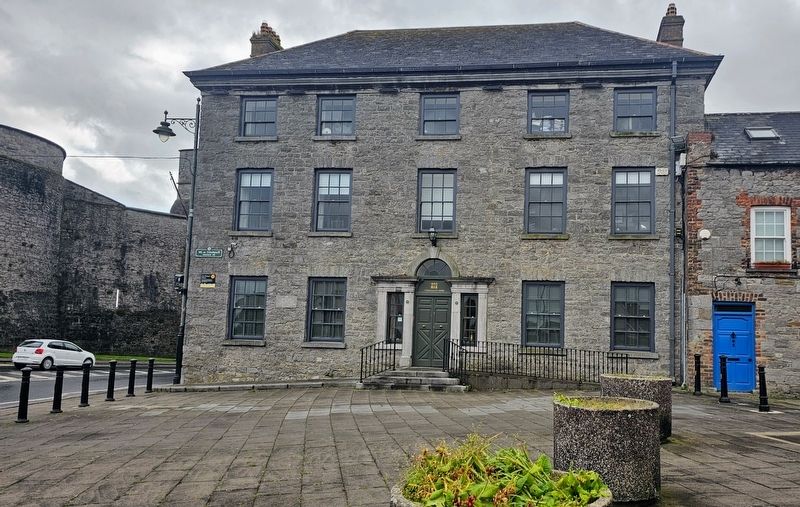
Photographed by Ian Lefkowitz, May 13, 2026
2. The Bishop’s Palace Marker
The marker is located along Church Street, on the corner of the Bishop's Palace.
Credits. This page was last revised on May 27, 2026. It was originally submitted on May 24, 2026, by Ian Lefkowitz of New York, New York. This page has been viewed 8 times since then. Photos: 1, 2. submitted on May 24, 2026, by Ian Lefkowitz of New York, New York. • Andrew Ruppenstein was the editor who published this page.
