King's Island in Limerick in County Limerick, Munster, Ireland — Irish South-West ((Éire) North Atlantic Ocean)
The Bishop's Palace
⎯⎯⎯
Saint Munchin's Church
King's Island
Photographed by Ian Lefkowitz, May 13, 2026
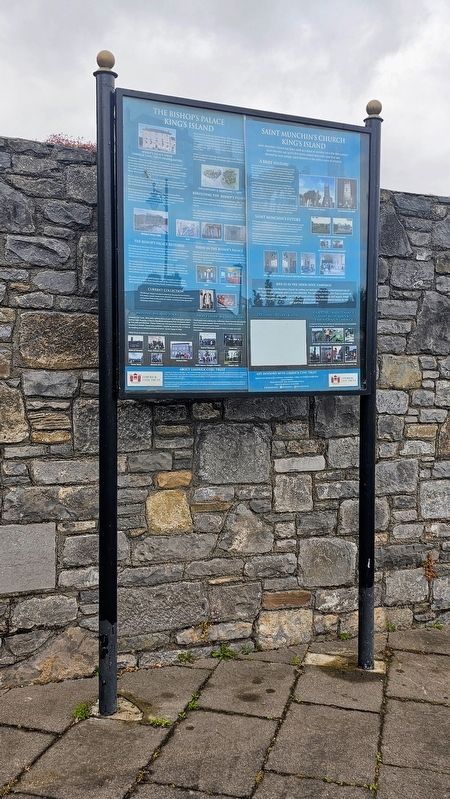
1. The Bishop's Palace / Saint Munchin's Church Marker
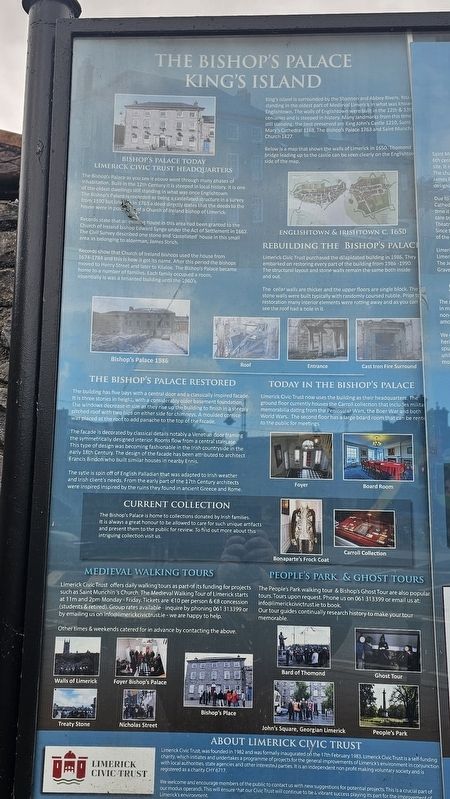
The Bishop’s Palace
King’s Island
King’s Island is surrounded by the Shannon and Abbey Rivers. You are standing in the oldest part of Medieval Limerick in what was known as Englishtown. The walls of Englishtown were built in the 12th & 13th centuries and is steeped in history. Many landmarks from this time are still standing, the best preserved are King John’s Castle 1210, Saint Mary’s Cathedral 1168, The Bishop’s Palace 1763 and Saint Munchin’s Church 1827.
Below is a map that shows the walls of Limerick in 1650. Thomond bridge leading up to the castle can be seen clearly on the Englishtown side of the map.
Bishop’s Palace Today
Limerick Civic Trust Headquarters
The Bishop’s Palace as you see it above went through many phases of inhabitation. Built in the 12th Century it is steeped in local history. It is one of the oldest dwellings still standing in what was once Englishtown. The Bishop’s Palace is recorded as being a castellated structure in a survey from 1590 but later in 1763 a deed directly states that the deeds to the house were in possession of a Church of Ireland bishop of Limerick.
Records state that an existing house in this area had been granted to the Church of Ireland bishop Edward Synge under the Act of Settlement in 1662. The Civil Survey described one stone and ‘castellated’ house in this small area as belonging to alderman, James Strich.
Records show that Church of Ireland bishops used the house from 1674–1784 and this is how it got its name. After this period the bishops moved to Henry Street and later to Kilaloe. The Bishop’s Palace became home to a number of families. Each family occupied a room, essentially it was a tenanted building until the 1960’s.
Englishtown & Irishtown c. 1650
Rebuilding the Bishop’s Palace
Limerick Civic Trust purchased the dilapidated building in 1986. They embarked on restoring
this page online
The cellar walls are thicker and the upper floors are single block. The stone walls were built typically with randomly coursed rubble. Prior to restoration many interior elements were rotting away and as you can see the roof had a hole in it.
The Bishop’s Palace Restored
The building has five bays with a central door and a classically inspired facade. It is three stories in height, with a considerably older basement foundation. The windows decrease in size as they rise up the building to finish in a steeply pitched roof with two hips on either side for chimneys. A moulded cornice was placed at the roof to add panache to the top of the facade.
The facade is decorated by classical details notably a Venetian door framing the symmetrically designed interior. Rooms flow from a central staircase. This type of design was becoming fashionable in the Irish countryside in the early 18th Century. The design of the facade has been attributed to architect Francis Bindon who built similar houses in nearby Ennis.
The sytle is spin off of
Photographed by Ian Lefkowitz, May 13, 2026
2. The Bishop's Palace Panel
Today in the Bishop’s Palace
Limerick Civic Trust now uses the building as their headquarters. The ground floor currently houses the Carroll collection that includes military memorabilia dating from the Peninsular Wars, the Boer War and both World Wars. The second floor has a large board room that can be rented to the public for meetings.
Current Collection
The Bishop’s Palace is home to collections donated by Irish families. It is always a great honour to be allowed to care for such unique artifacts and present them to the public for review. To find out more about this intriguing collection visit us.
Medieval Walking Tours
Limerick Civic Trust offers daily walking tours as part of its funding for projects such as Saint Munchin’s Church. The Medieval Walking Tour of Limerick starts at 11am and 2pm Monday–Friday. Tickets are €10 per person & €8 concession (students & retired). Group rates available — inquire by phoning 061 313399 or by emailing us on [email protected] — we are happy to help.
Other times & weekends catered for in advance by contacting the above.
People’s Park & Ghost Tours
The People’s Park walking tour & Bishop’s Ghost Tour are also popular tours. Tours upon request. Phone us on 061 313399 or email us at: [email protected] to book. Our tour guides continually research history to make your tour memorable.
About Limerick Civic Trust
Limerick Civic Trust, was founded in 1982 and was formally inaugurated on the 17th February 1983. Limerick Civic Trust is a self-funding charity, which initiates and undertakes a programme of projects for the general improvements of Limerick’s environment in conjunction
Photographed by Ian Lefkowitz, May 13, 2026
3. Saint Munchin's Church Panel
We welcome and encourage members of the public to contact us with new suggestions for potential projects. This is a crucial part of our modus operandi. This will ensure that our Civic Trust will continue to be a vibrant success playing its part for the improvement of Limerick’s environment.
Saint Munchin’s Church
King’s Island
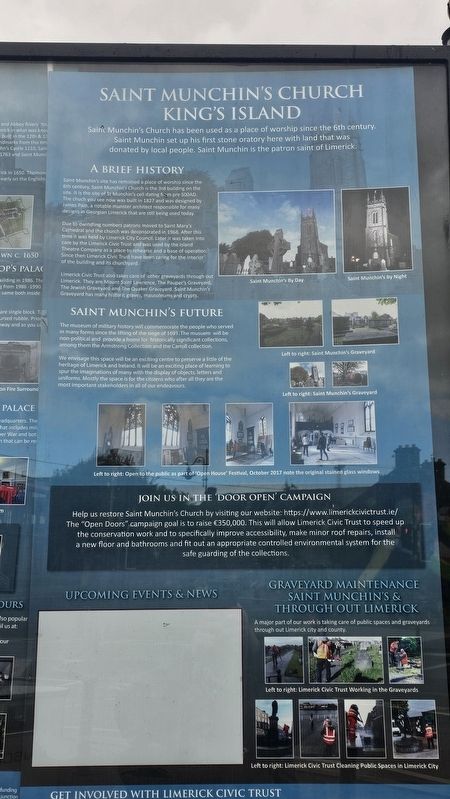
Saint Munchin’s Church has been used as a place of worship since the 6th century. Saint Munchin set up his first stone oratory here with land that was donated by local people. Saint Munchin is the patron saint of Limerick.
A Brief History
Saint Munchin’s site has remained a place of worship since the 6th century. Saint Munchin’s Church is the 3rd building on the site. It is the site of St Munchin’s cell dating from pre 500AD. The church you see now was built in 1827 and was designed by James Pain, a notable munster architect responsible for many designs in Georgian Limerick that are still being used today.
Due to dwindling numbers patrons moved to Saint Mary’s Cathedral and the church was deconsecrated in 1968. After this time it was held by Limerick City Council. Later it was taken into care by the Limerick Civic Trust and was used by the Island Theatre Company as a place to rehearse and a base of operation. Since then Limerick Civic Trust have been caring for the interior of the building and its churchyard.
Limerick Civic Trust also takes care of other graveyards through out Limerick. They are Mount Saint Lawrence, The Pauper’s Graveyard, The Jewish Graveyard and The Quaker Graveyard. Saint Munchin’s Graveyard has many historic graves, mausoleums and crypts.
Saint Munchin’s Future
The museum of military history will commemorate the people
Photographed by Ian Lefkowitz, May 13, 2026
4. The Bishop's Palace / Saint Munchin's Church Marker
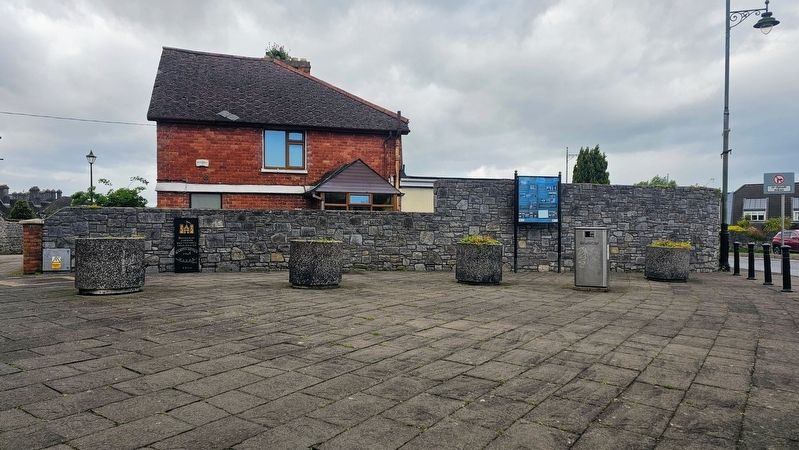
The free-standing marker is located in the plaza in front of the Bishop's Palace.
We envisage this space will be an exciting centre to preserve a little of the heritage of Limerick and Ireland. It will be an exciting place of learning to spur the imaginations of many with the display of objects, letters and uniforms. Mostly the space is for the citizens who after all they are the most important stakeholders in all of our endeavours.
Left to right: Open to the public as part of ‘Open House’ Festival, October 2017 note the original stained glass windows
Join Us in the ‘Door Open’ Campaign
Help us restore Saint Munchin’s Church by visiting our website: https://www.limerickcivictrust.ie/ The “Open Doors” campaign goal is to raise €350,000. This will allow Limerick Civic Trust to speed up the conservation work and to specifically improve accessibility, make minor roof repairs, install a new floor and bathrooms and fit out an appropriate controlled environmental system for the safe guarding of the collections.
Graveyard Maintenance Saint Munchin’s & Through Out Limerick
A major part of our work is taking care of public spaces and graveyards through out Limerick city and county.
Topics. This historical marker is listed in these topic lists: Architecture • Religion & Religious Structures. A significant historical year for this entry is 1763.
Location. 52° 40.233′ N, 8° 37.497′ W. Marker is in Limerick, Munster, in County Limerick. It is on King's Island. It is at the intersection of Church Street and Castle Street, on the left when traveling east on Church Street. Touch for map. Marker is at or near this postal address: 14 Church Street, Limerick, Munster, Ireland. Touch for directions.

Regionally, this marker is in the Ancient East. Globally, it is on the Atlantic Ocean, in the North Atlantic Region, in Europe, on the Island of Ireland, on the Celtic Fringe, in the European Union, in Atlantic Europe, on one of the British Isles, in the Western World, and in the Anglosphere.
Other nearby markers. At least 8 other markers are within walking distance of this marker: Bishops Palace (a few steps from this marker); a different marker also named The Bishop’s Palace (within shouting distance of this marker); a different marker also named The Bishop’s Palace (within shouting distance of this marker); The Bard of Thomond (within shouting distance of this marker); St Munchin’s Church (within shouting distance of this marker); The North Munster Masonic Centre (within shouting distance of this marker); Michael Hogan (within shouting distance of this marker); King John’s Castle (within shouting distance of this marker). Touch for a list and map of all markers in Limerick.
Credits. This page was last revised on May 28, 2026. It was originally submitted on May 24, 2026, by Ian Lefkowitz of New York, New York. This page has been viewed 11 times since then. Photos: 1, 2, 3, 4. submitted on May 24, 2026, by Ian Lefkowitz of New York, New York. • Andrew Ruppenstein was the editor who published this page.
