Englishtown in Limerick in County Limerick, Munster, Ireland — Irish South-West ((Éire) North Atlantic Ocean)
Willow Sculpture
| — | St. Mary’s Cathedral | — |
Photographed by Ian Lefkowitz, May 13, 2026
1. Willow Sculpture Marker
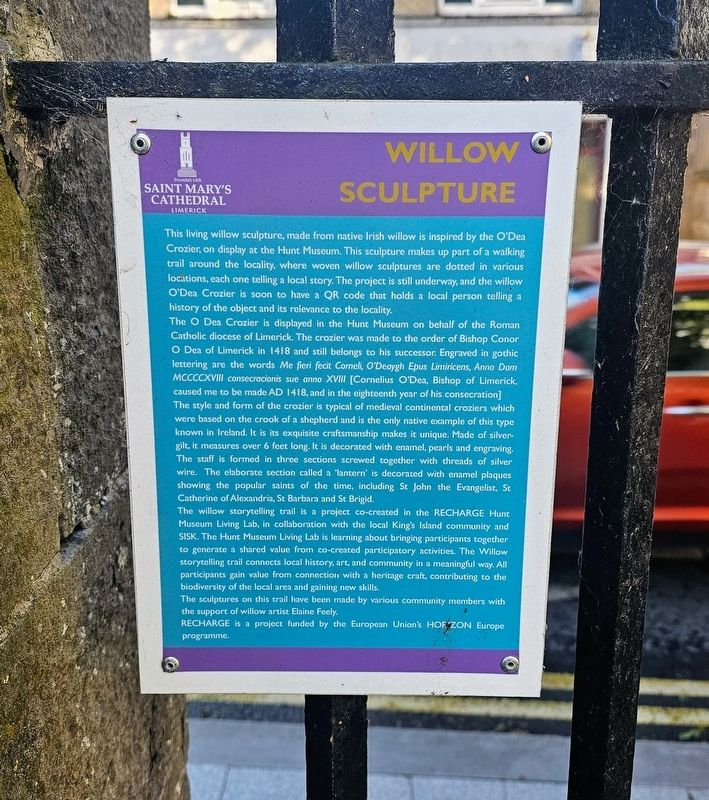
The O’Dea Crozier is displayed in the Hunt Museum on behalf of the Roman Catholic diocese of Limerick. The crozier was made to the order of Bishop Conor O’Dea of Limerick in 1418 and still belongs to his successor. Engraved in gothic lettering are the words Me fieri fecit Corneli, O’Deaygh Epus Limiricens, Anno Dom MCCCCXVIII consecracionis sue anno XVIII [Cornelius O’Dea, Bishop of Limerick, caused me to be made AD 1418, and in the eighteenth year of his consecration] The style and form of the crozier is typical of medieval continental croziers which were based on the crook of a shepherd and is the only native example of this type known in Ireland. It is its exquisite
this page online
The willow storytelling trail is a project co-created in the RECHARGE Hunt Museum Living Lab, in collaboration with the local King’s Island community and SISK. The Hunt Museum Living Lab is learning about bringing participants together to generate a shared value from co-created participatory activities. The Willow storytelling trail connects local history, art, and community in a meaningful way. All participants gain value from connection with a heritage craft, contributing to the biodiversity of the local area and gaining new skills.
The sculptures on this trail have been made by various community members with the support of willow artist Elaine Feely.
RECHARGE is a project funded by the European Union’s HORIZON Europe programme.
Topics.
Photographed by Ian Lefkowitz, May 13, 2026
2. Willow Sculpture
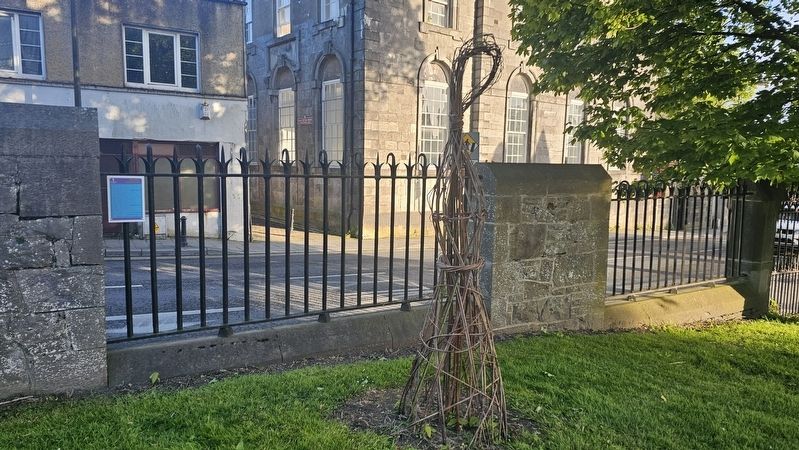
The willow sculpture and marker are both found on the grounds of St. Mary's Cathedral.
Location. 52° 40.065′ N, 8° 37.387′ W. Marker is in Limerick, Munster, in County Limerick. It is in Englishtown. It can be reached from Bridge Street west of Nicholas Street, on the left when traveling east. Touch for map. Marker is at or near this postal address: 9 Bridge Street, Limerick, Munster V94 AKN3, Ireland. Touch for directions.

Regionally, this marker is in the Ancient East. Globally, it is on the Atlantic Ocean, in the North Atlantic Region, in Europe, on the Island of Ireland, on the Celtic Fringe, in the European Union, in Atlantic Europe, on one of the British Isles, in the Western World, and in the Anglosphere.
Other nearby markers. At least 8 other markers are within walking distance of this marker: The Graveyard (a few steps from this marker); Welcome to Saint Mary's Cathedral, Limerick (a few steps from this marker); Old City Court House & Gerald Griffin Memorial School (within shouting distance of this marker); Maidenhair Fern (within
Photographed by Ian Lefkowitz, May 13, 2026
3. O'Dea Crozier
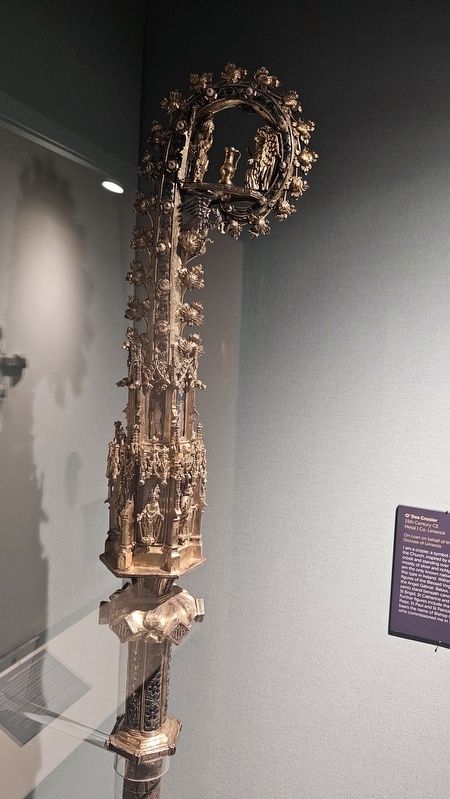
The O'Dea Crozier, on display nearby at the Hunt Museum.
Also see . . . Medieval Crozier (The Hunt Museum).
The O Dea Crozier is on display in the Museum on behalf of the Roman Catholic diocese of Limerick. The crozier was made to the order of Bishop Conor O Dea of Limerick in 1418 and still belongs to his successor. The crozier is of typical medieval continental form based on the crook of a shepherd and is the only native example of this type known in Ireland. It is made up of a staff and the decorated head bearing the crook.(Submitted on May 25, 2026, by Ian Lefkowitz of New York, New York.)
Credits. This page was last revised on May 27, 2026. It was originally submitted on May 25, 2026, by Ian Lefkowitz of New York, New York. This page has been viewed 11 times since then. Photos: 1, 2, 3. submitted on May 25, 2026, by Ian Lefkowitz of New York, New York. • Andrew Ruppenstein was the editor who published this page.
