L'avant-garde artistique au rendez-vous Chez Tranquille
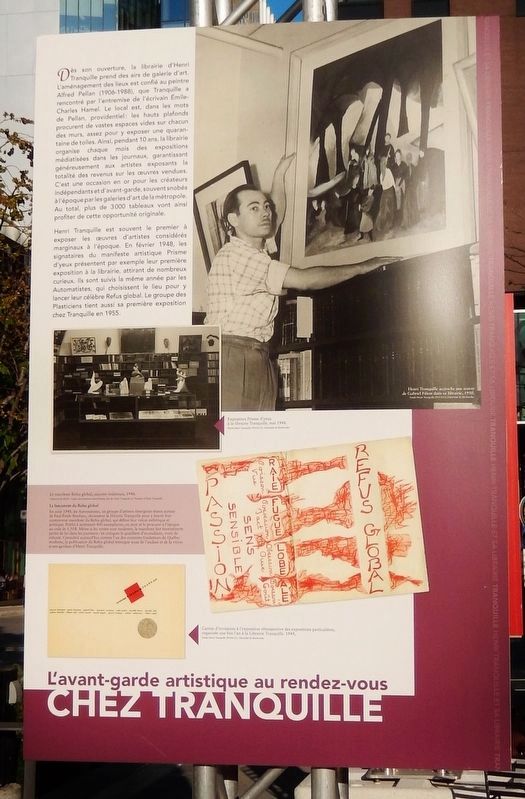

Henri Tranquille est souvent le premier à exposer les œuvres d'artistes considérés marginaux à l'époque. En février 1948, les signataires du manifeste artistique Prisme d'yeux présentent par exemple leur première exposition à la librairie, attirant de nombreux curieux. Ils sont suivis la même année par les Automatistes, qui choisissent le lieu pour y lancer leur célèbre Refus global. Le groupe des Plasticiens tient aussi sa première exposition chez Tranquille en 1955.
[légendes]
• Le manifeste Refus global, jaquette intérieure, 1948.
• Le lancement du Refus global
En août 1948, les Automatistes, un groupe d'artistes émergents réunis autour de Paul-Émile Borduas, choisissent la librairie Tranquille pour y lancer leur controversé manifeste du Refus global, qui définit leur vision esthétique et politique. Publié à seulement 400 exemplaires, on peut se le procurer à l'époque au coût de 1,50 $. Même si les ventes sont modestes, le manifeste fait énormément parler de lui dans les journaux:
this page online
• Carton d'invitation à l'exposition rétrospective des expositions particulières, organisée une fois l'an à la Librairie Tranquille, 1949.
The artistic avant-garde rendezvous at Chez Tranquille
From its opening, Henri Tranquille's bookstore takes on the air of an art gallery. The layout of the space is entrusted to the painter Alfred Pellan (1906-1988), whom Tranquille met through the writer Émile-Charles Hamel. The premises are, in Pellan's words, providential: the high ceilings provide vast empty spaces on each wall, enough to display around forty paintings. Thus, for 10 years, the bookstore organized monthly exhibitions publicized in the newspapers, generously guaranteeing the exhibiting artists the full proceeds from the works sold. It is a golden opportunity for independent and avant-garde creators, often snubbed at the time by the metropolitan art galleries. In total,
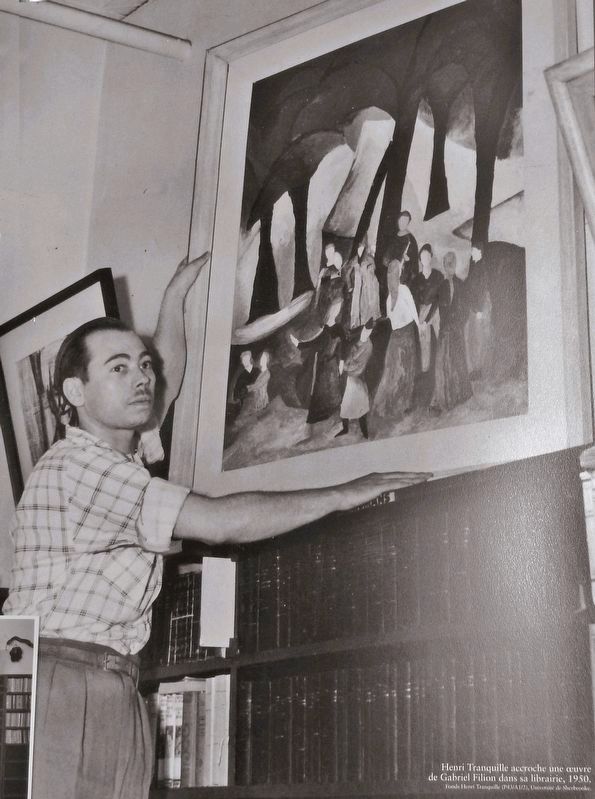
Henri Tranquille is often the first to exhibit the works of artists considered marginal at the time. In February 1948, the signatories of the artistic manifesto Prisme d'yeux, for example, hold their first exhibition at the bookstore, attracting many curious onlookers. They are followed the same year by the Automatists, who choose the venue to launch their famous Refus global. The group of Plasticiens also holds their first exhibition at Tranquille's in 1955.
[captions]
• The Refus global manifesto, inner jacket, 1948.
• The launch of Refus global
In August 1948, the Automatists, a group of emerging artists gathered around Paul-Émile Borduas, chose the Tranquille bookstore to launch their controversial Refus global manifesto, which defined their aesthetic and political vision. Published in only 400 copies, it could be purchased at the time for $1.50. Even though sales were modest, the manifesto generated a lot of discussion in the newspapers: critics called it incendiary, even ridiculous. Today considered one of the founding moments of modern Quebec, the publication

• Invitation card to the retrospective exhibition of private exhibitions, organized once a year at the Librairie Tranquille, 1949.
Topics. This historical marker is listed in this topic list: Arts, Letters, Music. A significant historical year for this entry is 1948.
Location. 45° 30.572′ N, 73° 33.877′ W. Marker is in Montréal, Québec. It is in Quartier des Spectacles. It can be reached from the intersection of Rue Clark and Rue Sainte-Catherine Ouest, on the left when traveling west. The marker is near the northeast corner of Esplanade Tranquille. Touch for map. Marker is at or near this postal address: 1442 Rue Clark, Montréal QC H2X 2R3, Canada. Touch for directions.

Regionally, this marker is in Central Canada. Globally, it is in North America, the Western Hemisphere, and the Western World. Historically, it finds itself in what was once a British colony, the Viceroyalty of New France, the Haudenosaunee (Iroquois) Confederacy, and Rupert’s Land.
Other nearby markers. At least 8 other markers are within walking distance of
Related markers. Click here for a list of markers that are related to this marker. Esplanade Tranquille
Also see . . . Refus Global (Wikipedia).
Excerpt: Le Refus global (English: Total Refusal) was an anti-establishment and anti-religious manifesto released on August 9, 1948, in Montreal by a group of sixteen young Québécois artists and intellectuals that included Paul-Émile Borduas, Jean-Paul Riopelle and Françoise Sullivan. Le Refus Global originated from a group called Les Automatistes, led by Paul-Émile Borduas. This group created abstract paintings inspired by French surrealists of the time and scorned all academic teaching available at the time in Quebec.(Submitted on May 28, 2026, by Cosmos Mariner of Cape Canaveral, Florida.)Le Refus Global was a manifesto that completely rejected the social, artistic and psychological norms and values of Québécois society at the time. Calling for "an untamed need for liberation," the manifesto cried out for "resplendent anarchy" and criticized the "cassocks that have remained the sole repositories of faith, knowledge, truth, and national wealth." Of the 400 published copies of Le Refus Global, selling for a dollar apiece, only about half of them were sold. Notwithstanding, this manifesto caused an uproar, and because of this manifesto, Borduas lost his job at the École du Meuble de Montréal. Later, the manifesto was translated into different languages and was read in America and Europe. It has been said by commentators that from the publication of this manifesto, "modern French Canada began", while CBC calls it "one of the most important and controversial artistic and social documents in modern Quebec society".
Credits. This page was last revised on May 28, 2026. It was originally submitted on May 26, 2026, by Cosmos Mariner of Cape Canaveral, Florida. This page has been viewed 18 times since then. Photos: 1, 2, 3, 4. submitted on May 28, 2026, by Cosmos Mariner of Cape Canaveral, Florida.
