Golden Square Mile in Montréal, Québec — Central Canada (French-Canadian)
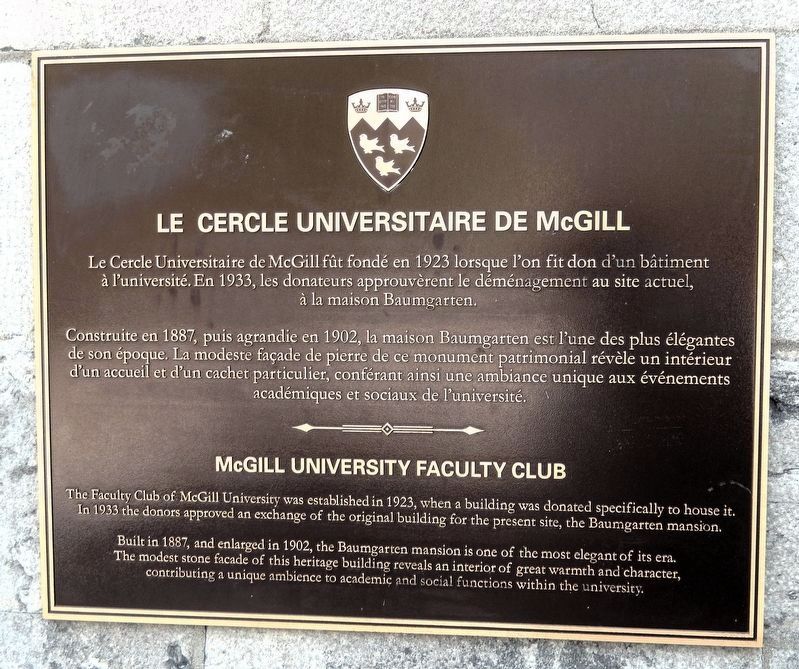
Le Cercle Universitaire de McGill
⎯⎯⎯
McGill University Faculty Club
Photographed by Cosmos Mariner, May 22, 2024
1. Le Cercle Universitaire de McGill / McGill University Faculty Club Marker

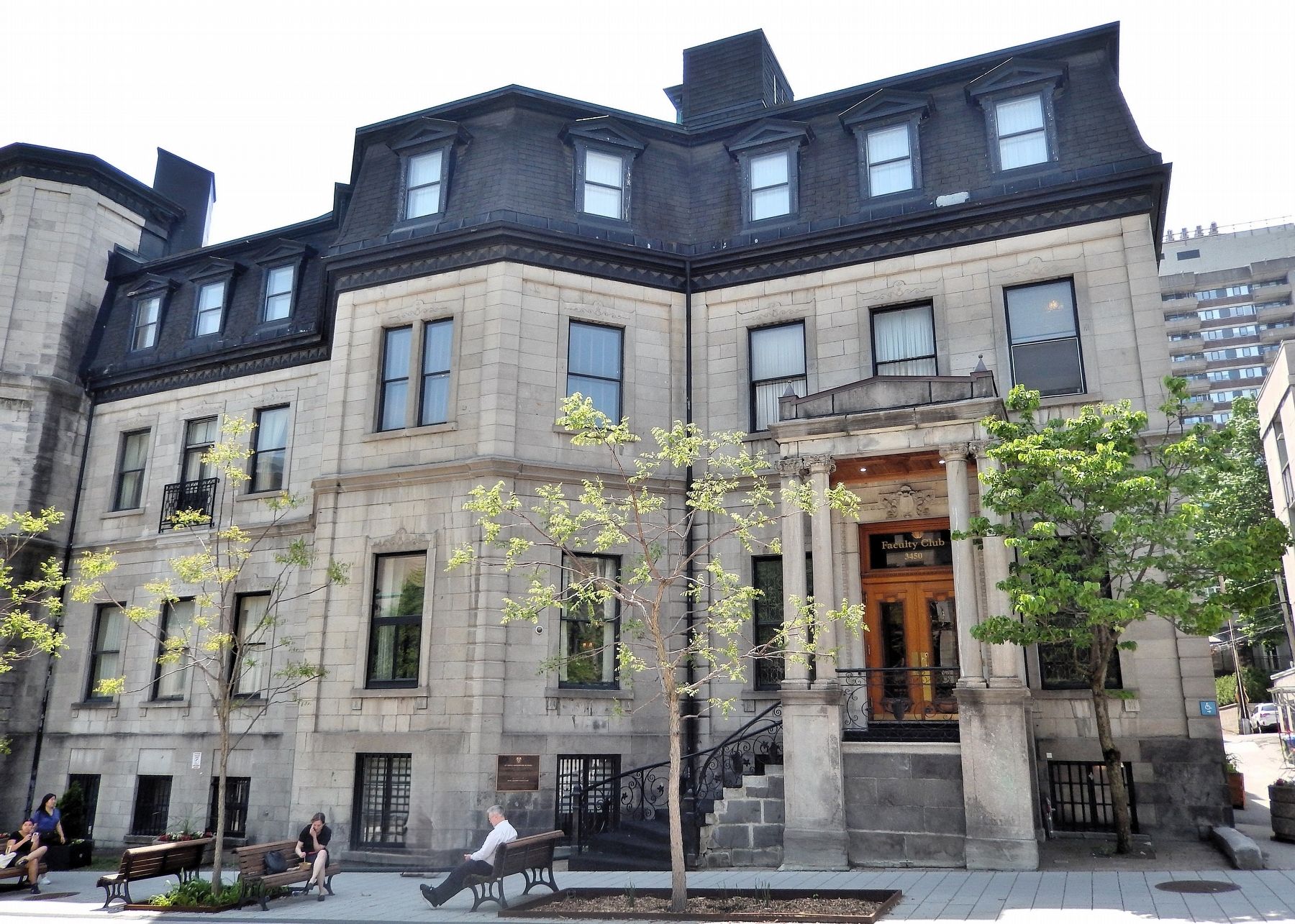
Construite en 1887, puis agrandie en 1902, la maison Baumgarten est l'une des plus élégantes de son époque. La modeste façade de pierre de ce monument patrimonial révèle un intérieur d'un accueil et d'un cachet particulier, conférant ainsi une ambiance unique aux événements académiques et sociaux de l'université.
Built in 1887, and enlarged in 1902, the Baumgarten mansion is one of the most elegant of its era. The modest stone facade of this heritage building reveals an interior of great warmth and character, contributing a unique ambience to academic and social functions within the university.
Topics. This historical marker is listed in these topic lists: Architecture • Education •
this page online
Location. 45° 30.198′ N, 73° 34.637′ W. Marker is in Montréal, Québec. It is in Golden Square Mile. It is on Rue McTavish just north of Rue Sherbrooke Ouest (Québec Route 138), on the left when traveling north. The marker is mounted on the front facade of the subject building. Touch for map. Marker is at or near this postal address: 3450 Rue McTavish, Montréal QC H3A 1X9, Canada. Touch for directions.

Regionally, this marker is in Central Canada. Globally, it is in North America, the Western Hemisphere, and the Western World. Historically, it finds itself in what was once a British colony, the Viceroyalty of New France, the Haudenosaunee (Iroquois) Confederacy, and Rupert’s Land.
Other nearby markers. At least 8 other markers are within walking distance of this marker: École Polytechnique Massacre (within shouting distance of this marker); Frank Dawson Adams (about 120 meters away, measured in a direct line); Hochelaga (about 180 meters away); Le Maxwelton (1912) devient le Château Nasso (1984) / The Maxwelton (1912) — Château Nasso (1984)
Photographed by Cosmos Mariner, May 22, 2024
2. Le Cercle Universitaire de McGill / McGill University Faculty Club Marker
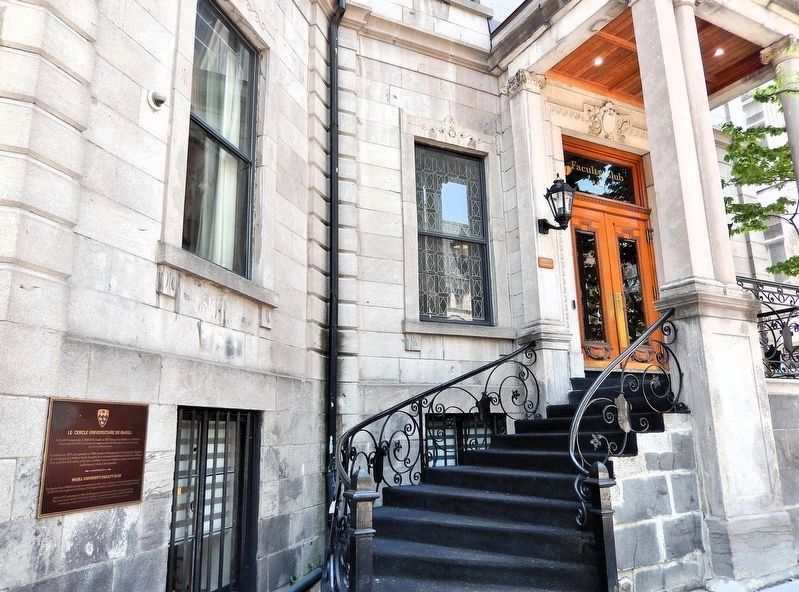
The marker is mounted on the left side of the front entrance.
Also see . . .
1. History of the Club (McGill University Faculty Club).
Excerpt: The Faculty Club was established in 1923 with the assistance of the Board of Governors. Its first premises were located on University Street and several of the academic staff became members.(Submitted on May 28, 2026, by Cosmos Mariner of Cape Canaveral, Florida.)In 1935 the club moved to its present location in the Baumgarten House on McTavish Street, former home of Sir Arthur Currie. At this time, membership was expanded to include women. Until the 1960s, a few of the male staff members lived in the Club. In the 1970's, many non-academic staff became eligible for membership.
2. Baron Alfred Baumgarten and the Home he Built (McGill University Faculty Club).
Excerpt: In 1886, Baron(Submitted on May 28, 2026, by Cosmos Mariner of Cape Canaveral, Florida.)Alfred Baumgarten, a wealthy German sugar tycoon who generously donated to Montreal museums and hospitals and who loved horses and the hunt, designed a house for his family on McTavish Street. One of the outstanding features of this abode was the ballroom, built for Baumgarten’s daughters who had just come of age. The ceiling, from which hung several chandeliers, was supported by marble columns, the floor was built on springs to help boost the dancers' feet, and a minstrel's gallery at one end was suspended from the ceiling with brass cords. The Gothic Gallery, which spanned two stories of the house, was made to resemble a German hunting lodge and was covered by an immense, amber-coloured, stained-glass skylight.Photographed by Cosmos Mariner, May 22, 20243. Le Cercle Universitaire de McGill / McGill University Faculty ClubAfter Baron Alfred Baumgarten's death in 1919, the house was occupied by his family. McGill University purchased it in 1926 as a residence for Sir Arthur Currie, who had just become principal of McGill. In 1935, the house was renovated to become the McGill Faculty Club. At this time, the Gothic Gallery was split into two separate floors, the lower floor, now serves as the main dining room, and the upper of which serves as the
billiard's room, still covered by the original amber stained-glass panels. The structure, and the other details in the interior have been preserved, and the aura of another century still pervades.
Credits. This page was last revised on May 28, 2026. It was originally submitted on May 26, 2026, by Cosmos Mariner of Cape Canaveral, Florida. This page has been viewed 15 times since then. Photos: 1, 2, 3. submitted on May 28, 2026, by Cosmos Mariner of Cape Canaveral, Florida.
