French Quarter in Charleston in Charleston County, South Carolina — The American South (South Atlantic)
Slave Auctions of the Domestic Slave Trade
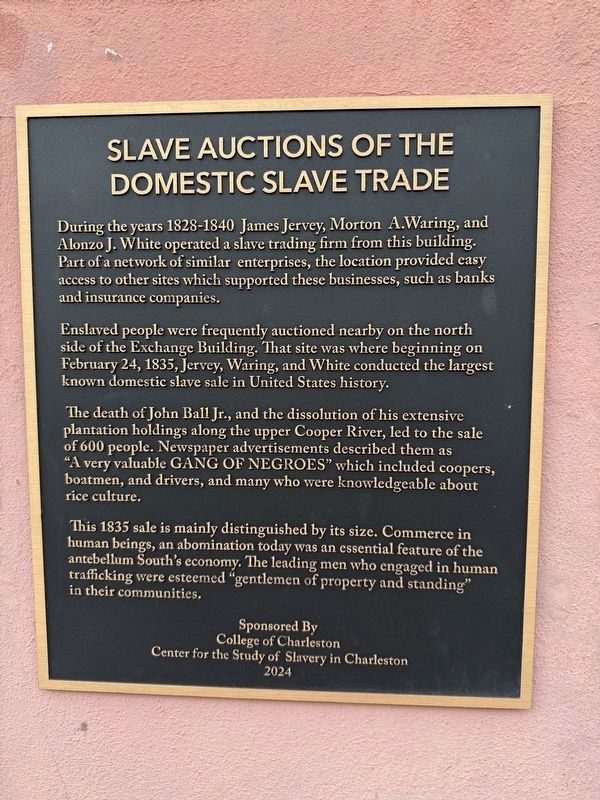
Photographed by Devry Becker Jones (CC0), May 21, 2026
1. Slave Auctions of the Domestic Slave Trade Marker
During the years 1828-1840 James Jervey, Morton A.Waring, and Alonzo J. White operated a slave trading firm from this building. Part of a network of similar enterprises, the location provided easy access to other sites which supported these businesses, such as banks and insurance companies.
Enslaved people were frequently auctioned nearby on the north side of the Exchange Building. That site was where beginning on February 24, 1835, Jervey, Waring, and White conducted the largest known domestic slave sale in United States history.
The death of John Ball Jr., and the dissolution of his extensive plantation holdings along the upper Cooper River, led to the sale of 600 people. Newspaper advertisements described them as "A very valuable gang of Negroes" which included coopers, boatmen, and drivers, and many who were knowledgeable about rice culture.
This 1835 sale is mainly distinguished by its size. Commerce in human beings, an abomination today was an essential feature of the antebellum South's economy. The leading men who engaged in human trafficking were esteemed "gentlemen of property and standing" in their
this page online
Erected 2024 by College of Charleston, Center for the Study of Slavery in Charleston.
Topics. This historical marker is listed in these topic lists: African Americans • Industry & Commerce. A significant historical date for this entry is February 24, 1835.
Location. 32° 46.611′ N, 79° 55.686′ W. Marker is in Charleston, South Carolina, in Charleston County. It is in the French Quarter. It is on Broad Street west of State Street when traveling west. Touch for map. Marker is at or near this postal address: 24 Broad St, Charleston SC 29401, United States of America. Touch for directions.

Regionally, this marker is in Historic Charleston and in the Lowcountry. It is also in the American South, specifically in the Deep South, and on the Eastern Seaboard. Globally, it is in the North Atlantic Region, North America, the Western Hemisphere, the Western World, and the Anglosphere. Historically, it finds itself in what was once the territory of the Mississippian Culture, one of the original Thirteen Colonies, one of the Confederate States of America, and the Antebellum South.
Other nearby markers. At least 8 other markers

Photographed by Devry Becker Jones (CC0), May 21, 2026
2. Slave Auctions of the Domestic Slave Trade Marker
Credits. This page was last revised on May 26, 2026. It was originally submitted on May 26, 2026, by Devry Becker Jones of Washington, District of Columbia. This page has been viewed 23 times since then. Photos: 1, 2. submitted on May 26, 2026, by Devry Becker Jones of Washington, District of Columbia.
