South of Broad in Charleston in Charleston County, South Carolina — The American South (South Atlantic)
Smith-Gordon-People's Building
15 Broad Street
| — | Built 1802 | — |
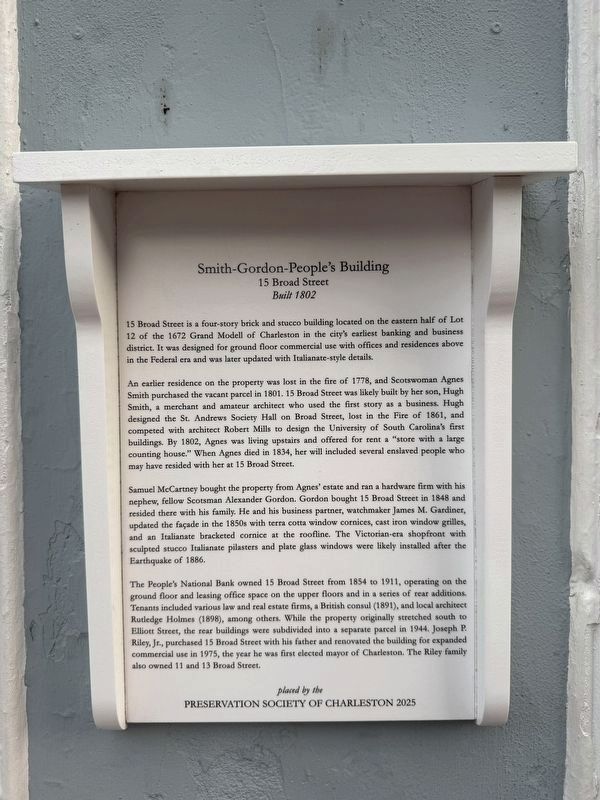
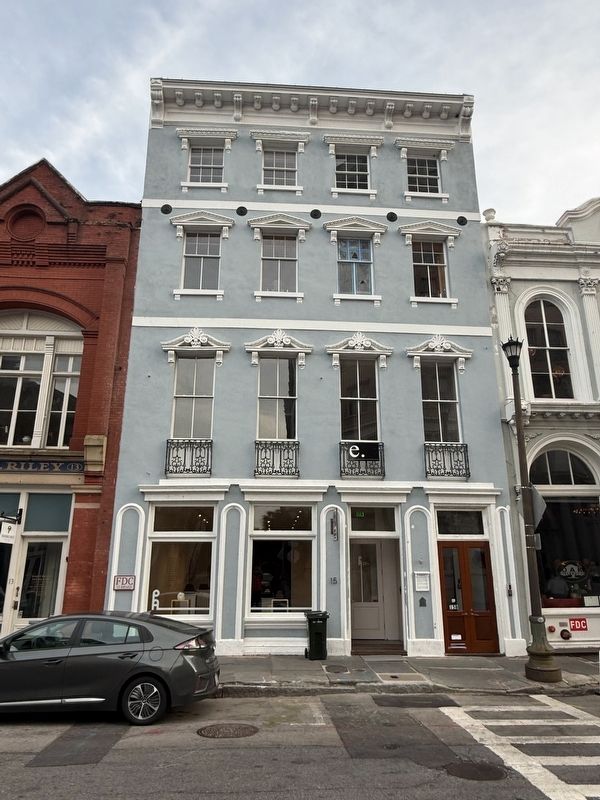
15 Broad Street is a four-story brick and stucco building located on the eastern half of Lot 12 of the 1672 Grand Modell of Charleston in the city’s earliest banking and business district. It was designed for ground floor commercial use with offices and residences above in the Federal era and was later updated with Italianate-style details.
An earlier residence on the property was lost in the fire of 1778, and Scotswoman Agnes Smith purchased the vacant parcel in 1801. 15 Broad Street was likely built by her son, Hugh Smith, a merchant and amateur architect who used the first story as a business. Hugh designed the St. Andrews Society Hall on Broad Street, lost in the Fire of 1861, and competed with architect Robert Mills to design the University of South Carolina’s first buildings. By 1802, Agnes was living upstairs and offered for rent a "store with a large counting house." When Agnes died in 1834, her will included several enslaved people who may have resided with her at 15 Broad Street.
Samuel McCartney bought the property from Agnes’ estate and ran a hardware firm with his nephew, fellow Scotsman Alexander Gordon.
this page online
The People’s National Bank owned 15 Broad Street from 1854 to 1911, operating on the ground floor and leasing office space on the upper floors and in a series of rear additions. Tenants included various law and real estate firms, a British consul (1891), and local architect Rutledge Holmes (1898), among others. While the property originally stretched south to Elliott Street, the rear buildings were subdivided into a separate parcel in 1944. Joseph P. Riley, Jr., purchased 15 Broad Street with his father and renovated the building for expanded commercial use in 1975, the year he was first elected mayor of Charleston. The Riley family also owned 11 and 13 Broad Street.
Erected 2025 by Preservation Society of Charleston.
Photographed by Devry Becker Jones (CC0), May 21, 2026
2. Smith-Gordon-People's Building at 15 Broad Street
Topics. This historical marker is listed in these topic lists: Architecture • Industry & Commerce. A significant historical year for this entry is 1672.
Location. 32° 46.603′ N, 79° 55.67′ W. Marker is in Charleston, South Carolina, in Charleston County. It is in South of Broad. It is at the intersection of Broad Street and State Street, on the right when traveling east on Broad Street. Touch for map. Marker is at or near this postal address: 15 Broad St, Charleston SC 29401, United States of America. Touch for directions.

Regionally, this marker is in Historic Charleston and in the Lowcountry. It is also in the American South, specifically in the Deep South, and on the Eastern Seaboard. Globally, it is in the North Atlantic Region, North America, the Western Hemisphere, the Western World, and the Anglosphere. Historically, it finds itself in what was once the territory of the Mississippian Culture, one of the original Thirteen Colonies, one of the Confederate States of America, and the Antebellum South.
Other nearby markers. At least 8 other markers are within walking distance of this marker: Slave Auctions of the Domestic Slave Trade
Photographed by Devry Becker Jones (CC0), May 21, 2026
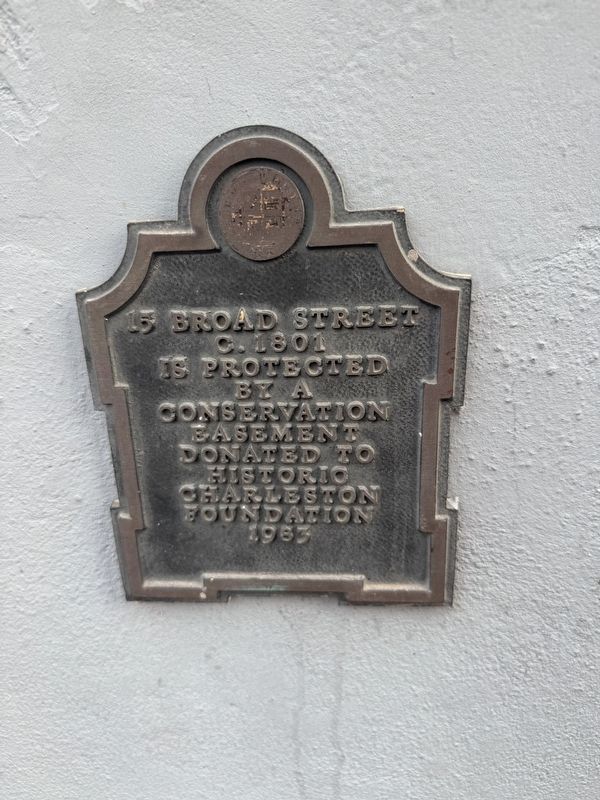
3. Additional plaque on the building
C. 1801
is protected
by a
conservation
easement
Donated to
Historic
Charleston
Foundation
1983
Credits. This page was last revised on May 26, 2026. It was originally submitted on May 26, 2026, by Devry Becker Jones of Washington, District of Columbia. This page has been viewed 13 times since then. Photos: 1, 2, 3. submitted on May 26, 2026, by Devry Becker Jones of Washington, District of Columbia.
