Lincolnville in Charleston County, South Carolina — The American South (South Atlantic)
Lincolnville

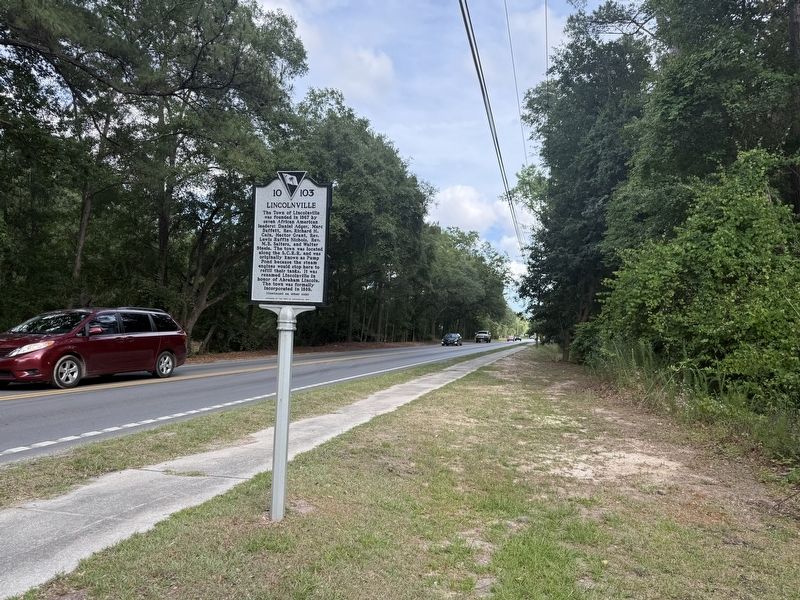
The Town of Lincolnville was founded in 1867 by seven African American leaders: Daniel Adger, Marc Buffett, Rev. Richard H. Cain, Hector Grant, Rev. Lewis Ruffin Nichols, Rev. M.B. Salters, and Walter Steele. The town was located along the S.C.R.R. and was originally known as Pump Pond because the steam engines would stop here to refill their tanks. It was renamed Lincolnville in honor of Abraham Lincoln. The town was formally incorporated in 1889.
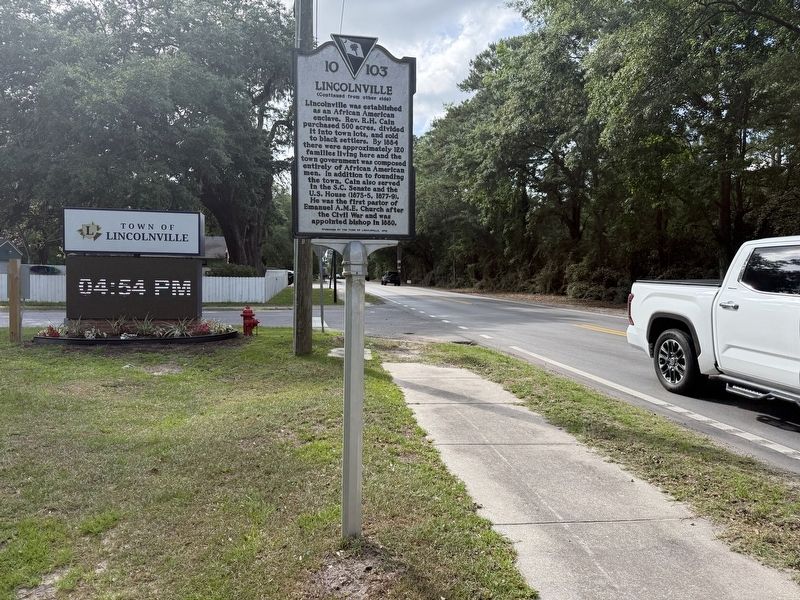
Lincolnville was established as an African American enclave. Rev. R.H. Cain purchased 500 acres, divided it into town lots, and sold to black settlers. By 1884 there were approximately 120 families living here and the town government was composed entirely of African American men. In addition to founding the town, Cain also served in the S.C. Senate and the U.S. House (1873-5, 1877-9). He was the first pastor of Emanuel A.M.E. Church after the Civil War and was appointed bishop in 1880.
Erected 2018 by South Carolina Department of Archives and History; sponsored by the Town of Lincolnville. (Marker Number 10-103.)
Topics and series. This historical marker is listed
this page online
Location. 33° 0.628′ N, 80° 9.426′ W. Marker is in Lincolnville, South Carolina, in Charleston County. It is at the intersection of Lincoln Avenue (State Road 10-881) and West Broad Street, on the right when traveling east on Lincoln Avenue. Touch for map. Marker is at or near this postal address: 741 Lincoln Ave, Summerville SC 29485, United States of America. Touch for directions.

Regionally, this marker is in the Lowcountry. It is also in the American South, specifically in the Deep South, and on the Eastern Seaboard. Globally, it is in the North Atlantic Region, North America, the Western Hemisphere, the Western World, and the Anglosphere. Historically, it finds itself in what was once the territory of the Mississippian Culture, one of the original Thirteen Colonies, one of the Confederate States of America, and the Antebellum South.
Other nearby markers. At

Credits. This page was last revised on May 29, 2026. It was originally submitted on May 29, 2026, by Devry Becker Jones of Washington, District of Columbia. This page has been viewed 15 times since then. Photos: 1, 2, 3, 4. submitted on May 29, 2026, by Devry Becker Jones of Washington, District of Columbia.
