Stratford in Perth County, Ontario — Central Canada (North America)
Wet or Dry?
Liquor in Stratford
Photographed by Tim Boyd, May 28, 2026
1. Wet or Dry? Marker
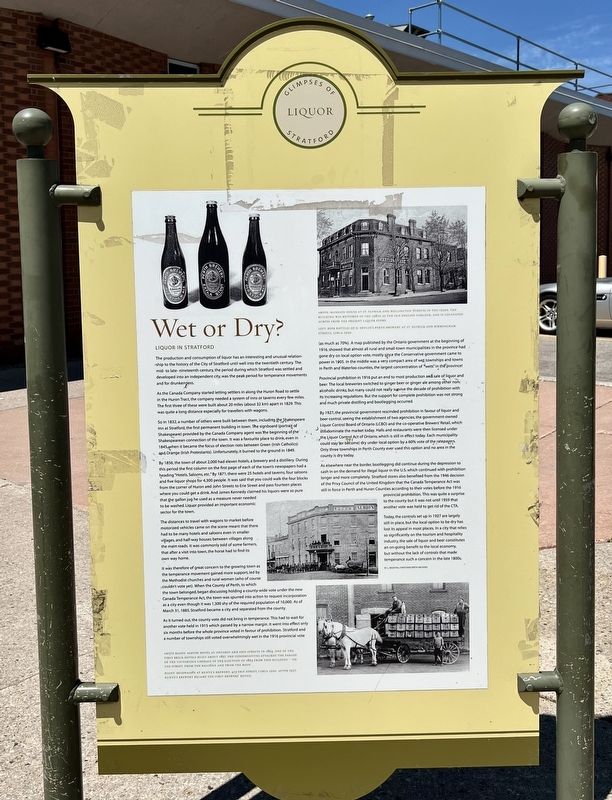
The production and consumption of liquor has an interesting and unusual relationship to the history of the City of Stratford until well into the twentieth century. The mid-to late-nineteenth century, the period during which Stratford was settled and developed into an independent city, was the peak period for temperance movements and for drunkenness.
As the Canada Company started letting settlers in along the Huron Road to settle in the Huron Tract, the company needed a system of inns or taverns every few miles. The first three of these were built about 20 miles (about 32 km) apart in 1829. This was quite a long distance especially for travellers with wagons.
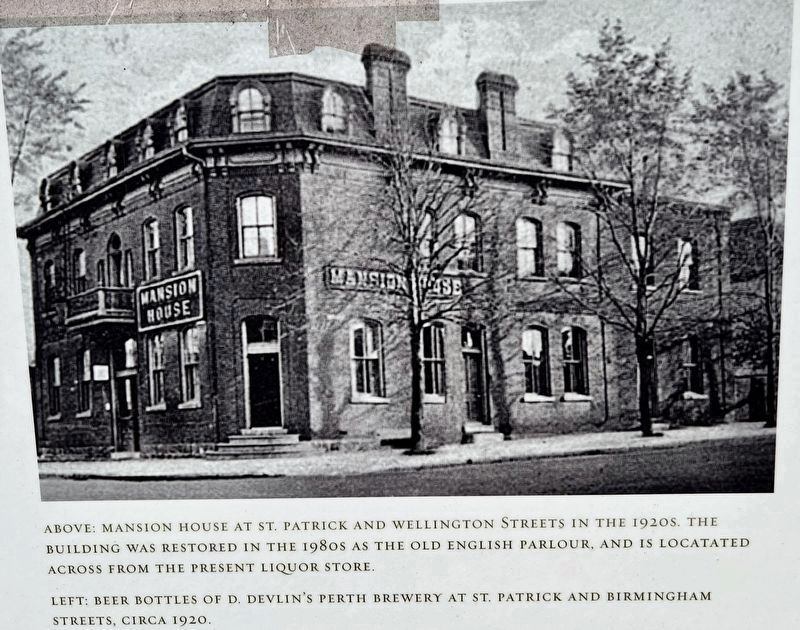
So in 1832, a number of others were built between them, including the Shakespeare Inn at Stratford, the first permanent building in town. The signboard (portrait of Shakespeare) provided by the Canada Company agent was the beginning of the Shakespearean connection of the town. It was a favourite place to drink, even in 1845 when it became the focus of election riots between Green (Irish Catholics) and Orange (Irish Protestants). Unfortunately, it burned to the
this page online
By 1856, the town of about 2,000 had eleven hotels, a brewery and a distillery. During this period the first column on the first page of each of the town's newspapers had a heading "Hotels, Saloons, etc." By 1871, there were 25 hotels and taverns, four saloons and five liquor shops for 4,300 people. It was said that you could walk the four blocks from the corner of Huron and John Streets to Erie Street and pass fourteen places where you could get a drink. And James Kennedy claimed his liquors were so pure that the gallon jug he used as a measure never needed to be washed. Liquor provided an important economic sector for the town.
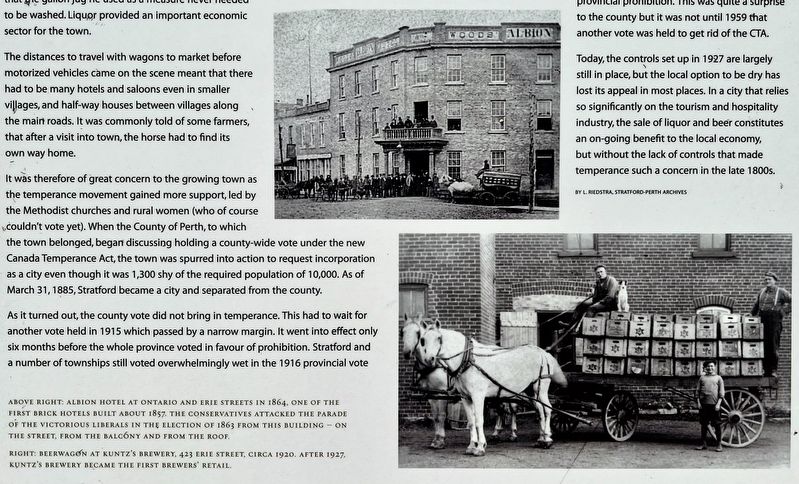
The distances to travel with wagons to market before motorized vehicles came on the scene meant that there had to be many hotels and saloons even in smaller villages, and half-way houses between villages along the main roads. It was commonly told of some farmers, that after a visit into town, the horse had to find its own way home.
It was therefore of great concern to the growing town as the temperance movement gained more support, led by the Methodist churches and rural women (who
Photographed by Tim Boyd, May 28, 2026
2. Wet or Dry? Marker
As it turned out, the county vote did not bring in temperance. This had to wait for another vote held in 1915 which passed by a narrow margin. It went into effect only six months before the whole province voted in favour of prohibition. Stratford and a number of townships still voted overwhelmingly wet in the 1916 provincial vote (as much as 70%). A map published by the Ontario government at the beginning of 1916, showed that almost all rural and small-town municipalities in the province had gone dry on local option vote, mostly since the Conservative government came to power in 1905. In the middle was a very compact area of wet townships and towns in Perth and Waterloo counties, the largest concentration of "wets" in the province!
Provincial prohibition in
1920s
3. Wet or Dry? marker photo and caption detail (top)
By 1927, the provincial government rescinded prohibition in favour of liquor and beer control, seeing the establishment of two agencies, the government-owned Liquor Control Board of Ontario (LCBO) and the co-operative Brewers' Retail, which Still dominate the market today. Halls and restaurants were then licensed under the Liquor Control Act of Ontario, which is still in effect today. Each municipality could stay (or become) dry under local option by a 60% vote of the ratepayers. Only three townships in Perth County ever used this option and no area in the county is dry today.
As elsewhere near the border, bootlegging did continue during the depression to cash in on the demand for illegal liquor in the U.S. which continued with prohibition longer and more completely. Stratford
Photographed by Tim Boyd, May 28, 2026
4. Wet or Dry? marker photos and captions detail (bottom)
Today, the controls set up in 1927 are largely still in place, but the local option to be dry has lost its appeal in most places. In a city that relies so significantly on the tourism and hospitality industry, the sale of liquor and beer constitutes an on-going benefit to the local economy, but without the lack of controls that made temperance such a concern in the late 1800s.
Erected by City of Stratford.
Topics. This historical marker is listed in this topic list: Industry & Commerce. A significant historical year for this entry is 1016 CE.
Location. 43° 22.13′ N, 80° 58.986′ W. Marker is in Stratford, Ontario, in Perth County. It is at the intersection of George Street West and St. Patrick Street, on the right when traveling west on George Street West. Touch for map. Marker is at or near this postal address: 91 Wellington St, Stratford ON N5A 2L3, Canada. Touch for directions.

Regionally, this marker is in the Huron-Perth-Waterloo-Wellington Area and in Southwestern Ontario. It is also in Central Canada. Globally, it is in North America, the Western Hemisphere, the Western World, and the Anglosphere. Historically, it finds itself in what was once a British colony, the Viceroyalty of New France, the Haudenosaunee (Iroquois) Confederacy, and Rupert’s Land.
Other nearby markers. At least 8 other markers are within walking distance of this marker: Mansion House (within shouting distance of this marker); Daly Terrace (1875) (about 120 meters away, measured in a direct line); a different marker also named Daly Terrace (1875) (about 120 meters away); City Hall (about 150 meters away); Stratford City Hall / L’hôtel de Ville de Stratford (about 150 meters away); 111-117 Downie Street (about 150 meters away); Festival Square (approx. 0.3 kilometers away); Gordon Block (approx. 0.3 kilometers away). Touch for a list and map of all markers in Stratford.
Credits. This page was last revised on June 4, 2026. It was originally submitted on June 1, 2026, by Tim Boyd of Hamilton, Ontario. This page has been viewed 17 times since then. Photos: 1, 2, 3, 4. submitted on June 1, 2026, by Tim Boyd of Hamilton, Ontario. • Andrew Ruppenstein was the editor who published this page.
