
Akersloot in Castricum, North Holland, Netherlands — Northwestern Europe
Korenmolen ‘De Oude Knegt’
⎯⎯⎯
‘The Old Servant’ Grain Mill
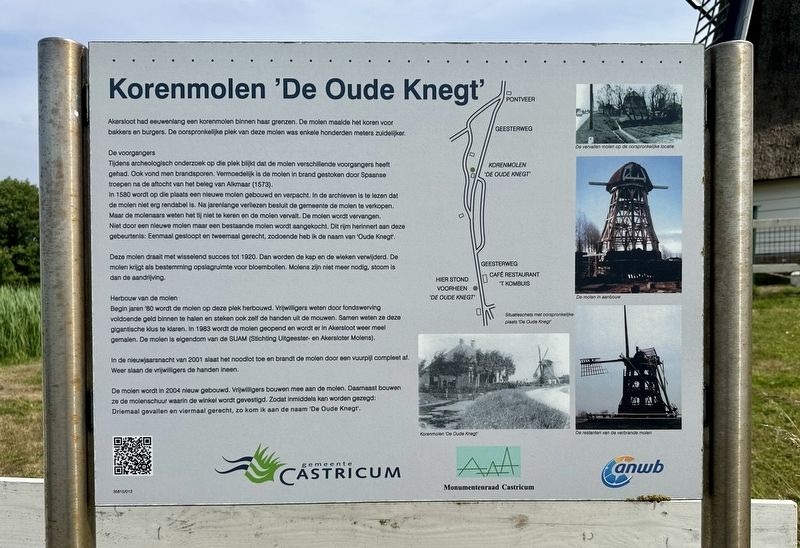
Photographed by Andrew Ruppenstein, May 31, 2026
1. Korenmolen ‘De Oude Knegt’ / ‘The Old Servant’ Grain Mill Marker

De voorgangers
Tijdens archeologisch onderzoek op die plek blijkt dat de molen verschillende voorgangers heeft gehad. Ook vond men brandsporen. Vermoedelijk is de molen in brand gestoken door Spaanse troepen na de aftocht van het beleg van Alkmaar (1573).
In 1580 wordt op die plaats een nieuwe molen gebouwd en verpacht. In de archieven is te lezen dat de molen niet erg rendabel is. Na jarenlange verliezen besluit de gemeente de molen te verkopen. Maar de molenaars weten het tij niet te keren en de molen vervalt. De molen wordt vervangen. Niet door een nieuwe molen maar een bestaande molen wordt aangekocht. Dit rijm herinnert aan deze gebeurtenis: Eenmaal gesloopt en tweemaal gerecht, zodoende heb ik de naam van 'Oude Knegt'.
Deze molen draait met wisselend succes tot 1920. Dan worden de kap en de wieken verwijderd. De molen krijgt als bestemming opslagruimte voor bloembollen. Molens zijn niet meer nodig, stoom is
this page online
Herbouw van de molen
Begin jaren '80 wordt de molen op deze plek herbouwd. Vrijwilligers weten door fondswerving voldoende geld binnen te halen en steken ook zelf de handen uit de mouwen. Samen weten ze deze gigantische klus te klaren. In 1983 wordt de molen geopend en wordt er in Akersloot weer meel gemalen. De molen is eigendom van de SUAM (Stichting Uitgeester- en Akersloter Molens).
In de nieuwjaarsnacht van 2001 slaat het noodlot toe en brandt de molen door een vuurpijl compleet af. Weer slaan de vrijwilligers de handen ineen.
De molen wordt in 2004 nieuw gebouwd. Vrijwilligers bouwen mee aan de molen. Daarnaast bouwen ze de molenschuur waarin de winkel wordt gevestigd. Zodat inmiddels kan worden gezegd: Driemaal gevallen en viermaal gerecht, zo kom ik aan de naam 'De Oude Knegt'.
For centuries, Akersloot had a grain mill within its borders. The mill ground grain for bakers and citizens. The original location of this mill was a few hundred meters further south.
The Predecessors
During archaeological research at the site, it became apparent that the mill had several predecessors.
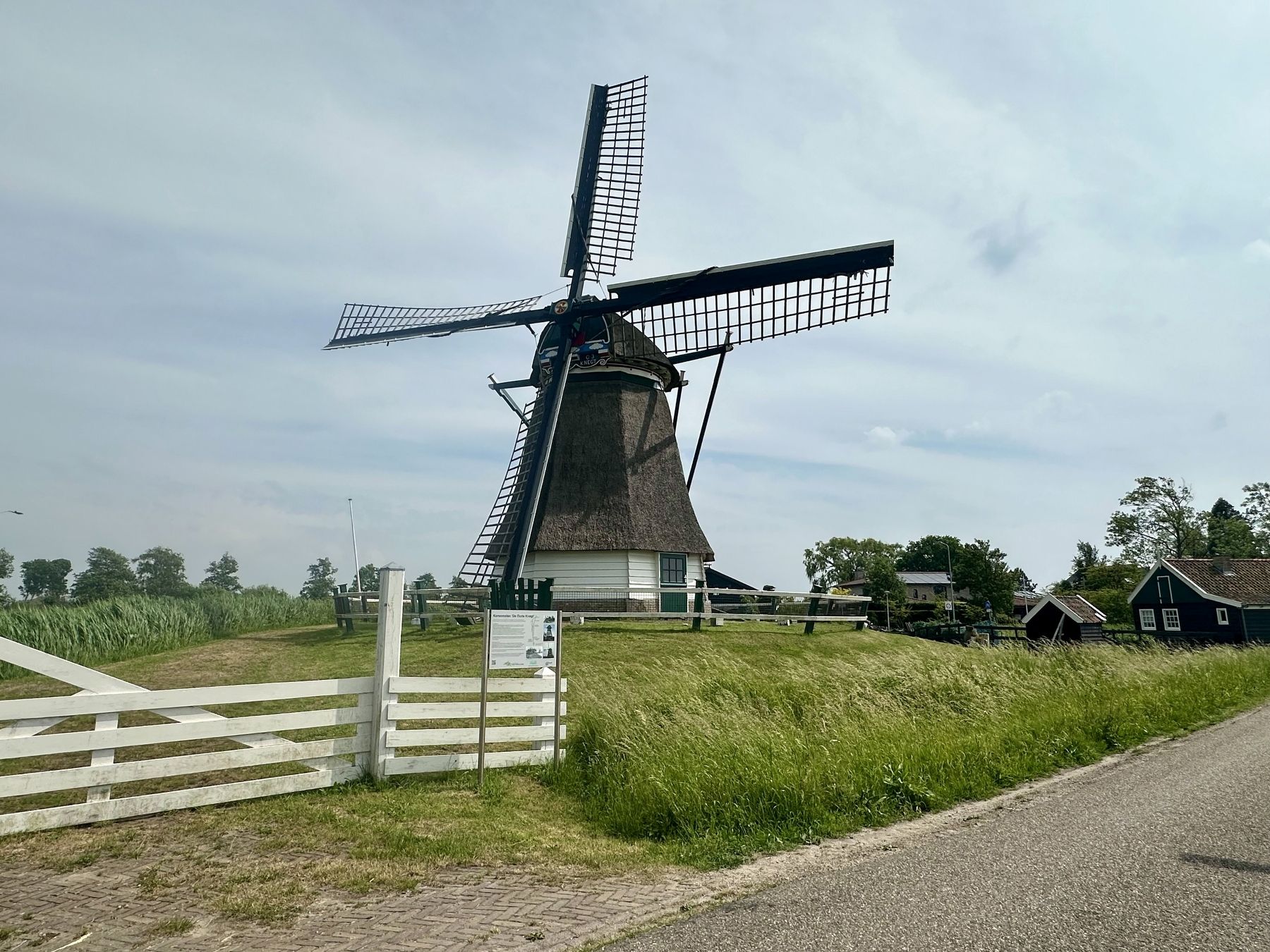
Photographed by Andrew Ruppenstein, May 31, 2026
2. Korenmolen ‘De Oude Knegt’ / ‘The Old Servant’ Grain Mill and Marker
In 1580, a new mill was built on the site and leased out. The archives state that the mill was not very profitable. After years of losses, the municipality decided to sell the mill. However, the millers were unable to turn the tide, and the mill fell into disrepair. The mill was replaced. Not by a new mill, but an existing mill was purchased. This rhyme commemorates this event: Once demolished and twice rebuilt, thus I have the name of 'Old Servant'.
This mill operated with varying success until 1920. Then the cap and sails were removed. The mill was repurposed as a storage space for flower bulbs. Mills were no longer needed; steam had become the power source.
Reconstruction of the Mill
In the early 1980s, the mill was rebuilt on this site. Volunteers managed to raise sufficient funds through fundraising and also rolled up their sleeves themselves. Together, they managed to complete this gigantic task. In 1983, the mill was opened, and flour was milled in Akersloot once again. The mill is owned by the SUAM (Foundation for Uitgeest and Akersloot Mills).
On New Year's Eve 2001, disaster struck, and the mill burned down completely due to a firework. Once again, the volunteers joined forces.
The mill was newly built in 2004. Volunteers helped build the mill. In addition, they built the mill shed, which houses the shop. So that by now it can be said: Fallen three times and righted four times, that is how I got the name 'De Oude Knegt'.
Erected by ANWB, Gemeente Castricum, Monumentraad Castricum. (Marker Number 35815/013.)
Topics. This historical marker is listed in this topic list: Industry & Commerce. A significant historical year for this entry is 1580.
Location. 52° 34.19′ N, 4° 44.569′ E. Marker is in Akersloot, Noord-Holland (North Holland), in Castricum. It is on Pontweg Noord north of Geesterweg, on the right when traveling north. Touch for map. Marker is at or near this postal address: Pontweg Noord 2a, Akersloot, Noord-Holland 1921, Netherlands. Touch for directions.

Regionally, it is in Europe, the European Union, Atlantic Europe, the Benelux Low Countries, the Schengen Area, Western Europe, and the Western World. Historically, it finds itself in what was once the Holy Roman Empire.
Other nearby markers. At least 8 other markers are within 5 kilometers of this marker, measured as the crow flies: Hervormde Kerk Limmen / Reformed Church of Limmen (approx. 3.4 kilometers away); Fusillade Monument Castricum / Castricum Execution Memorial (approx. 3.9 kilometers away); Heilige Willibrordus / St. Willibrord (approx. 4.1 kilometers away); Runxputte / The “Runx” Well (approx. 4.1 kilometers away); Genadekapel / Chapel of Grace (approx. 4.1 kilometers away); Onze lieve Vrouwe ter Nood / Our Lady in Need (approx. 4.1 kilometers away); Het Schuilveld / The Sheltering Field (approx. 4.2 kilometers away); Jan Brasser (approx. 4.2 kilometers away).
Also see . . . De Oude Knegt (De Stichting Uitgeester- en Akersloter Molens, in Dutch). History of the mill by the foundation that preserves and operates it. A bit more of the history that isn’t on the marker (in translation):
In 1580, the village council decided to build a grain mill that would be the property of the village community. The church of Akersloot advanced the amount needed for the construction of this standard mill. The mill was leased out, and the lease contract stipulated, among other things, that the miller would give priority to residents of the village over those coming “from outside the village” (so not first come, first served), and would keep the mill “clean and tidy of dust and debris,” at the discretion of the aldermen. The miller lived for free in the house and yard belonging to the mill, but had to take care of the mill's maintenance himself.(Submitted on June 3, 2026.)
It was not until 1664 that wind rights were applied for this mill, which means that the bailiff and aldermen of Akersloot kept the tax authorities of the then States of Holland and West Friesland unaware of their mill for 80 years. After all, wind rights had to be paid for the mill. This mill was probably in operation until 1817, as D’Oude Knegt is mentioned then.
Additional keywords. windmill
Credits. This page was last revised on June 3, 2026. It was originally submitted on June 3, 2026, by Andrew Ruppenstein of Lamorinda, California. This page has been viewed 17 times since then. Photos: 1, 2. submitted on June 3, 2026, by Andrew Ruppenstein of Lamorinda, California.