Stratford in Perth County, Ontario — Central Canada (North America)
Stratford Festival of Canada

Photographed by Tim Boyd, May 28, 2026
1. Stratford Festival of Canada Marker
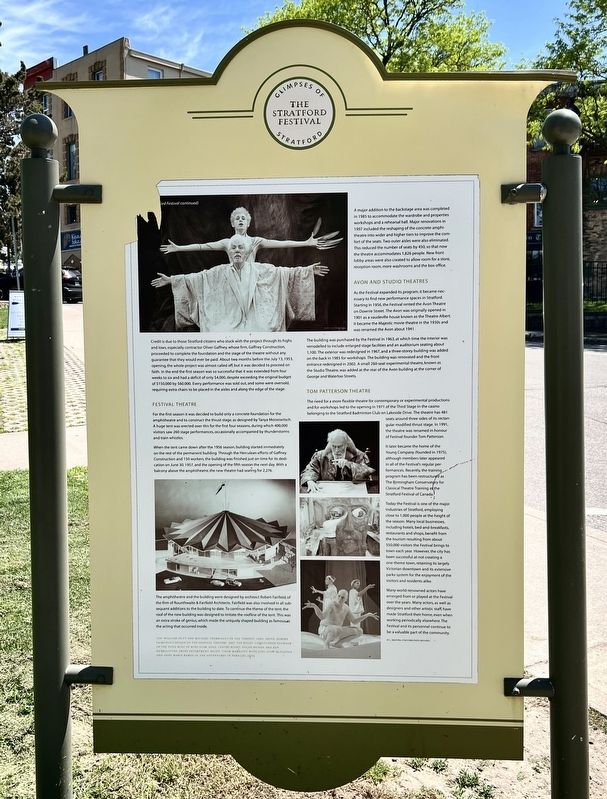
"With one bold stroke that has left our big cities gasping, Stratford, Ont. will this summer claim its birthright with a Shakespearean festival!" This was how Maclean's magazine saw the beginning of the Stratford Festival in 1953. It was bold indeed for an upstart community of 19,000 to think of establishing a permanent professional theatre in a country that had only half a dozen professional theatre companies and various summer stock companies. Yet the Stratford Festival quickly succeeded in becoming the largest classical repertory theatre in North America.
BACKGROUND
The Canada Company, the settlement company in this area, had created the birthright in 1832 by naming the proposed town (and its river) after Shakespeare’s home in England. Over the years, various leading citizens had taken the Shakespearean connection seriously. In the 1850s, this included the naming of the town’s five wards (and subsequently the public schools as well) as the two villages of Shakespeare and Gads Hill. In 1864, the town held a celebration for the tercentenary of the Bard's birth that was announced in newspapers as far away as Boston.
this page online
It was in this environment that Tom Patterson was raised. Attending the collegiate in the late 1930s, he frequented the nearby Shakespearean Gardens with his school chums to ponder the future. Here he first raised the idea of a Shakespearean festival as an economic opportunity for Stratford. After service overseas during World War II, he took a job as a magazine editor in Toronto, and began to promote his idea of the Festival to anyone who would listen on his trips home to Stratford.
THE BEGINNING
After discussing his ideas with
Photographed by Tim Boyd, May 28, 2026
2. Stratford Festival of Canada Marker (reverse side)
A committee of prominent Stratford citizens was formed in the meantime, which soon developed to the Stratford Shakespearean Festival of Canada Foundation. At the advice leading Canadian director Dora Mavor Moore, Patterson contacted world-reknown director Tyrone Guthrie at his home in Ireland and interested him in the idea. Intrigued, Guthrie came to Canada in July 1952 to check things out. Rather than a committee “mainly of artistic and excitable elderly ladies of both sexes, with a sprinkling of Business Men to restrain the Artistic People from spending money..." he was surprised to find a committee of mainly young business and professional men
Photographed by Tim Boyd, May 28, 2026
3. Stratford Festival of Canada Marker
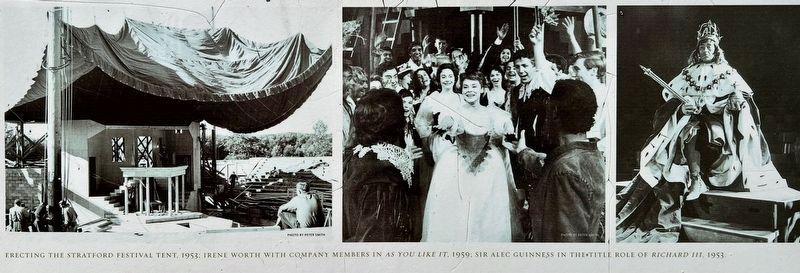
This gave Guthrie the opportunity to fulfill his dream of building a thrust stage that would emulate one of the key features of Shakespeare's theatre. At Guthrie's suggestion, designer Tanya Moiseiwitsch and leading actor Alec Guinness were signed on, and subsequently leading actress Irene Worth - all at the height of their careers. Their eager participation in the risky venture gave much support to the professional status of the new theatre. Other than two other actors brought from Britain, the rest of the cast and crew were Canadians, chosen in auditions held across the country.
Credit is due to those Stratford citizens who stuck with the project through its highs and lows, especially contractor Oliver Gattney, whose firm, Gattney Construction, proceeded to complete the foundation and the stage of the theatre without any guarantee that they would ever be paid. About two months before the July 13, 1953, opening, the whole project was almost called off, but it was decided

Photographed by Tim Boyd, May 28, 2026
4. Stratford Festival of Canada marker photos and captions detail (front side, top)
FESTIVAL THEATRE
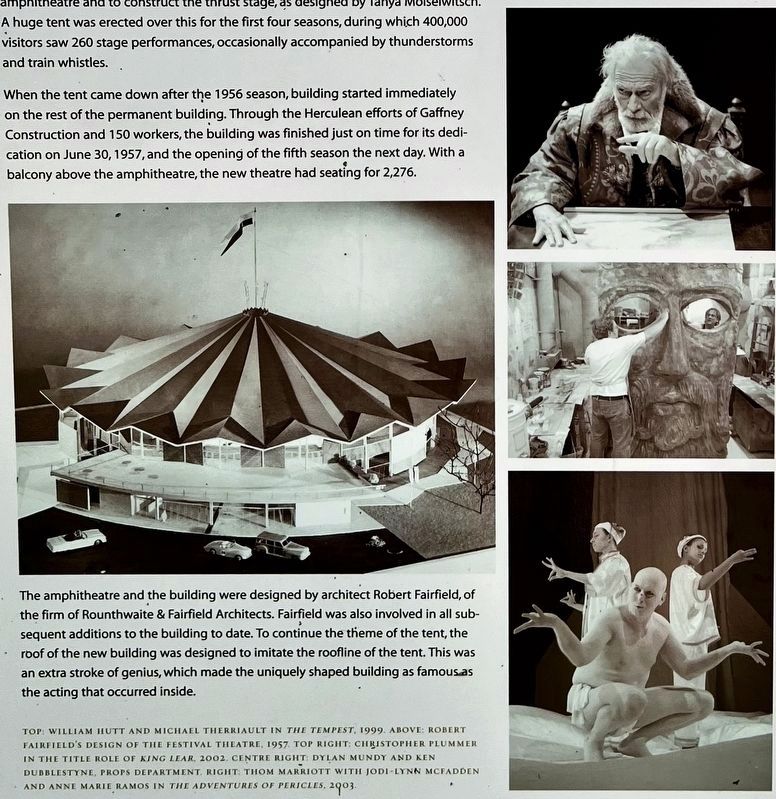
For the first season it was decided to build only a concrete foundation for the amphitheatre and to construct the thrust stage, as designed by Tanya Moiseiwitsch. A huge tent was erected over this for the first four seasons, during which 400,000 visitors saw 260 stage performances, occasionally accompanied by thunderstorms and train whistles.
When the tent came down after the 1956 season, building started immediately on the rest of the permanent building. Through the Herculean efforts of Gaffney construction and 150 workers, the buulding was finished just on time for is dedication on June 30, 1957, and the opening of the fifth season the next day. With a balcony above the amphitheatre, the new theatre had seating for 2,276.
The amphitheatre and the building were designed
Photographed by Tim Boyd, May 28, 2026
5. Stratford Festival of Canada marker photos and captions detail (front side, bottom)
A major addition to the backstage area was completed in 1985 to accommodate the wardrobe and properties workshops and a rehearsal hall. Major renovations in 1997 included the reshaping of the concrete amphi-theatre into wider and higher tiers to improve the comfort of the seats. Two outer aisles were also eliminated This reduced the number of seats by 450, so that now the theatre accommodates 1,826 people. New front lobby areas were also created to allow room for a store, reception room, more washrooms and the box office.
AVON AND STUDIO THEATRES
As the Festival expanded its program, it became necessary to find new performance spaces in Stratford. Starting in 1956, the Festival rented the Avon Theatre on Downie Street. The Avon was
Photographed by Tim Boyd, May 28, 2026
6. Stratford Festival of Canada marker photos and captions detail (reverse side, bottom)
The building was purchased by the Festival in 1963, at which time the interior was remodelled to include enlarged stage facilities and an auditorium seating about 1,100. The exterior was redesigned in 1967, and a three-storey building was added on the back in 1985 for workshops. The building was renovated and the front entrance redesigned in 2002. A small 260-seat experimental theatre, known as the Studio Theatre, was added at the rear of the Avon building at the corner of George and Waterloo Streets.
TOM PATTERSON THEATRE
The need for a more flexible theatre for contemporary or experimental productions and for workshops led to the opening in 1971 of the Third Stage in the casino belonging to the Stratford Badminton Club on Lakeside Drive. The theatre has 481 seats around three sides of its rectangular modified thrust stage. In 1991, the theatre was renamed in honour of festival founder Tom Patterson.
It later became the home of the Young Company (founded in 1975), although members later appeared in all of the Festival's regular performances. Recently the training program has been restructured as The Birmingham Conservatory for Classical Theatre Training at the Stratford Festival of Canada.
Today the Festival is one of the major industries of Stratford, employing close to 1,000 people at the height of the season. Many local businesses including hotels, bed-and-breakfasts, restaurants and shops, benefit from the tourism resulting from about 550,000 visitors the Festival brings to town each year. However, the city has been successful at not creating a one-theme town, retaining its largely Victorian downtown ands extensive parks system for the enjoyment of the visitors and residents alike.
Many world-renowned actors have emerged from or played at the Festival over thie years. Many actors, as well as designers and other artistic staff have made Stratford their home, even when working periodically elsewhere. The festival and its personnel continue to be a valuable part of the community.
Erected by City of Stratford.
Topics. This historical marker is listed in these topic lists: Architecture • Arts, Letters, Music • Entertainment. A significant historical year for this entry is 1953.
Location. 43° 22.328′ N, 80° 58.986′ W. Marker is in Stratford, Ontario, in Perth County. It is at the intersection of York Street and Erie Street, on the right when traveling west on York Street. Touch for map. Marker is at or near this postal address: 30 York Street, Stratford ON N5A 1A1, Canada. Touch for directions.

Regionally, this marker is in the Huron-Perth-Waterloo-Wellington Area and in Southwestern Ontario. It is also in Central Canada. Globally, it is in North America, the Western Hemisphere, the Western World, and the Anglosphere. Historically, it finds itself in what was once a British colony, the Viceroyalty of New France, the Haudenosaunee (Iroquois) Confederacy, and Rupert’s Land.
Other nearby markers. At least 8 other markers are within walking distance of this marker: The Stratford War Memorial (within shouting distance of this marker); Site of First Canada Company Mill (within shouting distance of this marker); The Saving of the Stratford Parks (within shouting distance of this marker); The Freeman Memorial Fountain (within shouting distance of this marker); The Freeland Fountain (about 90 meters away, measured in a direct line); Site of the Shakespeare Hotel (about 90 meters away); Gordon Block (about 90 meters away); 70-76 Ontario (about 90 meters away). Touch for a list and map of all markers in Stratford.
Credits. This page was last revised on June 4, 2026. It was originally submitted on June 3, 2026, by Tim Boyd of Hamilton, Ontario. This page has been viewed 11 times since then. Photos: 1, 2, 3, 4, 5, 6. submitted on June 3, 2026, by Tim Boyd of Hamilton, Ontario. • Andrew Ruppenstein was the editor who published this page.
