
Columbus Square in St. Louis, Missouri — The American Midwest (Upper Plains)
Neighborhood Gardens Apartments
Neighborhood: Columbus Gardens
| — | Living in Community | — |
Photographed by Jason Voigt, June 5, 2025
1. Neighborhood Gardens Apartments Marker
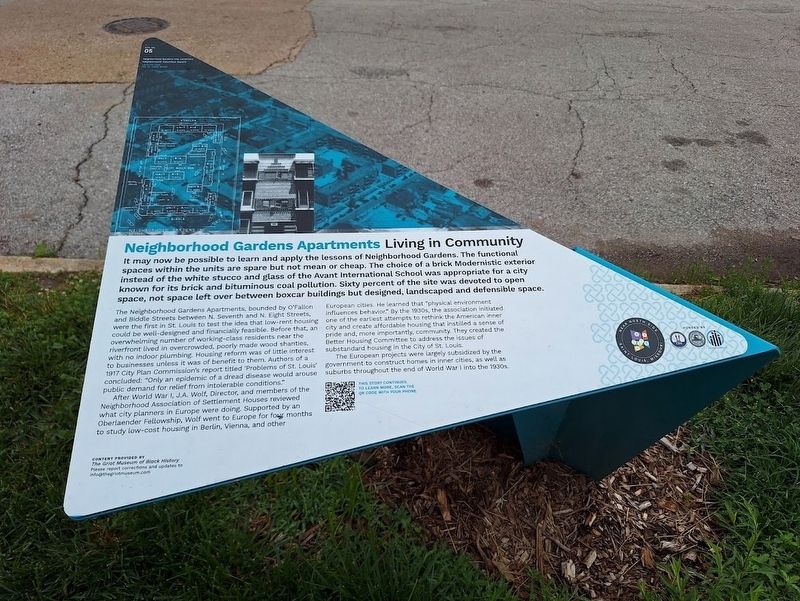
It may now be possible to learn and apply the lessons of Neighborhood Gardens. The functional spaces within the units are spare but not mean or cheap. The choice of a brick Modernistic exterior instead of the white stucco and glass of the Avant International School was appropriate for a city known for its brick and bituminous coal pollution. Sixty percent of the site was devoted to open space, not space left over between boxcar buildings but designed, landscaped and defensible space.
The Neighborhood Gardens Apartments, bounded by O'Fallon and Biddle Streets between N. Seventh and N. Eighth Streets, were the first in St. Louis to test the idea that low-rent housing could be well-designed and financially feasible. Before that, an overwhelming number of working-class residents near the riverfront lived in overcrowded, poorly made wood shanties, with no indoor plumbing. Housing reform was of little interest with no indoor plumbing. Housing reform was of little interest to businesses unless it was of benefit to them. Authors of a 1917 City Plan Commission's report titled "Problems of St. Louis" concluded: "Only an epidemic
this page online
After World War I, J.A. Wolf, Director, and members of the Neighborhood Association of Settlement Houses reviewed what city planners in Europe were doing. Supported by an Oberlaender Fellowship, Wolf went to Europe for four months to study low-cost housing in Berlin, Vienna, and other European cities. He learned that "physical environment influences behavior." By the 1930s, the association initiated one of the earliest attempts to rethink the American inner city and create affordable housing that instilled a sense of pride and, more importantly, community. They created the Better Housing Committee to address the issues of substandard housing in the City of St. Louis.
The European projects were largely subsidized by the government to construct homes in inner cities, as well as suburbs throughout the end of World War I into the 1930s.
Erected 2025 by the City of St. Louis, St. Louis Community Development Administration, Near North Side Organization and Urban Strategies, Inc. (Marker Number 5.)
Topics. This historical marker is listed
Photographed by Jason Voigt, June 5, 2025
2. Neighborhood Gardens Apartments Marker
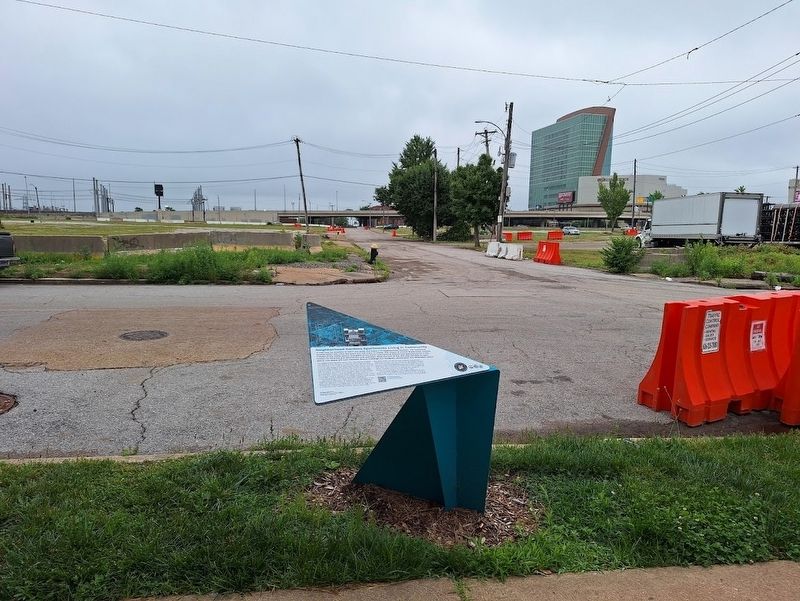
Location. 38° 38.171′ N, 90° 11.316′ W. Marker is in St. Louis, Missouri. It is in Columbus Square. It is at the intersection of North 7th Street and Biddle Street, on the right when traveling south on North 7th Street. Touch for map. Marker is at or near this postal address: 1203 N 7th St, Saint Louis MO 63106, United States of America. Touch for directions.

Regionally, this marker is in the American Midwest, in the Lewis & Clark Corridor, in the Corn Belt, and in the Great River Road Region. Globally, it is in North America, the Western Hemisphere, the Western World, and the Anglosphere. Historically, it finds itself in what was once the territory of the Mississippian Culture, the Louisiana Purchase, and the Antebellum South.
Other nearby markers. At least 8 other markers are within walking distance of this marker: Fr. Edward S. Filipiak Park (approx. 0.2 miles away); AMDG Shrine of St. Joseph (approx. ¼ mile away); 1993 (approx. 0.3 miles away); 1991 (approx. 0.3 miles away); 1992 (approx. 0.3 miles away); 1990 (approx. 0.3 miles away); Robert J. Baer Plaza (approx. 0.3 miles away); 1994 (approx. 0.3 miles away). Touch for a list and map of all markers in St. Louis.
Additional keywords. poverty
Credits. This page was last revised on June 3, 2026. It was originally submitted on June 3, 2026, by Jason Voigt of Glen Carbon, Illinois. This page has been viewed 10 times since then. Photos: 1, 2. submitted on June 3, 2026, by Jason Voigt of Glen Carbon, Illinois.
