Richmond in Yarra, Victoria, Australia — Oceania
WW1 Field Gun, Barkly Gardens Richmond
Photographed by Dean Barton-Ancliffe, May 19, 2026
1. WW1 Field Gun, Barkly Gardens Richmond Marker
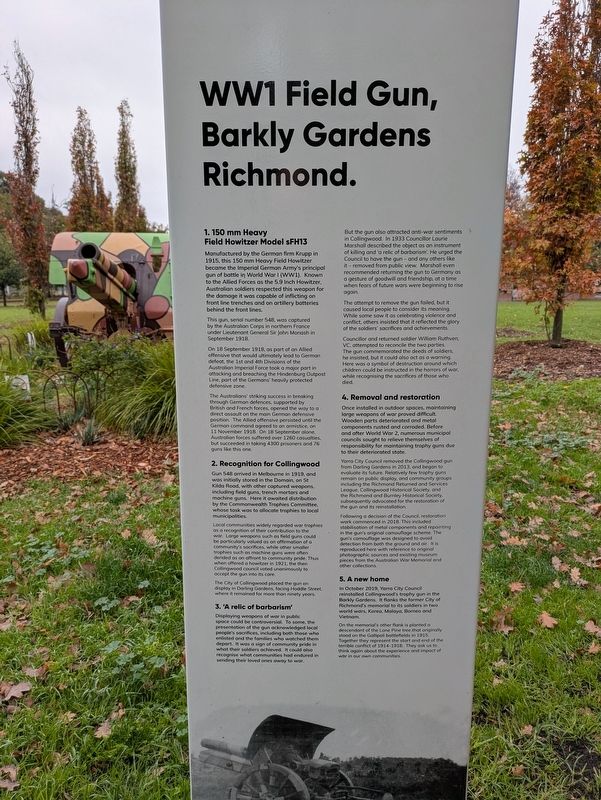
1. 150 mm Heavy Field Howitzer Model SFH13
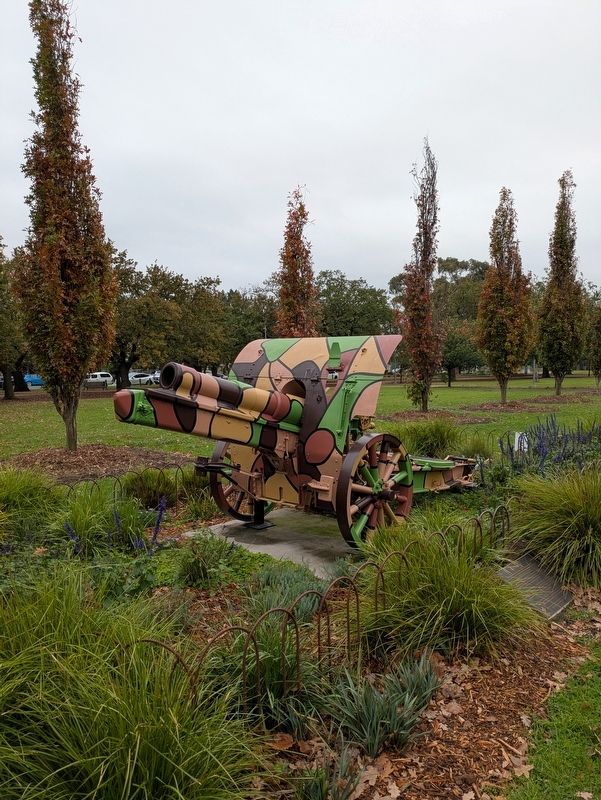
Manufactured by the German firm Krupp in 1915, this 150 mm Heavy Field Howitzer became the Imperial German Army's principal gun of battle in World War 1 (WW1). Known to the Allied Forces as the 59 Inch Howitzer, Australian soldiers respected this weapon for the damage it was capable of inflicting on front line trenches and on artillery batteries behind the front lines.
This gun, serial number 584, was captured by the Australian Corps in northern France under Lieutenant General Sir John Monash in September 1918.
On 18 September 1918, as part of an Allied offensive that would ultimately lead to German defeat, the 1st and 4th Divisions of the Australian Force took a major part in attacking and breaching the Hindenburg Outpost Line, part of the Germans heavily protected defensive zone.
The Australians' striking success is breaking through German defences, supported by British and French forces, opened the way to a direct assault on the main German defensive position. The Allied offensive persisted until the German command agreed to an armistice, on 11 November 1918. On
this page online
2. Recognition for Collingwood
Gun 548 arrived in Melbourne in 1919, and was initially stored in the Domain on St Kilda Road, with other captured weapons, including field guns, trench mortars and machine guns. Here it awaited distribution by the Commonwealth Trophies Committee, whose task was to allocate trophies to local municipalities.
Local communities widely regarded war trophies as a recognition of their contribution to the war. Large weapons such as field guns could be particularly valued as an affirmation of a community's sacrifices, while other smaller trophies such as machine guns were often derided as an affront to community pride. Thus, when offered a howitzer in 1921, the then the City of Collingwood council voted unanimously to accept the gun into its care.
The City of Collingwood placed the gun on display in Darling Gardens, facing Hoddle Street, where it remained for more than 90 years.
3. 'A relic of barbarism'
Displaying weapons of war in a public space could be controversial.
Photographed by Dean Barton-Ancliffe, May 19, 2026
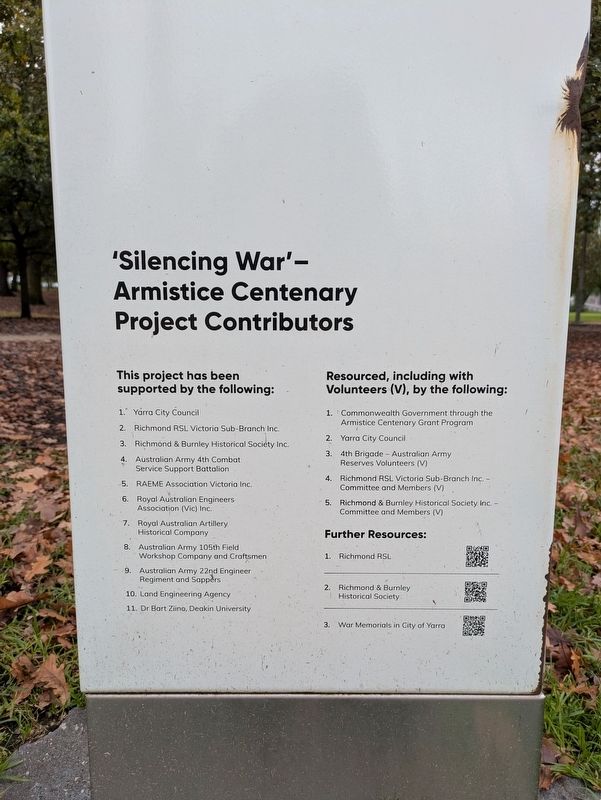
2. Acknowledgements on the rear of the Marker
But the gun also attracted anti-war sentiments in Collingwood. In 1933 Councillor Laurie Marshall described the object as an instrument of killing and a relic of barbarism. He urged the Council to have the gun - and any others like it - removed from public view. Marshall even recommended returning the gun to Germany as a gesture of goodwill and friendship, at a time when fears of future wars were beginning to rise again.
The attempt to remove the gun failed, but it caused local people to consider its meaning. While some saw it as celebrating violence and conflict, others insisted that it reflected the glory of the soldiers' sacrifices and achievements.
Councillor and returned soldier William Ruthven, VC, opted to reconcile the two parties. The gun commemorated the deeds of soldiers, he insisted, but it could also act
Photographed by Dean Barton-Ancliffe, May 19, 2026
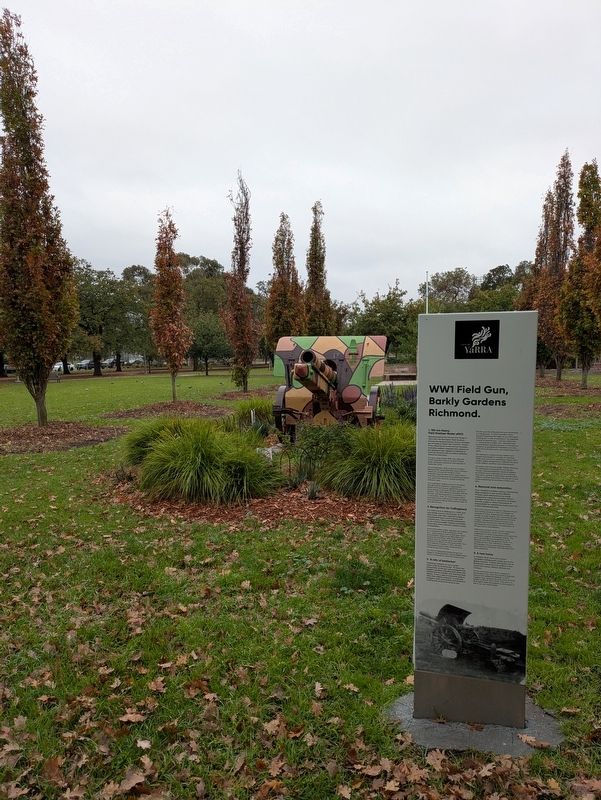
3. The WW1 Field Gun with the Marker
4. Removal and restoration
Once installed in outdoor spaces, maintaining large weapons of war proved difficult. Wooden parts deteriorated and metal components rusted and corroded. Before and after World War 2, numerous municipal councils sought to relieve themselves of responsibility for maintaining trophy guns due to their deteriorated state.
Yarra City Council removed the Collingwood gun from Darling Gardens in 2013, and began to evaluate its future. Relatively few trophy guns remain on public display, and community groups including the Richmond Returned and Services League, Collingwood historical Society, and the Richmond and Burnley Historical Society, subsequently advocated for the restoration of the gun and its reinstallation.
Following a decision of the council, resoration work commenced in 2018. This included stabilisation of metal components and repainting the guns original camouflage scheme. The gun's camouflage was designed to avoid detection from both
Photographed by Dean Barton-Ancliffe, May 19, 2026
4. The 150 mm Heavy Field Howitzer Model SFH13
5. A new home
In October 2009 Yarra City Council reinstalled Collingwood's trophy gun in the Barkley Gardens. It flanks the former City of Richmond's memorial to its soldiers in two world wars, Korea, Malaya, Borneo and Vietnam.
On the memorial's other flank is planted a descendant of the Lone Pine tree that originally stood on the Gallipoli battlefields in 1915. Together they represent the start and end of the terrible conflict of 1914-1918. They ask us to think again about the experience and impact of war in our own communities.
Topics. This memorial is listed in this topic list: War, World I. A significant historical year for this entry is 1918.
Location. 37° 49.71′ S, 145° 0.076′ E. Memorial is in Richmond, Victoria, in Yarra. It is on Mary Street 0.1 kilometers east of Rose Street. Touch for map. Memorial is at or near this postal address: Mary Street, Richmond VIC 3121, Australia. Touch for directions.

Regionally, it is in Oceania, in Australasia, in the Pacific Ocean, in South Pacific, on the Pacific Rim, in the Western World, and in the Anglosphere. Historically, it finds itself in what was once a British colony.
Other nearby markers. At least 8 other markers are within walking distance of this marker: Silencing War (here, next to this marker); Richmond War Memorial (within shouting distance of this marker); 100th Anniversary of Anzac Landing at Gallipoli (within shouting distance of this marker); St Ignatius Church (approx. 0.8 kilometers away); Ferenc Puskás (approx. 1.4 kilometers away); Carlo Catani (approx. 1.4 kilometers away); Morell (Anderson Street) Monier Arch Bridge (approx. 1.5 kilometers away); The Army and Olympic Park (approx. 1.5 kilometers away). Touch for a list and map of all markers in Richmond.
Credits. This page was last revised on June 4, 2026. It was originally submitted on June 3, 2026, by Dean Barton-Ancliffe of Rowville, Victoria. This page has been viewed 10 times since then. Photos: 1. submitted on June 3, 2026, by Dean Barton-Ancliffe of Rowville, Victoria. 2, 3, 4. submitted on June 4, 2026, by Dean Barton-Ancliffe of Rowville, Victoria. • Andrew Ruppenstein was the editor who published this page.
