Summerton in Clarendon County, South Carolina — The American South (South Atlantic)
Fort Watson

Photographed by C Summers, October 22, 2025
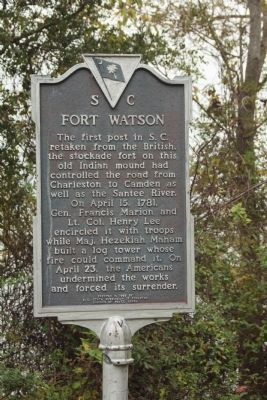
1. Fort Watson Marker
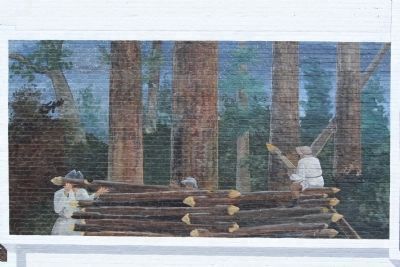
The first post in S.C. retaken from the British, the stockade fort on this old Indian mound had controlled the road from Charleston to Camden as well as the Santee River. On April 15, 1781, Gen. Francis Marion and Lt. Col. Henry Lee encircled it with troops while Maj. Hezekiah Maham built a log tower whose fire could command it. On April 23, the Americans undermined the works and forced its surrender.
Erected 1963 by S.C. Forestry Commission, Parks Division. (Marker Number 14-1.)
Topics and series. This historical marker is listed in these topic lists: Forts and Castles • War, US Revolutionary. In addition, it is included in the Francis Marion Trail series list. A significant historical date for this entry is April 15, 1781.
Location. 33° 31.966′ N, 80° 25.91′ W. Marker is in Summerton, South Carolina, in Clarendon County. It is on Fort Watson Road (State Highway 14-803), on the left when traveling west. Located Approx. .5 miles west of US 301, US15 - 1 mile north of I-95 interchange 102. Touch for map. Marker is in this post office area: Summerton SC 29148, United States of America. Touch for directions.

Regionally,
this page online
Other nearby markers. At least 8 other markers are within 5 miles of this marker, measured as the crow flies: 2nd Battle of Fort Watson (here, next to this marker); Swamp Fox (a few steps from this marker); Fort Watson: (approx. 0.4 miles away); Santee National Wildlife Refuge (approx. half a mile away); a different marker also named Fort Watson (approx. half a mile away); Butler Cemetery / Butler School (approx. 3.4 miles away); Liberty Garden (approx. 3.4 miles away); Liberty Hill Church / Pioneers in Desegregation (approx. 4.7 miles away). Touch for a list and map of all markers in Summerton.
Regarding Fort Watson. Santee Indian Mound was part of a mound village complex; it was probably a burial
Photographed by Mike Stroud, October 11, 2009
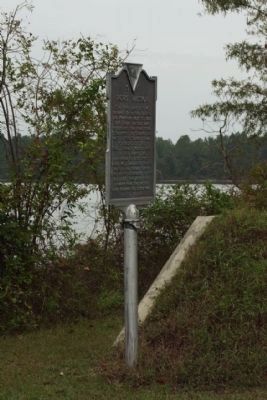
2. Fort Watson Marker
This is a photo of the marker before it was repainted.
National Register of Historic Places :
Santee Indian Mound and Fort Watson ** (added 1969 - Site - #69000164)
Photographed by Mike Stroud, October 11, 2009
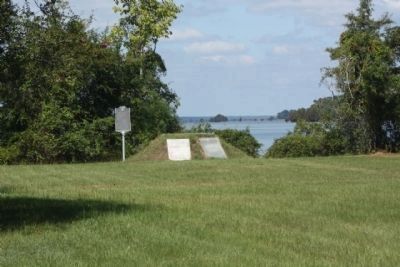
3. Fort Watson Marker, with Lake Marion, (nee Santee River), in background
♦ Historic Significance: Information Potential
♦ Area of Significance: Prehistoric
♦ Cultural Affiliation: Native American
♦ Period of Significance: 1499-1000 AD
♦ Owner: State
♦ Historic Function: Domestic, Funerary, Religion
♦ Historic Sub-function: Ceremonial Site, Graves/Burials, Village Site
♦ Current Function: Landscape
♦ Current Sub-function: Park
Photographed by Mike Stroud, September 8, 2011
4. Fort Watson Marker shares location with Swamp Fox and 2nd Battle of Fort Watson Markers
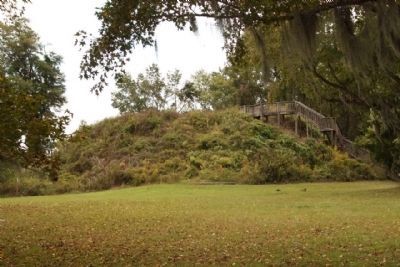
Photographed by Mike Stroud, October 23, 2009
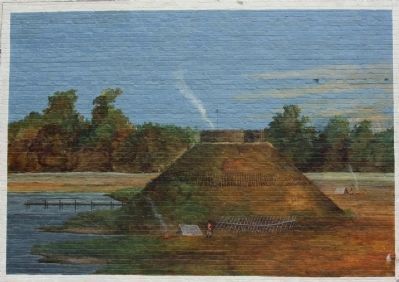
5. Fort Watson stood atop this Indian Mound, in 1871
coordinates 33.538998,-80.437646 for the Indian Mound / Fort Watson
Photographed by Mike Stroud, October 11, 2009
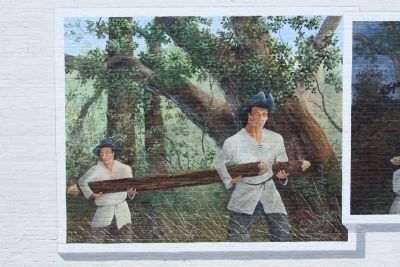
6. From the Swamp Fox Murals Trail, in nearby Summerton - Patriots hauling cut sapplings
Photographed by Mike Stroud, October 23, 2009
7. From the Swamp Fox Murals Trail - Patriots building the Maham Tower
Photographed by Mike Stroud, October 11, 2009
8. Fort Watson , From the Swamp Fox Murals Trail
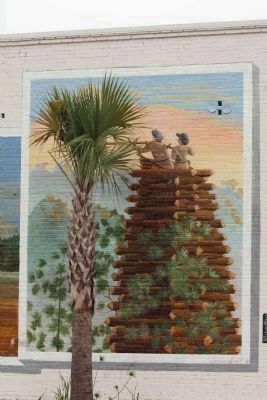
In his memoirs,(Lt. Col. Henry) Lee described the tower as a ``large, strong oblong pen, to be covered on the top with a floor of logs, and protected on the side opposite to the fort with a breastwork of light timbers.'' The use of the tower to attack a fortified position is an old practice known to the Romans. But to Hezekiah Maham must go the credit for re-inventing its use in the New World.
Photographed by Mike Stroud, October 11, 2009
9. Patriot sharpshooters fire on Fort Watson - from the Swamp Fox Murals Trail
Credits. This page was last revised on June 8, 2026. It was originally submitted on October 27, 2009, by Mike Stroud of Bluffton, South Carolina. This page has been viewed 2,418 times since then and 168 times this year. Last updated on June 6, 2026, by C Summers of Manning, South Carolina. Photos: 1. submitted on October 22, 2025, by C Summers of Manning, South Carolina. 2, 3. submitted on October 27, 2009, by Mike Stroud of Bluffton, South Carolina. 4. submitted on October 3, 2011, by Mike Stroud of Bluffton, South Carolina. 5, 6, 7, 8, 9. submitted on October 27, 2009, by Mike Stroud of Bluffton, South Carolina. • Devry Becker Jones was the editor who published this page.
Editor’s want-list for this marker. A wide shot of the repainted marker in its context. • Can you help?
