
Monacnapa in Cork in County Cork, Munster, Ireland — Irish South-West ((Éire) North Atlantic Ocean)
Blarney House
Photographed by Ian Lefkowitz, May 15, 2026
1. Blarney House Marker
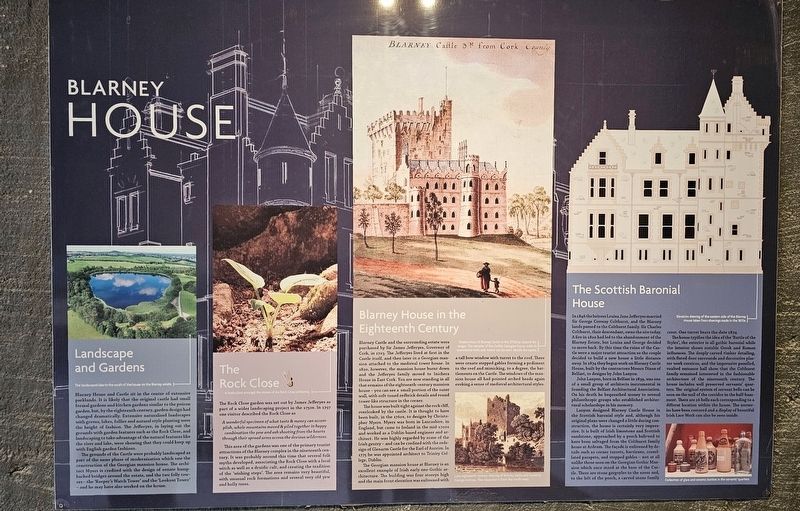
Landscape and Gardens
The landscaped lake to the south of the house on the Blarney estate.
Blarney House and Castle sit in the centre of extensive parklands. It is likely that the original castle had small formal gardens and kitchen gardens similar to the poison garden, but, by the eighteenth century, garden design had changed dramatically. Extensive naturalised landscapes with groves, lakes, follies and natural style planting were the height of fashion. The Jefferyes, in laying out the grounds with garden features such as the Rock Close, and landscaping to take advantage of the natural features like the river and lake, were showing that they could keep up with English garden fashions.
The grounds of the Castle were probably landscaped as part of the same phase of modernisation which saw the construction of the Georgian mansion house. The architect Myers is credited with the design of ornate hump-backed bridges around the estate, and the two folly towers — the ‘Keeper’s Watch Tower’ and the ‘Lookout Tower’ — and he may have also worked on the house.
The Rock Close
A hosta plant amongst the stones of the Rock Close at Blarney.
The
this page online
A wonderful specimen of what taste & money can accomplish, whole mountains moved & piled together in happy combination the yew and ash shooting from the hearts through their spread arms across the devious wilderness.
This area of the gardens was one of the primary tourist attractions of the Blarney complex in the nineteenth century. It was probably around this time that several folk myths developed, associating the Rock Close with a local witch as well as a druidic cult, and creating the tradition of the ‘wishing steps’. The area remains very beautiful, with unusual rock formations and several very old yew and holly trees.
Blarney House in the Eighteenth Century
Watercolour of Blarney Castle in the 1770s by Gabriel Beranger. The remains of the Gothic Georgian house with its crenellated walls and tower can be seen beside the castle.
Blarney Castle and the surrounding estate were purchased by Sir James Jefferyes, Governor of Cork, in 1703. The Jefferyes lived at first in the Castle itself,
Photographed by Ian Lefkowitz, May 15, 2026
2. Blarney House Marker
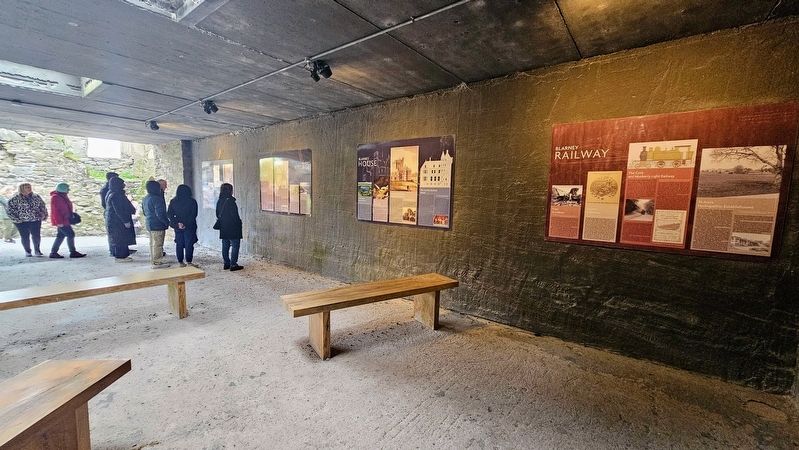
The marker is one of four located in an open-air alcove that used to be a portion of the mansion house.
The house was built tight against the rock cliff, overlooked by the castle. It is thought to have been built, in the 1760s, to designs by Christopher Myers. Myers was born in Lancashire, in England, but came to Ireland in the mid-1700s and worked as a Dublin-based engineer and architect. He was highly regarded by some of the Irish gentry — and can be credited with the redesign of Glenarm Castle for the Earl of Antrim. In 1775 he was appointed architect to Trinity College, Dublin.
The Georgian mansion house at Blarney is an excellent example of Irish early neo-Gothic architecture. The building was four storeys high and the main front elevation was enlivened with a tall bow window with turret to the roof. There were ornate stepped gables forming a pediment to the roof and mingling, to a degree, the battlements on the Castle. The windows of the mansion house all had pointed arched heads again evoking a sense of medieval architectural styles.
Late-eighteenth-century military survey of Blarney castle and house by George Holmes. The viewpoint is from the north-west.
The Scottish Baronial House
Elevation drawing of the eastern side of the Blarney House taken from drawings made in the 1870s.
In 1846 the heiress Louisa Jane Jefferyes married Sir George Conway Colthurst, and the Blarney lands passed to the Colthurst family. Sir Charles Colthurst, their descendant, owns the site today. A fire in 1820 had led to the abandonment of the Blarney Estate, but Louisa and George decided to move back. By this time the ruins of the Castle were a major tourist attraction so the couple decided to build a new house a little distance away. In 1874 they began work on Blarney Castle House, built by the contractors Messrs Dixon of Belfast, to designs by John Lanyon.
John Lanyon, born in Belfast in 1839, was one of a small group of architects instrumental in founding the Belfast Architectural Association. On his death he bequeathed money to several philanthropic groups who established architectural scholarships in his memory.
Lanyon designed Blarney Castle House in the Scottish baronial style and, although his original plans were changed a little during construction, the house is certainly very impressive. It is built of Irish limestone and Scottish sandstone, approached by a porch believed to have been salvaged from the Colthurst family home at Ardrum. The facade is enlivened by details such as corner turrets, bartizans, crenellated parapets, and stepped gables — not at all unlike those seen on the Georgian Gothic Mansion which once stood at the base of the Castle. There are strong gargoyles to the eaves and, to the left of the porch, a carved stone family crest. One turret bears the date 1874.
The house typifies the idea of the ‘Battle of the Styles’, the exterior is all gothic baronial while the interior shows notable Greek and Roman influences. The deeply carved timber detailing, with fluted door surrounds and decorative plaster work cornices, and the impressive panelled vaulted entrance hall show that the Colthurst family remained interested in the fashionable architecture of the nineteenth century. The house includes well preserved servants’ quarters. The original system of servant bells can be seen on the wall of the corridor in the half-basement. There are 26 bells each corresponding to a different location within the house. The interiors have been restored and a display of beautiful Irish Lace Work can also be seen inside.
Collection of glass and ceramic bottles in the servants’ quarters.
Topics. This historical marker is listed in these topic lists: Architecture • Forts and Castles • Horticulture & Forestry. A significant historical year for this entry is 1874.
Location. 51° 55.743′ N, 8° 34.241′ W. Marker is in Cork, Munster, in County Cork. It is in Monacnapa. It can be reached from Blarney Castle Estate. The marker is located on the grounds of Blarney Castle & Gardens. Touch for map. Marker is at or near this postal address: Blarney Castle Estate, Cork, Munster, Ireland. Touch for directions.

Regionally, it is on the Atlantic Ocean, in the North Atlantic Region, on the Atlantic Arc, in Europe, on the Island of Ireland, on the Celtic Fringe, in the European Union, in Atlantic Europe, on one of the British Isles, in the Western World, and in the Anglosphere.
Other nearby markers. At least 8 other markers are within walking distance of this marker: Blarney Railway (here, next to this marker); Blarney Castle (here, next to this marker); Blarney Village (here, next to this marker); Murder Hole (here, next to this marker); Blarney Castle Timeline (here, next to this marker); The Court (here, next to this marker); Jefferyes & Colthurst Family History (here, next to this marker); Oubliette (here, next to this marker). Touch for a list and map of all markers in Cork.
Also see . . . Blarney House (Historic Houses of Ireland).
When her first children died, Lady Colthurst demanded to be given a new house at Blarney on an elevated site. This was built in the Scots Baronial style by Sir Thomas Lanyon of Belfast who, rather surprisingly, incorporated a number of classical details from the recently demolished Ardrum into the design. Their very high quality shows that Ardrum was an extremely important building, about which nothing is known today.(Submitted on June 6, 2026, by Ian Lefkowitz of New York, New York.)
Credits. This page was last revised on June 8, 2026. It was originally submitted on June 6, 2026, by Ian Lefkowitz of New York, New York. This page has been viewed 9 times since then. Photos: 1, 2. submitted on June 6, 2026, by Ian Lefkowitz of New York, New York. • Andrew Ruppenstein was the editor who published this page.
