
Monacnapa in Cork in County Cork, Munster, Ireland — Irish South-West ((Éire) North Atlantic Ocean)
Blarney Village
Photographed by Ian Lefkowitz, May 15, 2026
1. Blarney Village Marker
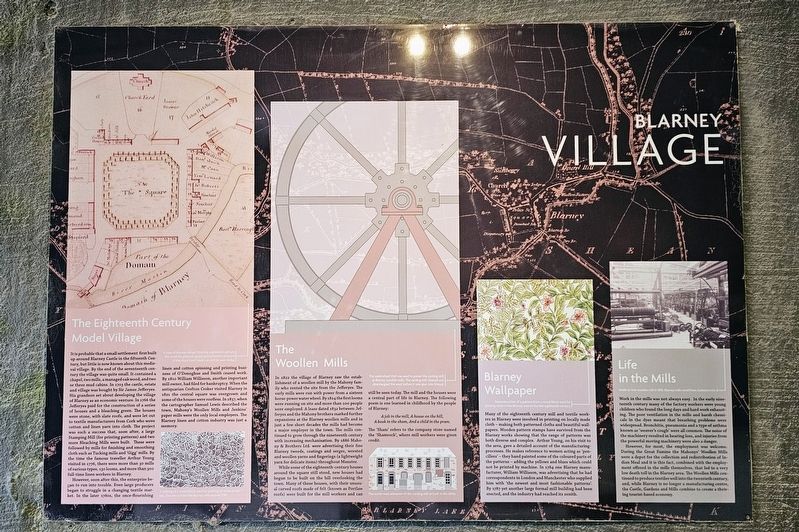
The Eighteenth Century Model Village
A map of Blarney village from the eighteenth century. The carefully planned square and symmetrical layout of the streets and houses still survives today.
It is probable that a small settlement first built up around Blarney Castle in the fifteenth century, but little is now known about this medieval village. By the end of the seventeenth century the village was quite small. It contained a chapel, two mills, a managed oak wood, and two or three mud cabins. In 1703 the castle, estate and village was bought by Sir James Jefferyes. His grandson set about developing the village of Blarney as an economic venture. In 1756 the Jefferyes paid for the construction of a series of houses and a bleaching green. The houses were stone, with slate roofs, and were let out to textile manufacturers from Cork who wove cotton and linen yarn into cloth. The project was such a success that, soon after, a large Stamping Mill (for printing patterns) and two more Bleaching Mills were built. These were followed by mills for finishing and smoothing cloth such as Tucking mills and ‘Gigg’ mills. By the time the famous
this page online
However, soon after this, the enterprise began to run into trouble. Even large producers began to struggle in a changing textile market. In the later 1780s, the once-flourishing linen and cotton spinning and printing business of O’Donoghue and Smith ceased work. By 1810 William Willisson, another important mill owner, had filed for bankruptcy. When the antiquarian Crofton Croker visited Blarney in 1821 the central square was overgrown and some of the houses were roofless. In 1837, when the cartographer Samuel Lewis described the town, Mahony’s Woollen Mills and Jenkins’ paper mills were the only local employers. The Blarney linen and cotton industry was just a memory.
A rubbing of a wood block used for printing on linen or cotton. This piece is from the Blarney area around 1760.
The Woollen Mills
The waterwheel that was used to power the carding mill at Blarney woollen mills. The carding mill cleaned and disentangled the wool before it was spun into thread.
In 1822 the village of Blarney
Photographed by Ian Lefkowitz, May 15, 2026
2. Blarney Village Marker
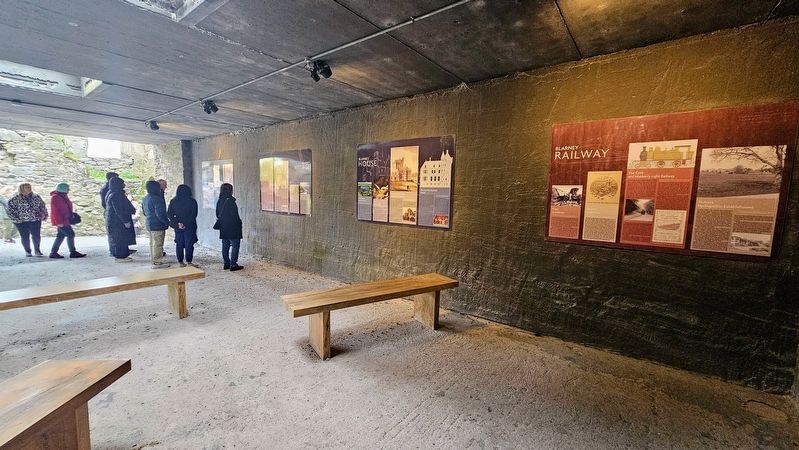
The marker is the second of four found in an open-air alcove on the grounds beneath Blarney Castle.
A job in the mill, A house on the hill,
A book in the sham, And a child in the pram.
The ‘Sham’ refers to the company store named the ‘Shamrock’, where mill workers were given credit.
The south-west elevation of the carding mill as built in the 1850s.
Blarney Wallpaper
Reconstruction of a pattern from a wood block used for printing cloth in the Blarney area in the late eighteenth century.
Many of the eighteenth century mill and textile workers in Blarney were involved in printing on locally made cloth — making both patterned cloths and beautiful wallpapers. Wooden pattern stamps have survived from the Blarney works showing that the range of patterns was both diverse and complex. Arthur Young, on his visit to the area, gave a detailed account of the manufacturing processes. He makes reference to women acting as ‘pencillers’ — they hand painted some of the coloured parts of the patterns — adding the yellows and blues which could not be printed by machine. In 1784 one Blarney manufacturer, William Willisson, was advertising that he had correspondents in London and Manchester who supplied him with ‘the newest and most fashionable patterns’. By 1787 yet another large formal mill building had been erected, and the industry had reached its zenith.
Life in the Mills
Inside an Irish woollen mill in 1895. Blarney mills would have looked similar.
Work in the mills was not always easy. In the early nineteenth century many of the factory workers were young children who found the long days and hard work exhausting. The poor ventilation in the mills and harsh chemicals in the dyes meant that breathing problems were widespread. Bronchitis, pneumonia and a type of asthma known as ‘weaver’s cough’ were all common. The noise of the machinery resulted in hearing loss, and injuries from the powerful moving machinery were also a danger.
However, for most, the employment was welcome. During the Great Famine the Mahonys’ Woollen Mills were a depot for the collection and redistribution of Indian Meal and it is this fact, combined with the employment offered in the mills themselves, that led to a very low death toll in the Blarney area. The Woollen Mills continued to produce textiles well into the twentieth century, and, while Blarney is no longer a manufacturing centre, the Castle, Gardens and Mills combine to create a thriving tourist-based economy.
Topics. This historical marker is listed in this topic list: Industry & Commerce.
Location. 51° 55.743′ N, 8° 34.241′ W. Marker is in Cork, Munster, in County Cork. It is in Monacnapa. It can be reached from Blarney Castle Estate. The marker is located on the grounds of Blarney Castle & Gardens. Touch for map. Marker is at or near this postal address: Blarney Castle Estate, Cork, Munster, Ireland. Touch for directions.

Regionally, it is on the Atlantic Ocean, in the North Atlantic Region, on the Atlantic Arc, in Europe, on the Island of Ireland, on the Celtic Fringe, in the European Union, in Atlantic Europe, on one of the British Isles, in the Western World, and in the Anglosphere.
Other nearby markers. At least 8 other markers are within walking distance of this marker: Blarney House (here, next to this marker); Blarney Railway (here, next to this marker); Blarney Castle (here, next to this marker); Murder Hole (here, next to this marker); Blarney Castle Timeline (here, next to this marker); The Court (here, next to this marker); Jefferyes & Colthurst Family History (here, next to this marker); Oubliette (here, next to this marker). Touch for a list and map of all markers in Cork.
Credits. This page was last revised on June 8, 2026. It was originally submitted on June 6, 2026, by Ian Lefkowitz of New York, New York. This page has been viewed 12 times since then. Photos: 1, 2. submitted on June 6, 2026, by Ian Lefkowitz of New York, New York. • Andrew Ruppenstein was the editor who published this page.
