Hebron in Capitol Region, Connecticut — The American Northeast (New England)
Hebron
Photographed by Michael Herrick, September 19, 2019
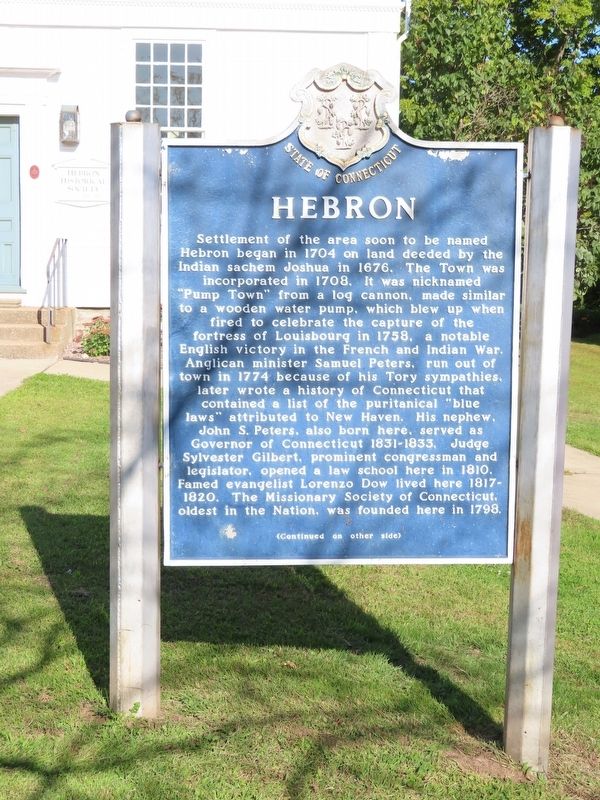
1. Hebron Marker
Settlement of the area soon to be named Hebron began in 1704 on land deeded by the Indian sachem Joshua in 1676. The Town was incorporated in 1708. It was nicknamed “Pump Town” from a log cannon, made similar to a wooden water pump, which blew up when fired to celebrate the capture of the fortress of Louisbourg in 1758, a notable English victory in the French and Indian War. Anglican minister Samuel Peters, run out of town in 1774 because of his Tory sympathies, later wrote a history of Connecticut that contained a list of the puritanical "blue laws" attributed to New Haven. His. nephew, John S. Peters, also born here, served as Governor of Connecticut 1831-1833. Judge Sylvester Gilbert, prominent congressman and legislator, opened a law school here in 1810. Famed evangelist Lorenzo Dow lived here 1817- 1820. The Missionary Society of Connecticut oldest in the Nation, was founded here in 1798.
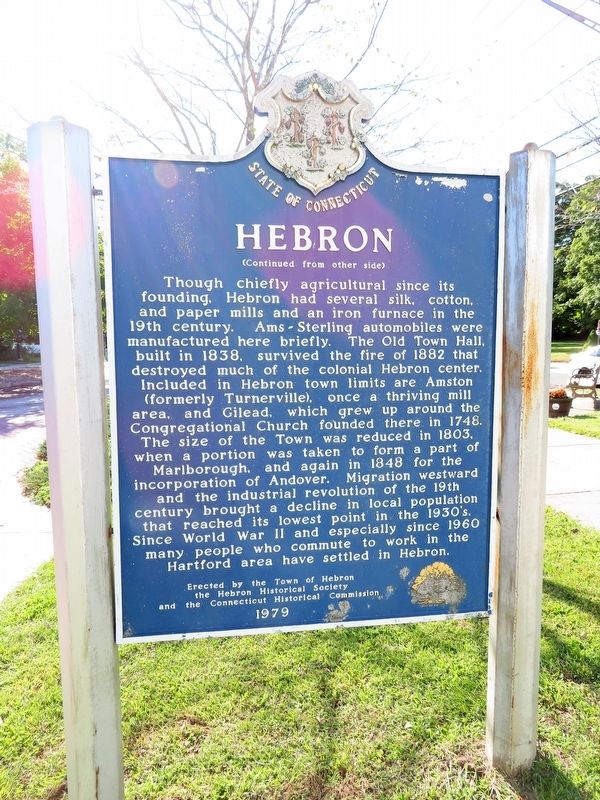
Though chiefly agricultural since its founding. Hebron had several silk, cotton, and paper mills and an iron furnace in the 19th century. Ams-Sterling automobiles were manufactured here briefly. The Old Town Hall, built in 1838,
this page online
Erected 1979 by Town of Hebron, Hebron Historical Society, & Connecticut Historical Commission.
Topics. This historical marker is listed in this topic list: Settlements & Settlers. A significant historical year for this entry is 1704.
Location. 41° 39.506′ N, 72° 21.838′ W. Marker is in Hebron in Capitol Region, Connecticut. It is at the intersection of Main Street (Connecticut Route 66) and Hebron Center Road, on the left when traveling west on Main Street. Located
Photographed by Michael Herrick, September 19, 2019
2. Hebron Marker

Regionally, this marker is in the Quiet Corner. It is also in the American Northeast and in New England. Globally, it is in North America, the Western Hemisphere, the Western World, and the Anglosphere. Historically, it finds itself in what was once Tolland County and also one of the original Thirteen Colonies.
Other nearby markers. At least 8 other markers are within 5 miles of this marker, measured as the crow flies: Missionary Society of Connecticut (about 500 feet away, measured in a direct line); Hebron Civil War Monument (about 600 feet away); Hebron World War I (about 700 feet away); World War II, Korean, and Vietnam Conflicts Monument (about 700 feet away); Hebron Court of Honor (about 700 feet away); Observation Post 52 (approx. ¼ mile away); Columbia (approx. 4.4 miles away); Eleazar Wheelock D.D. (approx. 4.4 miles away). Touch for a list and map of all markers in Hebron.
Also see . . .
1. Town of Hebron. (Submitted on October 5, 2019, by Michael Herrick of Southbury, Connecticut.)
2. Hebron, Connecticut on Wikipedia.
Photographed by Michael Herrick, September 19, 2019
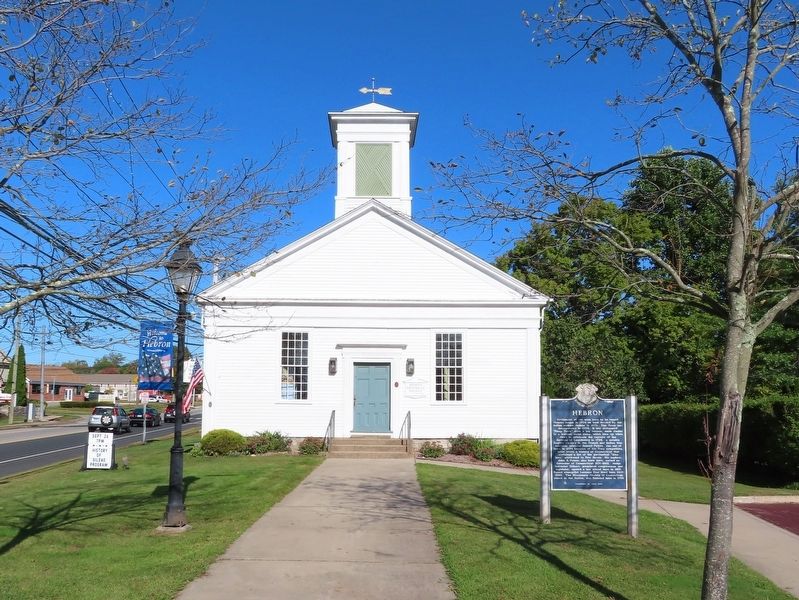
3. Hebron Marker and Hebron Old Town Hall, now the Hebron Historical Society
Credits. This page was last revised on June 8, 2026. It was originally submitted on October 5, 2019. This page has been viewed 858 times since then and 108 times this year. Last updated on June 6, 2026. Photos: 1, 2, 3. submitted on October 5, 2019, by Michael Herrick of Southbury, Connecticut. • Devry Becker Jones was the editor who published this page.
