Near Burgaw in Pender County, North Carolina — The American South (South Atlantic)
George Burrington
ca. 1682–1759
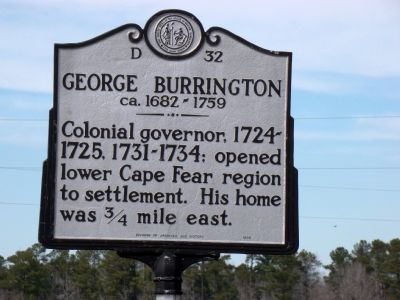
Photographed by J. J. Prats, February 27, 2010
1. George Burrington Marker
Erected 1999 by Division of Archives and History. (Marker Number D-32.)
Topics and series. This historical marker is listed in this topic list: Colonial Era. In addition, it is included in the North Carolina Division of Archives and History series list. A significant historical year for this entry is 1725.
Location. 34° 32.167′ N, 77° 54.433′ W. Marker is near Burgaw, North Carolina, in Pender County. It is on U.S. 117 just south of Business U.S. 117, on the right when traveling north. Touch for map. Marker is in this post office area: Burgaw NC 28425, United States of America. Touch for directions.

Regionally, this marker is in the Coastal Plain. It is also in the American South, specifically in the Upper South, in the Tidewater, and on the Eastern Seaboard. Globally, it is in the North Atlantic Region, North America, the Western Hemisphere, the Western World, and the Anglosphere. Historically, it finds itself in what was once the territory of the Mississippian Culture, one of the
this page online
Other nearby markers. At least 8 other markers are within 2 miles of this marker, measured as the crow flies: Stag Park (here, next to this marker); S. S. Satchwell (approx. 1.3 miles away); Burgaw Presbyterian Church (approx. 1.4 miles away); Pender County Veterans Memorial (approx. 1.4 miles away); Pender County Court House (approx. 1½ miles away); Our Heroes (approx. 1½ miles away); Company K. 3rd N.C. Infantry Regiment, C.S.A. (approx. 1½ miles away); Burgaw Depot (approx. 1½ miles away). Touch for a list and map of all markers in Burgaw.
Also see . . . George Burrington. “George Burrington is known as the first ‘Royal Governor’ of North Carolina. He was first appointed Governor of North Carolina on January 15, 1724, because his father had been active in support of the British government at the accession of George I. Burrington was ignorant and profligate, and on 7 April, 1725, was succeeded by Sir Richard Everard.
“His retirement angered him so much that he proceeded to make himself disagreeable to
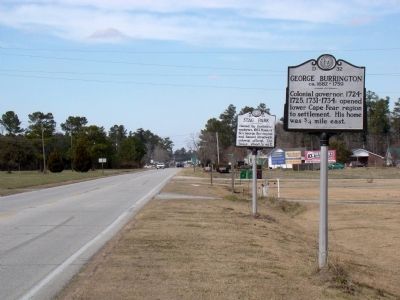
Photographed by J. J. Prats, February 27, 2010
2. George Burrington and Stag Park Markers
“He arrived the second time in February, 1731, and conducted himself with such a want of prudence as to increase the number of his enemies. Riding across the country one day, and observing that a poor man had built a cabin on his land, the governor ordered his servant to burn the cabin. Finally, knowing that Smith, late chief justice of the colony, had been sent to England by the council to complain of him, Burrington left, in April, 1734, ostensibly on a visit to South Carolina, but went immediately to England. Some time after this he engaged in a drunken frolic in London, and was found murdered one morning in St. James’s park—he died there in 1734.” (Submitted on April 28, 2010.)
Credits. This page was last revised on June 16, 2016. It was originally submitted on April 28, 2010, by J. J. Prats of Powell, Ohio. This page has been viewed 1,132 times since then and 40 times this year. Photos: 1, 2. submitted on April 28, 2010, by J. J. Prats of Powell, Ohio.
