Old Wethersfield in Capitol Region, Connecticut — The American Northeast (New England)
Trinity Parish
Building With Faith in the Future
| — | Wethersfield Heritage Walk | — |
Photographed by Conrad Ward, May 25, 2025
1. Trinity Parish Marker
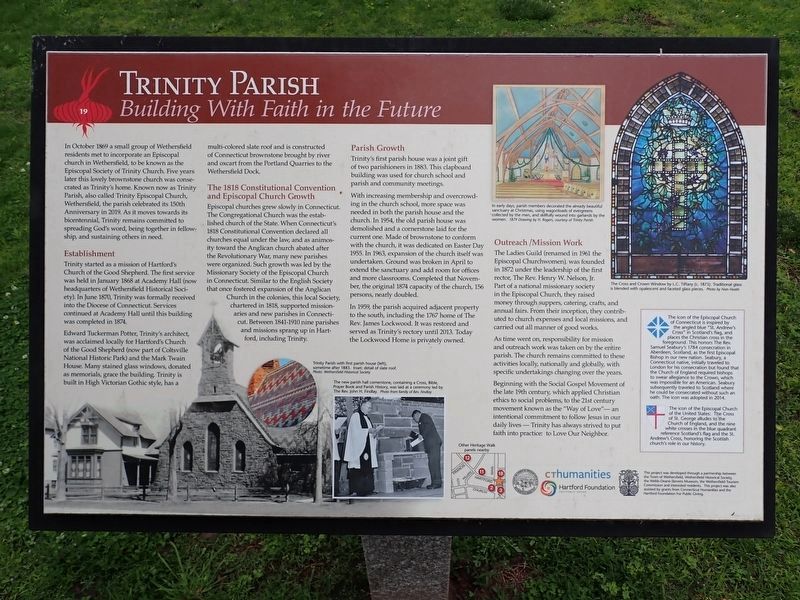
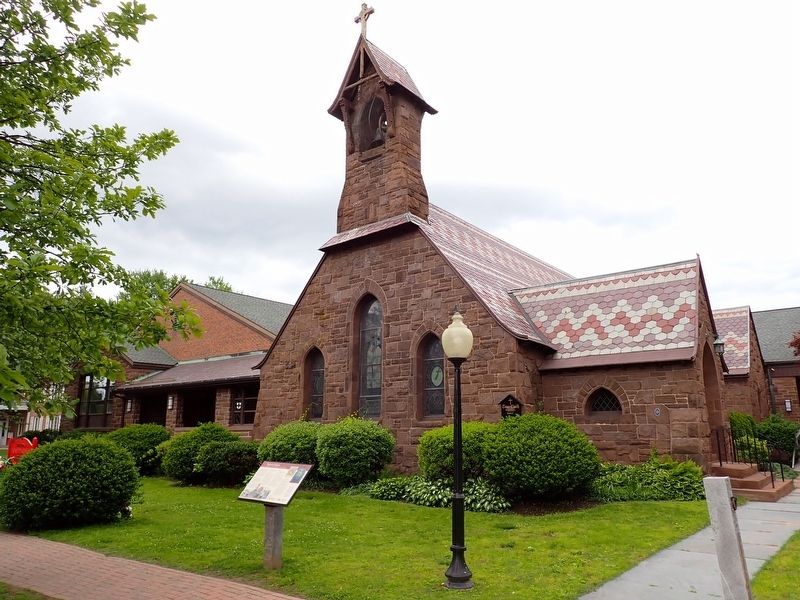
In October 1869 a small group of Wethersfield residents met to incorporate an Episcopal church in Wethersfield, to be known as the Episcopal Society of Trinity Church. Five years later this lovely brownstone church was consecrated as Trinity’s home. Known now as Trinity Parish, also called Trinity Episcopal Church, Wethersfield, the parish celebrated its 150th Anniversary in 2019. As it moves towards its bicentennial, Trinity remains committed to spreading God’s word, being together in fellowship, and sustaining others in need.
Establishment
Trinity started as a mission of Hartford’s Church of the Good Shepherd. The first service was held in January 1868 at Academy Hall (now headquarters of Wethersfield Historical Society). In June 1870, Trinity was formally received into the Diocese of Connecticut. Services continued at Academy Hall until this building was completed in 1874.
Edward Tuckerman Potter, Trinity’s architect, was acclaimed locally for Hartford’s Church of the Good Shepherd (now part of Coltsville National Historic Park) and the Mark Twain House. Many stained glass windows, donated as memorials, grace
this page online
The 1818 Constitutional Convention and Episcopal Church Growth
Episcopal churches grew slowly in Connecticut. The Congregational Church was the established church of the State. When Connecticut’s 1818 Constitutional Convention declared all churches equal under the law, and as animosity toward the Anglican church abated after the Revolutionary War, many new parishes were organized. Such growth was led by the Missionary Society of the Episcopal Church in Connecticut. Similar to the English Society that once fostered expansion of the Anglican Church in the colonies, this local Society, chartered in 1818, supported missionaries and new parishes in Connecticut. Between 1841-1910 nine parishes and missions sprang up in Hartford, including Trinity.
Parish Growth
Trinity’s first parish house was a joint gift of two parishioners in 1883. This clapboard building was used for church school and parish and community meetings.
With
Photographed by Conrad Ward, May 25, 2025
2. Trinity Parish Marker
In 1959, the parish acquired adjacent property to the south, including the 1767 home of The Rev. James Lockwood. It was restored and served as Trinity’s rectory until 2013. Today the Lockwood Home is privately owned.
Outreach / Mission Work
The Ladies Guild (renamed in 1961 the Episcopal Churchwomen), was founded in 1872 under the leadership of the first rector, The Rev. Henry W. Nelson, Jr. Part of a national missionary society in the Episcopal Church, they raised money through suppers, catering, crafts, and annual fairs. From their inception, they contributed to church expenses and local missions, and carried out all manner of good works.
As time went on, responsibility for mission and outreach work was taken on by the entire parish. The church remains committed to these activities locally, nationally and globally, with specific undertakings changing over the years.
Beginning with the Social Gospel Movement of the late 19th century, which applied Christian ethics to social problems, to the 21st century movement known as the “Way of Love”—an intentional commitment to follow Jesus in our daily lives—Trinity has always strived to put faith into practice: to Love Our Neighbor.
The icon of the Episcopal Church of Connecticut is inspired by the angled blue “St. Andrew’s Cross” in Scotland’s flag, and places the Christian cross in the foreground. This honors The Rev. Samuel Seabury’s 1784 consecration in Aberdeen, Scotland, as the first Episcopal Bishop in our new nation. Seabury, a Connecticut native, initially traveled to London for his consecration but found that the Church of England required bishops to swear allegiance to the Crown, which was impossible for an American. Seabury subsequently traveled to Scotland where he could be consecrated without such an oath. The icon was adopted in 2014.
The icon of the Episcopal Church of the United States: The Cross of St. George alludes to the Church of England, and the nine white crosses in the blue quadrant reference Scotland’s flag and the St. Andrew’s Cross, honoring the Scottish church’s role in our history.
[Captions:]
In early days, parish members decorated the already beautiful sanctuary at Christmas, using wagonloads of evergreens collected by the men, and skillfully wound into garlands by the women. 1879 Drawing by H. Rogers, courtesy of Trinity Parish
The Cross and Crown Window by L.C. Tiffany (c. 1873). Traditional glass is blended with opalescent and faceted glass pieces. Photo by Nan Heath
Trinity Parish with first parish house (left), sometime after 1883. Inset: detail of slate roof. Photo: Wethersfield Historical Society
The new parish hall cornerstone, containing a Cross, Bible, Prayer Book and Parish History, was laid at a ceremony led by The Rev. John H. Findlay. Photo from family of Rev. Findlay
Erected 2016 by Town of Wethersfield, Wethersfield Historical Society, Webb-Deane-Stevens Museum, Wethersfield Tourism Commission, Wethersfield Residents, Connecticut Humanities, & Hartford Foundation For Public Giving. (Marker Number 19.)
Topics. This historical marker is listed in these topic lists: Architecture • Education • Religion & Religious Structures. A significant historical year for this entry is 1874.
Location. 41° 42.89′ N, 72° 39.148′ W. Marker is in Wethersfield in Capitol Region, Connecticut. It is in Old Wethersfield. It can be reached from Main Street north of Hartford Avenue, on the right when traveling north. Touch for map. Marker is at or near this postal address: 300 Main Street, Wethersfield CT 06109, United States of America. Touch for directions.

Regionally, this marker is in the Connecticut River Valley, in Greater Hartford, and in the Knowledge Corridor. It is also in the American Northeast and in New England. Globally, it is in North America, the Western Hemisphere, the Western World, and the Anglosphere. Historically, it finds itself in what was once Hartford County and also one of the original Thirteen Colonies.
Other nearby markers. At least 8 other markers are within walking distance of this marker: The Cradle of American Seed Companies (within shouting distance of this marker); The Stillman Tavern (about 300 feet away, measured in a direct line); Comstock, Ferre & Co. (about 500 feet away); Washington – Rochambeau Revolutionary Route (approx. 0.2 miles away); Webb House (approx. 0.2 miles away); Society of the Cincinnati (approx. 0.2 miles away); a different marker also named Webb House (approx. 0.2 miles away); Silas Deane House (approx. 0.2 miles away). Touch for a list and map of all markers in Wethersfield.
Credits. This page was last revised on June 12, 2026. It was originally submitted on June 6, 2026, by Conrad Ward of Guilford, Connecticut. This page has been viewed 13 times since then. Photos: 1, 2. submitted on June 6, 2026, by Conrad Ward of Guilford, Connecticut. • Devry Becker Jones was the editor who published this page.
