Heiloo, North Holland, Netherlands — Northwestern Europe
Heilige Willibrordus
⎯⎯⎯
St. Willibrord

Photographed by Andrew Ruppenstein, May 31, 2026
1. Heilige Willibrordus / St. Willibrord Marker
Note that the QR code on the marker leads to an audio podcast (3:38, in Dutch).

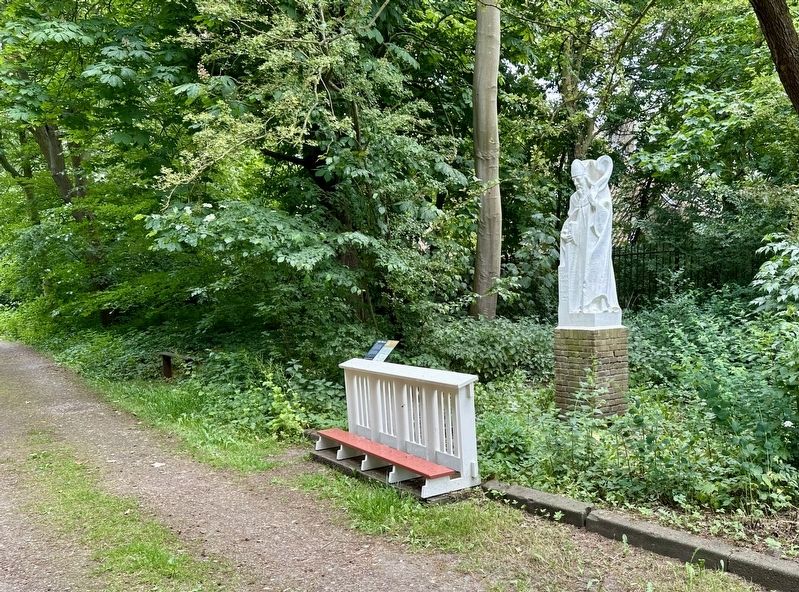
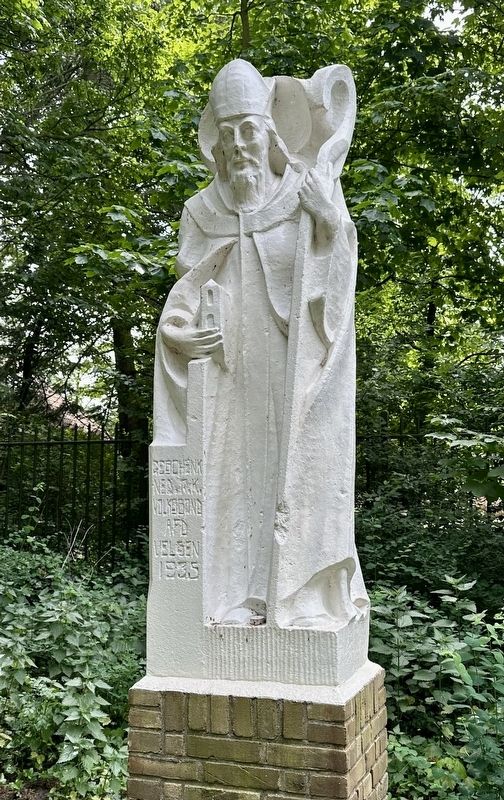
Dit Willibrordusbeeld is in 1935 vervaardigd door de Haagse beeldhouwer Pieter Biesiot (1890-1980). Het wit geschilderde natuurstenen beeld toont De heilige Willibrordus met zijn attributen. In de linkerhand draagt hij, als aartsbisschop, zijn bisschopsstaf en in de rechterhand een kerkmodel. De kerk in zijn handen verwijst naar zijn missionaire levensdoel om het geloof te verkondigen en kloosters en kerken te bouwen.
De heilige Willibrordus was een gedreven missionaris en bracht het geloof over op niet gelovigen door over Jezus te vertellen. Welke verhaal vertel jij graag aan anderen?
Saint
this page online
This statue of Willibrord was created in 1935 by the Hague sculptor Pieter Biesiot (1890-1980). The white-painted natural stone statue depicts Saint Willibrord with his attributes. In his left hand, as an archbishop, he holds his bishop's staff, and in his right hand, a model of a church. The church in his hands refers to his missionary life's goal of proclaiming the faith and building monasteries and churches.
Saint Willibrord was a driven missionary and conveyed the faith to non-believers by telling them about Jesus. What story do you like to tell others?
(Marker Number 10.)
Topics. This
Photographed by Andrew Ruppenstein, May 31, 2026
2. Heilige Willibrordus / St. Willibrord Statue and Marker
Location. 52° 34.997′ N, 4° 41.209′ E. Marker is in Heiloo, Noord-Holland (North Holland). It can be reached from Runxputteweg, on the right when traveling north. Touch for map. Marker is at or near this postal address: Runxputteweg 24, Heiloo, Noord-Holland 1851 PM, Netherlands. Touch for directions.

Regionally, it is in Europe, the European Union, Atlantic Europe, the Benelux Low Countries, the Schengen Area, Western Europe, and the Western World. Historically, it finds itself in what was once the Holy Roman Empire.
Other nearby markers. At least 8 other markers are within 5 kilometers of this marker, measured as the crow flies: Runxputte / The “Runx” Well (within shouting distance of this marker); Genadekapel / Chapel of Grace (within shouting distance of this marker); Onze lieve Vrouwe ter Nood / Our Lady in Need (about 90 meters away, measured in a direct line); Jan Brasser (approx. 0.7 kilometers away); Het Schuilveld / The Sheltering Field (approx. 0.7 kilometers
Photographed by Andrew Ruppenstein, May 31, 2026
3. Heilige Willibrordus / St. Willibrord Statue
More about this marker. The marker is located on the grounds of the Our Lady of Ter Nood complex, just a few steps in as one enters from the Runxputteweg entrance.
Also see . . . Willibrord. Overview:
Willibrord (Latin: Villibrordus; c. 658 – 7 November AD 739) was an Anglo-Saxon monk, bishop, and missionary. He became the first Bishop of Utrecht in what is now the Netherlands, dying at Echternach in Luxembourg, and is known as the "Apostle to the Frisians".(Submitted on June 7, 2026.)
Credits. This page was last revised on June 7, 2026. It was originally submitted on June 7, 2026, by Andrew Ruppenstein of Lamorinda, California. This page has been viewed 22 times since then. Photos: 1, 2, 3. submitted on June 7, 2026, by Andrew Ruppenstein of Lamorinda, California.
