
Monacnapa in Cork in County Cork, Munster, Ireland — Irish South-West ((Éire) North Atlantic Ocean)
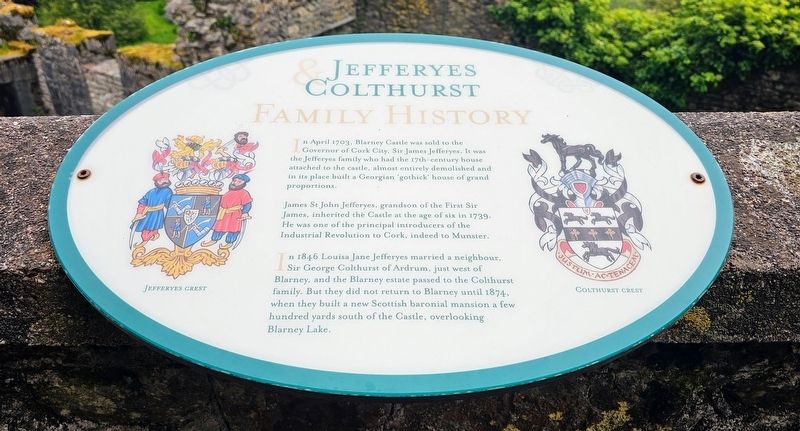
Jefferyes & Colthurst Family History
Photographed by Ian Lefkowitz, May 15, 2026
1. Jefferyes & Colthurst Marker
James St John Jefferyes, grandson of the First Sir James, inherited the Castle at the age of six in 1739. He was one of the principal introducers of the Industrial Revolution to Cork, indeed to Munster.
In 1846 Louisa Jane Jefferyes married a neighbour, Sir George Colthurst of Ardrum, just west of Blarney, and the Blarney estate passed to the Colthurst family. But they did not return to Blarney until 1874, when they built a new Scottish baronial mansion a few hundred yards south of the Castle, overlooking Blarney Lake.
Topics. This historical marker is listed in this topic list: Forts and Castles. A significant historical year for this entry is 1703.
Location. 51° 55.743′ N, 8° 34.24′ W. Marker is in Cork, Munster, in County Cork. It is in Monacnapa. It can be reached from Blarney Castle Estate. The marker is located on the grounds of Blarney Castle & Gardens.
this page online

Regionally, it is on the Atlantic Ocean, in the North Atlantic Region, on the Atlantic Arc, in Europe, on the Island of Ireland, on the Celtic Fringe, in the European Union, in Atlantic Europe, on one of the British Isles, in the Western World, and in the Anglosphere.
Other nearby markers. At least 8 other markers are within walking distance of this marker: The Court (here, next to this marker); Oubliette (here, next to this marker); MacCarthy Family History (here, next to this marker); Murder Hole (here, next to this marker); Blarney Railway (here, next to this marker); Blarney House (here, next to this marker); Blarney Village (here, next to this marker); Blarney Castle (here, next to this marker). Touch for a list and map of all markers in Cork.
Also see . . . James St John Jeffereyes (Wikipedia).
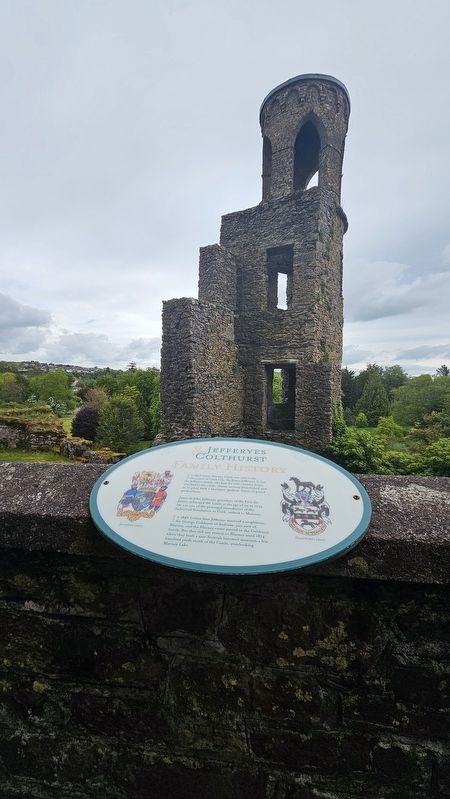
Jeffereyes was noted for his work as a reforming landlord on his Blarney Castle estate. During the 1760s and 1770s he spent over £8,000 as loans to manufacturers or in building premises(Submitted on June 8, 2026, by Ian Lefkowitz of New York, New York.)on the estate which he then leased out to encourage economic activity. He invested in improvement works, including housing for workers and water power for local industry. He granted favourable leases to residents and encouraged textile printers to come from Dublin to set up in his village; the thirteen factories on his estate in 1776 included a linen tape factory, a tuck mill, and a leather works.Photographed by Ian Lefkowitz, May 15, 20262. Jefferyes & Colthurst Family History MarkerThe marker faces the ruined gothic house on the way into Blarney Castle.
Credits. This page was last revised on June 8, 2026. It was originally submitted on June 8, 2026, by Ian Lefkowitz of New York, New York. This page has been viewed 9 times since then. Photos: 1, 2. submitted on June 8, 2026, by Ian Lefkowitz of New York, New York. • Andrew Ruppenstein was the editor who published this page.
