Lakeview in Chicago in Cook County, Illinois — The American Midwest (Great Lakes)
Into the Cubs Archives
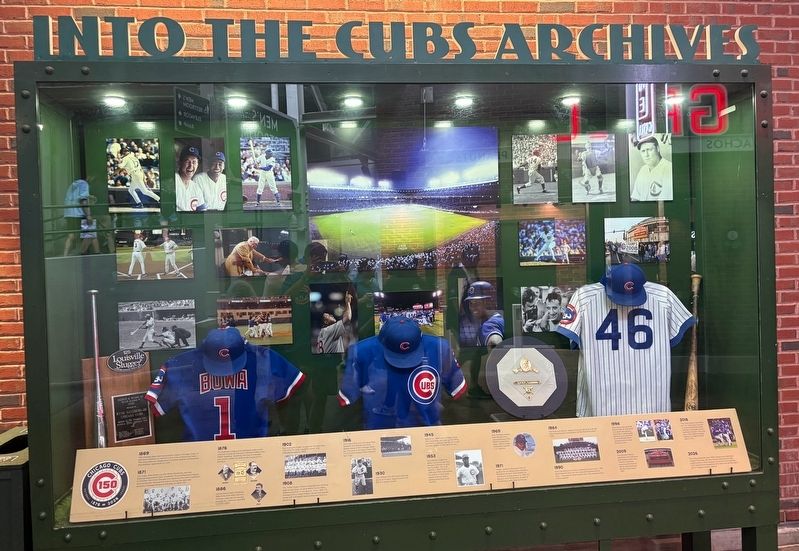
Photographed by Sean P. Flynn, June 5, 2026
1. Into the Cubs Archives Marker
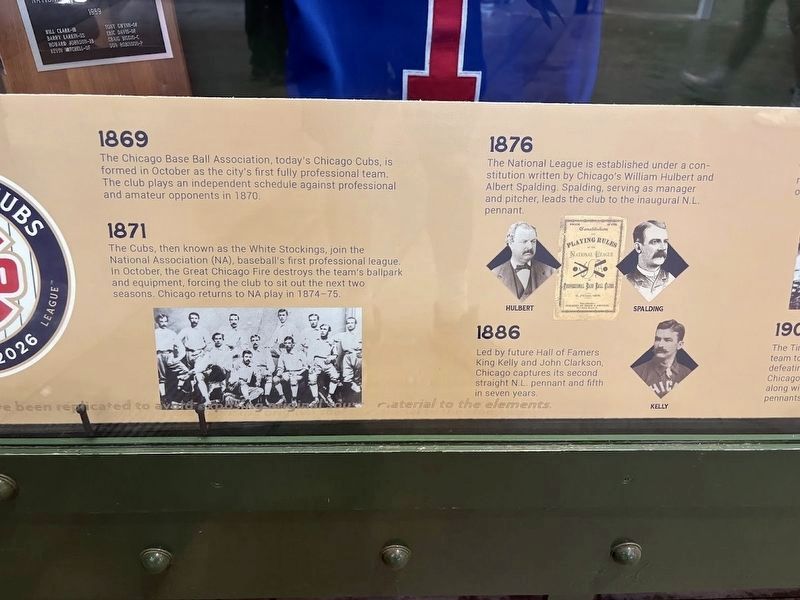
1869
The Chicago Base Ball Association, today's Chicago Cubs, is formed in October as the city's first fully professional team. The club plays an independent schedule against professional and amateur opponents in 1870.
1871
The Cubs, then known as the White Stockings, join the National Association (NA), baseball's first professional league. In October, the Great Chicago Fire destroys the team's ballpark and equipment, forcing the club to sit out the next two seasons. Chicago returns to NA play in 1874-75.
1876
The National League is established under a constitution written by Chicago's William Hulbert and Albert Spalding. Spalding, serving as manager and pitcher, leads the club to the inaugural N.L. pennant.
1886
Led by future Hall of Famers King Kelly and John Clarkson, Chicago captures its second straight N.L. pennant and fifth in seven years.
1902
The nickname "Cubs" is
this page online
1916
The Cubs move from the West Side Grounds into Weeghman Park, former home of the Chicago Federals. The park is renamed Cubs Park in 1919 and Wrigley Field in December 1926.
1908
The Tinker-Evers-Chance Cubs become the first team to win back-to-back World Series titles, defeating Detroit in five games. From 1906-10, Chicago wins a major league-record 530 games, along with two World Series titles and four N.L pennants.
1930
Hack Wilson hits 56 home runs and drives in a major league record 191 RBI in a single season.
1945
Behind N.L. MVP and Chicago native Phil Cavarretta, the Cubs go 98-56 to win the N.L. pennant but fall to Detroit in seven games in the World Series.
1953
Ernie Banks makes his debut, becoming the first African American to play for the Cubs. "Mr. Cub" wins N.L. MVP honors
Photographed by Sean P. Flynn, June 5, 2026
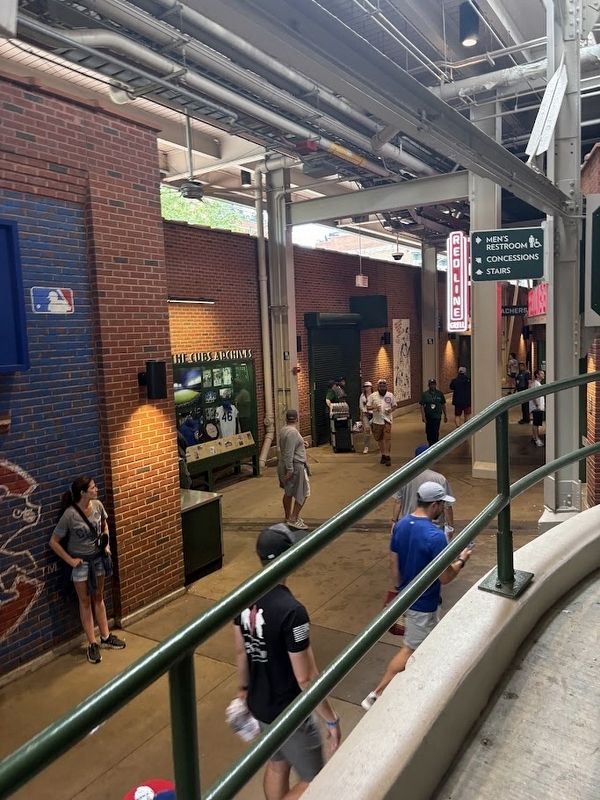
2. Into the Cubs Archives
The display is in the concourse beneath the right field bleachers at Wrigley Field.
1969
Billy Williams breaks Stan Musial's N.L. record playing in his 896th consecutive game. Billy's streak ultimately reaches 1,117 games.
1971
Fergie Jenkins, who would win 20 games for six consecutive seasons, becomes the first Cubs pitcher to win the Cy Young Award. In 1982, he became only the seventh pitcher in MLB history with 3000 strikeouts.
1984
The Cubs win the N.L. Eastern Division title with a 96-65 record, reaching the postseason for the first time since 1945.
1990
Ryne Sandberg hits an N.L. leading 40 home runs third-highest total ever by a second baseman at the time and sets an MLB record with 123 consecutive errorless games.
1998
Kerry Wood ties an MLB record with 20 strikeouts in a game and Sammy Sosa hits a club record 66 home runs, the first of an MLB best three seasons
Photographed by Sean P. Flynn, June 5, 2026
3. Into the Cubs Archives, 1869-1886
2009
The Ricketts family purchases the franchise and Wrigley Field from Tribune Company, returning the team to family ownership for the first time since 1981.
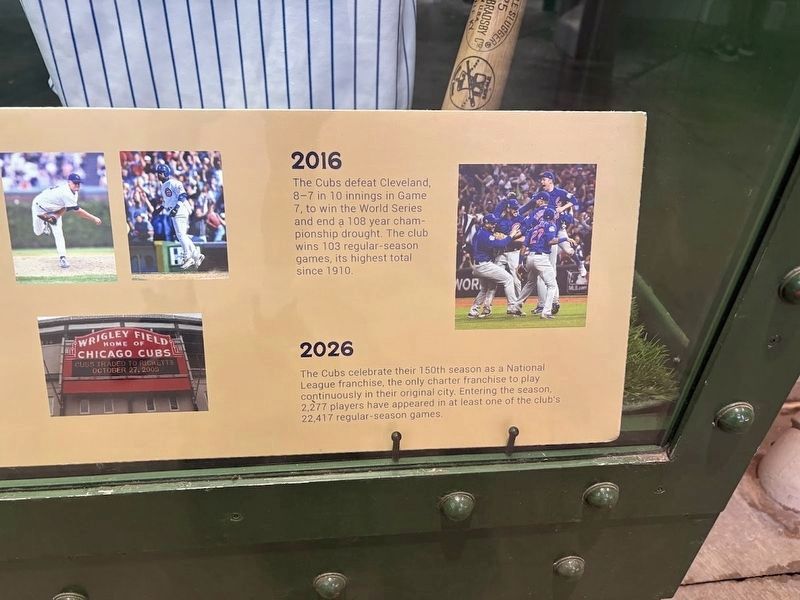
2016
The Cubs defeat Cleveland, 8-7 in 10 innings in Game 7, to win the World Series and end a 108 year championship drought. The club wins 103 regular-season games, its highest total since 1910.
2026
The Cubs celebrate their 150th season as a National League franchise, the only charter franchise to play continuously in their original city. Entering the season, 2,277 players have appeared in at least one of the club's 22,417 regular-season games.
Erected 2026 by Chicago Cubs.
Topics and series. This historical marker is listed in these topic lists: African Americans • Sports. In addition, it is included in the Baseball Hall of Famers, and the The Great Chicago Fire of 1871 series lists. A significant historical year for this entry is 1876.
Location. 41° 56.928′ N,

Photographed by Sean P. Flynn, June 5, 2026
4. Into the Cubs Archives, 1902-1930

Regionally, this marker is on Chicago’s North Side. It is also in the American Midwest. Globally, it is in North America, on the Great Lakes, in the Western Hemisphere, in the Western World, and in the Anglosphere. Historically, it finds itself in what was once the Viceroyalty of New France, the territory of the Mississippian Culture, and the Northwest Territory.
Other nearby markers. At least 8

Photographed by Sean P. Flynn, June 5, 2026
5. Into the Cubs Archives, 1945-1971
Regarding Into the Cubs Archives. The display was updated in 2026 in honor of the 150th anniversary of the club's charter membership in the National League.

Photographed by Sean P. Flynn, June 5, 2026
6. Into the Cubs Archives, 1984-2009
Photographed by Sean P. Flynn, June 5, 2026
7. Into the Cubs Archives, 2016-2026
Photographed by Sean P. Flynn, June 5, 2026
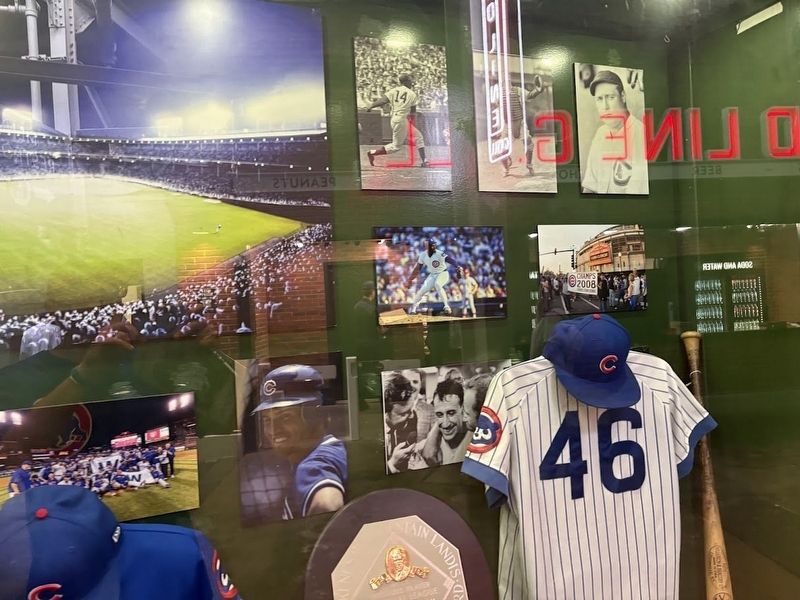
8. Display case items

Photographed by Sean P. Flynn, June 5, 2026
9. Hank Sauer's 1952 MVP award
Sauer led the National League in RBIs with 121, and he tied Pittsburgh's Ralph Kiner for the National League home run crown with 37. The 1952 Cubs finished with a 77-77 record, their only season between 1947 and 1962 with a record at or above .500.
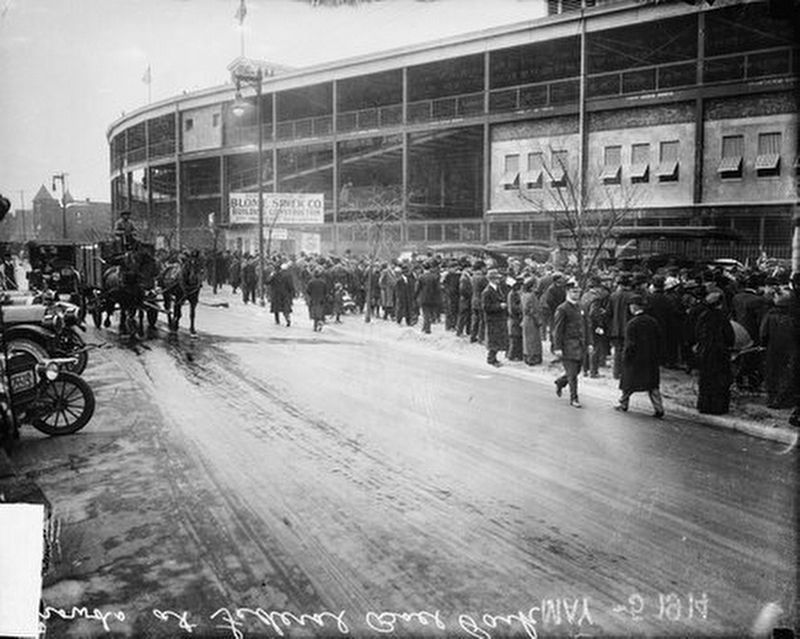
Chicago Daily News collection, Chicago History Museum (DN-0059404), May 14, 1914
10. Weeghman Park, 1914
The park in Chicago's Lakeview neighborhood that is now called Wrigley Field was first occupied by the Chicago Whales of the Federal League, a competitor to the Major Leagues that went defunct in 1915. The Whales' former owner Charles Weeghman, whose name was on the field, acquired the Cubs in 1916, at the head of an investor group that included chewing gum magnate William Wrigley Jr., and moved the club into the Whales' old park. Within a few years, William Wrigley acquired the controlling interest in the Cubs, and in 1920 the stadium was renamed Cubs Park. In 1927, it was renamed after Wrigley. The Wrigley family owned the club until 1981, when it was sold to the Tribune Company, but the name remained attached to the stadium.
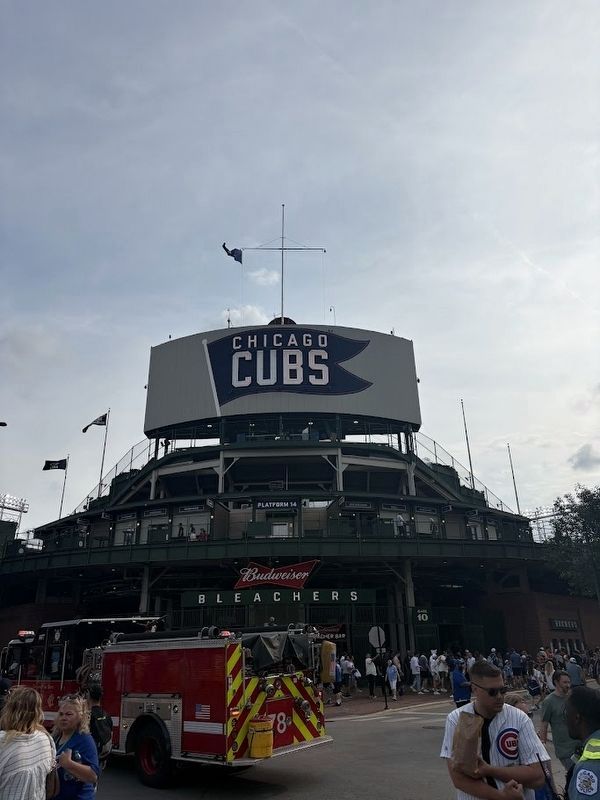
Photographed by Sean P. Flynn, June 5, 2026
11. Bleachers entrance at Wrigley Field
An "L" flag flies over the ballpark's famed scoreboard after the Cubs lost to the San Francisco Giants 18-3 on June 5, 2026.
Credits. This page was last revised on June 9, 2026. It was originally submitted on June 8, 2026, by Sean P. Flynn of Oak Park, Illinois. This page has been viewed 27 times since then. Photos: 1, 2, 3, 4, 5, 6, 7, 8, 9, 10, 11. submitted on June 8, 2026, by Sean P. Flynn of Oak Park, Illinois.
