
Munster in Lake County, Indiana — The American Midwest (Great Lakes)
Stallbohm Barn-Kaske House
Photographed by Daniel Barriball, April 25, 2026
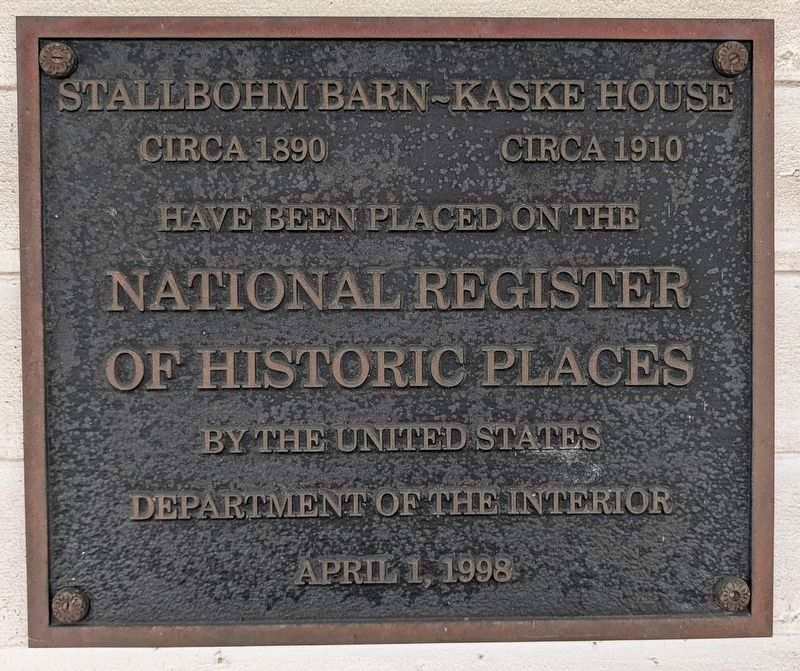
1. Stallbohm Barn∼Kaske House Marker
Circa 1890 Circa 1910
have been placed on the
National Register
of Historic Places
by the United States
Department of the Interior
April 1, 1998
Erected 1998 by United States Department of the Interior.
Topics. This historical marker is listed in these topic lists: Architecture • Settlements & Settlers. A significant historical date for this entry is April 1, 1998.
Location. 41° 33.585′ N, 87° 30.02′ W. Marker is in Munster, Indiana, in Lake County. It is at the intersection of Columbia Avenue and Ridge Road, on the right when traveling east on Columbia Avenue. This marker stand to the left of the front door of the Kaske House in Heritage Park. Touch for map. Marker is at or near this postal address: 8645 Columbia Ave, Munster IN 46321, United States of America. Touch for directions.

Regionally, this marker is in Northwest Indiana and in the Calumet Region. It is also in the American Midwest and in the Corn Belt. Globally, it is in North America, on the Great Lakes, in the Western Hemisphere, in the Western World, and in the Anglosphere. Historically, it finds itself in
this page online
Other nearby markers. At least 8 other markers are within walking distance of this marker: Site of Brass Tavern (within shouting distance of this marker); Native Plants of Heritage Park & Bieker Woods (within shouting distance of this marker); Pollinators at Heritage Park (within shouting distance of this marker); The power of the wind has been used to pump water for hundreds of years. (within shouting distance of this marker); A Blooming Town (about 300 feet away, measured in a direct line); Munster's Beginnings / How did Munster get its name? (about 300 feet away); Brass Tavern / Kaske House (about 300 feet away); Munster Herstory (about 300 feet away). Touch for a list and map of all markers in Munster.
More about this marker. The Stallbohm Barn was lost to arson in 2002.
Regarding Stallbohm Barn-Kaske House.
From the Statement of Significance in the NRHP application:
The Stallbohm Barn is significant for its architecture. It is an excellent example of an English Barn, a once common type in Lake County. This barn type originated
Photographed by Daniel Barriball, April 25, 2026
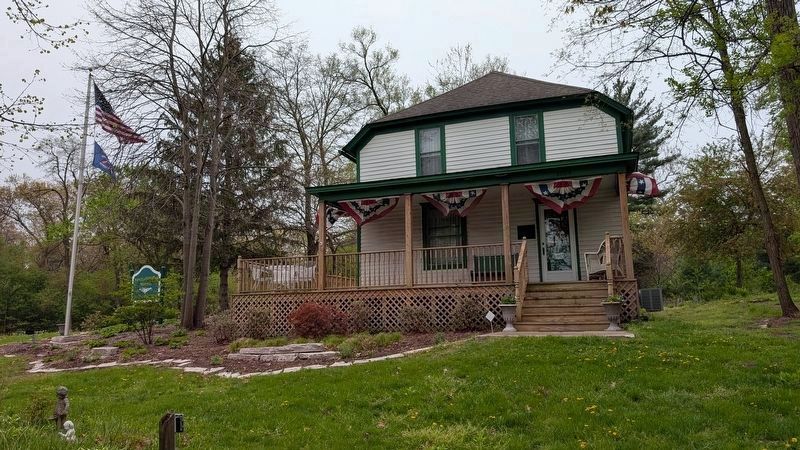
2. Stallbohm Barn / Kaske House Marker in context
The marker is to the left of the front door of the Kaske House.
The Kaske House is a contributing element of the property, and is significant for its architecture. It is an example of an early twentieth century, vernacular house. It is similar in form to an American four-square house, but lacks the usual hipped roof and dormer windows. The jerkin-head roof on the Kaske House was a popular type in northern Indiana in the early twentieth century. The Kaske House is also similar to a four-square in its interior configuration. A characteristic of the four-square house is that there were generally four rooms on the first level, and four on the second. The Kaske House has three bedrooms upstairs, plus a bathroom which was added in what was originally the fourth bedroom. Downstairs, there are only three rooms. What would typically have been two rooms in the front of the house is one large living room in the Kaske House. It seems likely that the large room was planned to accommodate the massive piano which came from the Stallbohm Inn.
Also see . . . Stallbohm Barn-Kaske House NRHP Application. Indiana State Historic Architectural and Archaeological Research Database (SHAARD)
The family which occupied the Stallbohm-Kaske property was prominent in the community from Munster's early days. Johann and Wilhelmina Stallbohm, both born in Germany, worked hard to build a prosperous inn and farm. Their daughter, Wilhelmina Stallbohm Kaske and her husband, Hugo Kaske, were active in their community. Wilhelmina was first president of the PTA, and donated land for the first Munster library. Hugo was a judge, a town clerk, and a member of the school board and several town(Submitted on June 8, 2026, by Daniel Barriball of Chesterton, Indiana.)
commissions. The Kaskes daughter, Helen, married Lawrence Bieker, and they continued the family tradition of community responsibility. Lawrence, chief engineer with Graver Tank Corporation, was a member of the Munster Town Board. Helen, a teacher at Hammond High School and the University of Chicago, was active in many organizations including the American Association of University Women, the League of Women Voters, and the Indiana Save the Dunes Council.
Credits. This page was last revised on June 8, 2026. It was originally submitted on June 8, 2026, by Daniel Barriball of Chesterton, Indiana. This page has been viewed 18 times since then. Photos: 1, 2. submitted on June 8, 2026, by Daniel Barriball of Chesterton, Indiana. • Devry Becker Jones was the editor who published this page.
