Le village d'Argentine, dernier témoin d'une époque
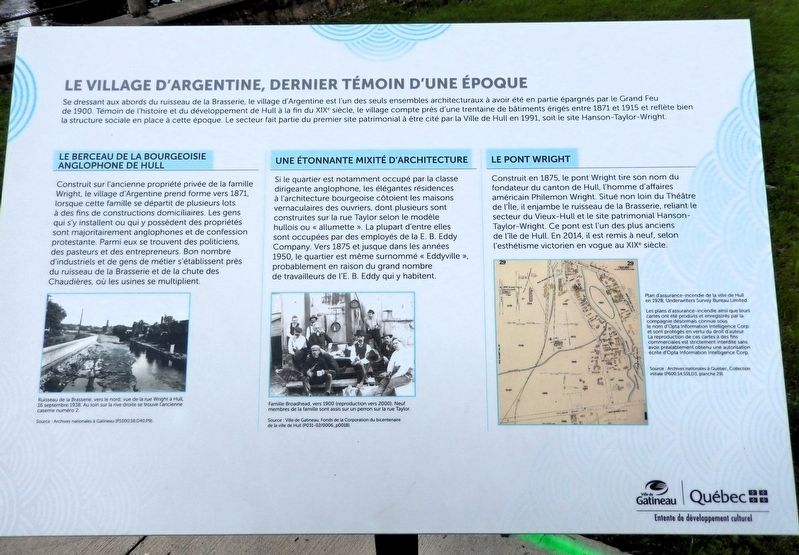

Le berceau de la bourgeoisie anglophone de Hull
Construit sur l'ancienne propriété privée de la famille Wright, le village d'Argentine prend forme vers 1871, lorsque cette famille se départit de plusieurs lots à des fins de constructions domiciliaires. Les gens qui s'y installent ou qui y possèdent des propriétés sont majoritairement anglophones et de confession protestante. Parmi eux se trouvent des politiciens, des pasteurs et des entrepreneurs. Bon nombre d'industriels et de gens de métier s'établissent près du ruisseau de la Brasserie et de la chute des Chaudières, où les usines se multiplient.
Une étonnante mixité d’architecture
Si
this page online
Le pont Wright
Construit en 1875, le pont Wright tire son nom du fondateur du canton de Hull, l'homme d'affaires américain Philemon Wright. Situé non loin du Théâtre de l'île, il enjambe le ruisseau de la Brasserie, reliant le secteur du Vieux-Hull et le site patrimonial Hanson-Taylor-Wright. Ce pont est l'un des plus anciens de l'île de Hull. En 2014, il est remis à neuf, selon l'esthétisme victorien en vogue au XIXe siècle.
The village of Argentine, last witness of an era
Rising near the Brasserie stream, the village of Argentine is one of the few architectural ensembles to have been partly spared by the

The cradle of the English-speaking bourgeoisie of Hull
Built on the former private property of the Wright family, the village of Argentine took shape around 1871, when this family sold off several lots for residential construction purposes. The people who settled there or owned properties were mostly anglophone and of the Protestant faith. Among them are politicians, pastors, and entrepreneurs. Many industrialists and tradespeople settle near the Brewery Creek and the Chaudières Falls, where factories are multiplying.
An astonishing mix of architecture
Although the neighborhood is notably occupied by the English-speaking ruling class, the elegant residences with bourgeois architecture coexist with the workers’ vernacular houses, several of which are built on Taylor Street according to

The Wright Bridge
Built in 1875, the Wright Bridge takes its name from the founder of the township of Hull, the American businessman Philemon Wright. Located not far from the Island Theatre, it spans Brewery Creek, connecting the Old Hull area and the Hanson-Taylor-Wright heritage site. This bridge is one of the oldest on Hull Island. In 2014, it was renovated, according to the Victorian aesthetic popular in the 19th century.
Erected by Ville de Gatineau, Québec, Entente de développement culturel.
Topics. This historical marker is listed in these topic lists: Architecture • Bridges & Viaducts • Industry & Commerce • Settlements & Settlers. A significant historical year for this entry is 1875.
Location. 45° 25.581′ N, 75° 43.49′ W. Marker is in Gatineau, Québec, in Outaouais. It is in District de Hull. It is on Rue Wright just east of Rue Montcalm, on the right when traveling


Regionally, this marker is in the Ottawa Metropolitan Area and in the Outaouais & Eastern Townships. It is also in Central Canada. Globally, it is in North America, the Great North Woods, the Western Hemisphere, and the Western World. Historically, it finds itself in what was once a British colony, the Viceroyalty of New France, the Haudenosaunee (Iroquois) Confederacy, and Rupert’s Land.
Other nearby markers. At least 8 other markers are within walking distance of this marker: Le ruisseau de la Brasserie (within shouting distance of this marker); Place de la Francophonie (about 90 meters away, measured in a direct line); La Rue Hanson : témoin d'une famille d'industriels (about 150 meters away); La Maison Wright-Scott : Un environnement pittoresque au cœur de la ville (about 150 meters away); Philemon Wright (approx. 0.3 kilometers away); L'édifice Jules-Léger / The Jules Léger Building (approx. 0.4 kilometers away); Les débuts modestes de l'usine E. B. Eddy (approx. 0.4 kilometers away); Hull, une ville ouvrière dans l'âme

Also see . . . Site patrimonial Hanson-Taylor-Wright / Hanson-Taylor-Wright Heritage Site.
Excerpt : Les terres sur lesquelles est situé le site patrimonial Hanson-Taylor-Wright faisaient d'abord partie de la propriété privée du fondateur du canton de Hull, Philemon Wright (1760-1839). Philemon Wright, accompagné d'un petit groupe de cultivateurs du Massachusetts, arrive en 1800 dans la région outaouaise, où il fonde un canton et initie le commerce du bois.(Submitted on June 8, 2026, by Cosmos Mariner of Cape Canaveral, Florida.)En 1881, on compte déjà 29 familles dans ce quartier qui perdit alors son nom original de « village d'Argentine » pour celui, non officiel, de « Eddyville » - nom attribué probablement en raison du nombre important d'employés des moulins de Ezra Butler Eddy (1827-1907) qui y résidaient.
Les résidences construites à la fin du XIXe siècle ont presque toutes été préservées des nombreux incendies qu'a connus la ville de Hull. Ainsi, la majorité des bâtiments de ce site datent de cette époque. Ces maisons arborent une ornementation d'inspiration néo-Queen Anne. Les demeures de ce
style se distinguent notamment par leur plan asymétrique, leur toiture à géométrie complexe, leurs grands frontons triangulaires en saillie et leurs éléments décoratifs en bois menuisé. Les grandes galeries des maisons de ce secteur et leur ornementation fine et abondante sont des manifestations de ce style.[English translation] The lands on which the Hanson-Taylor-Wright heritage site is located were originally part of the private property of the founder of the township of Hull, Philemon Wright (1760-1839). Philemon Wright, accompanied by a small group of farmers from Massachusetts, arrived in 1800 in the Outaouais region, where he founded a township and started the timber trade.
By 1881, there were already 29 families in this neighborhood, which then lost its original name of "village of Argentine" for the unofficial name of "Eddyville" – a name probably given because of the significant number of employees of Ezra Butler Eddy's (1827-1907) mills who lived there.
The residences built at the end of the 19th century have almost all been preserved from the many fires that the city of Hull has experienced. Thus, the majority of the buildings on this site date from that period. These houses display ornamentation inspired by the neo-Queen Anne style. Homes of this style are particularly distinguished by their asymmetrical layouts, complex-shaped roofs, large projecting triangular gables, and decorative carved wood elements. The spacious porches of the houses in this area and their intricate and abundant ornamentation exemplify this style.
Credits. This page was last revised on June 15, 2026. It was originally submitted on June 8, 2026, by Cosmos Mariner of Cape Canaveral, Florida. This page has been viewed 28 times since then. Photos: 1, 2, 3, 4, 5. submitted on June 8, 2026, by Cosmos Mariner of Cape Canaveral, Florida.
