District de Hull in Gatineau in Outaouais, Québec — Central Canada (French-Canadian)
La Maison Wright-Scott : Un environnement pittoresque au cœur de la ville

Photographed by Cosmos Mariner, May 27, 2024
1. La Maison Wright-Scott Marker

Le domaine de la maison Wright-Scott est surtout associé à Nancy Louisa Wright, sœur aînée de Philemon Ephraim. Mariée à John Scott, le premier maire d'Ottawa, elle vient habiter la villa avec ses enfants au décès de son époux, en 1857. Elle hérite d'une partie de l'ancienne propriété de son grand-père qu'elle divise en parcelles pour la vente en 1871, donnant ainsi forme au village d'Argentine. La propriété est vendue en 1964, après avoir appartenu à la famille Wright pendant 164 ans. Reconnu par le ministère des Affaires culturelles du Québec en 1979, puis classé site patrimonial en 2012, ce site témoigne des débuts de la ville de Hull et commémore la famille fondatrice de la région.
Composé d'une villa en pierre et d'un magnifique jardin,
this page online
La Maison du 15, Rue Hanson
Construite entre 1874 et 1880, la maison située au 15, rue Hanson fait partie des plus anciennes propriétés du site patrimonial Hanson-Taylor-Wright. Son architecture s'inspire des styles néoclassiques, néo-Renaissance et néo-Queen Anne et se distingue par ses deux pignons à avant-toit à retour et ses œils-de-bœuf. Ses ouvertures et ses chaînes d'angle sont soulignées par l'utilisation de briques de couleurs contrastantes, dont certaines sont importées des États-Unis. Ce détail témoigne de l'aisance financière de son premier propriétaire, le comptable d'origine irlandaise William Lough.
The Wright-Scott House: A Picturesque Setting in the Heart of the City
When Philemon Wright settled in the area at the

Courtesy Patrick M.O. Evans, Les Wrights…, © Commission de la capitale nationale
2. Marker detail: Nancy Louisa Wright (1870) & John Scott (1855)
The Wright-Scott House estate is mostly associated with Nancy Louisa Wright, the elder sister of Philemon Ephraim. Married to John Scott, the first mayor of Ottawa, she moved into the villa with her children after her husband’s death in 1857. She inherited a portion of her grandfather’s former property, which she divided into lots for sale in 1871, thus shaping the village of Argenteuil. The property was sold in 1964, after having belonged to the Wright family for 164 years. Recognized by the Quebec Ministry of Cultural Affairs in 1979, and later designated as a heritage site in 2012, this site reflects the early days of the city of Hull and honors the founding family of the region.
Consisting of a stone villa and a gorgeous garden, the Wright-Scott House estate is a good example of a type of urban dwelling popular in the 19th century, the garden

N.C.C. Houses and churches in Hull, Bibliotheque et Archives Canada, Fonds Ted Grant
3. Marker detail: Maison Wright-Scott, 1960
The House at 15 Hanson Street
Built between 1874 and 1880, the house at 15 Hanson Street is one of the oldest properties in the Hanson-Taylor-Wright heritage site. Its architecture draws on Neo-classical, Neo-Renaissance, and Neo-Queen Anne styles and stands out with its two gables with returning eaves and its oculus windows. The openings and corner quoins are highlighted by the use of contrasting colored bricks, some of which were imported from the United States. This detail reflects the financial comfort of its first owner, Irish-born accountant William Lough.
Erected by Ville de Gatineau, Québec, Entente de développement culturel.
Topics. This historical marker is listed in these topic lists: Architecture • Settlements & Settlers. A significant historical year for this entry is 1874.
Location. 45° 25.521′ N, 75° 43.582′ W. Marker is in Gatineau, Québec, in Outaouais. It is

Bibliothèque et Archives Canada
4. Marker detail: Ottawa River & Chaudières Falls, in 1825
Carte des deux rives de la rivière des Outaouais et de la chute des Chaudières, en 1825. Sur ta rive nord, on aperçoit la résidence de Philemon Wright. • • • Map of both banks of the Ottawa River and the Chaudières Falls, in 1825. On the north bank, you can see Philemon Wright's residence.

Regionally, this marker is in the Ottawa Metropolitan Area and in the Outaouais & Eastern Townships. It is also in Central Canada. Globally, it is in North America, the Great North Woods, the Western Hemisphere, and the Western World. Historically, it finds itself in what was once a British colony, the Viceroyalty of New France, the Haudenosaunee (Iroquois) Confederacy, and Rupert’s Land.
Other nearby markers. At least 8 other markers are within walking distance of this marker: La Rue Hanson : témoin d'une famille d'industriels (within shouting distance of this marker); Le ruisseau de la Brasserie (about 150 meters away, measured in a direct line); Le village d'Argentine, dernier témoin d'une époque (about 150 meters away); Place de la Francophonie (about 180 meters away); Philemon Wright (approx. 0.4 kilometers away); L'édifice Jules-Léger / The Jules Léger Building

Photographed by Cosmos Mariner, May 27, 2024
5. La Maison Wright-Scott Marker
Looking east from Rue Hanson. The Wright-Scott house is hidden behind the heavy foliage in the background.
Also see . . . Wright-Scott House (Parks Canada).
Excerpt: The Wright-Scott House is an elegant two-and-a-half-storey residence clad in rough natural stone and incorporates a number of stylistic influences. It is remarkable for its two large gables, its projecting bays, its multi-light windows, its slate roof punched with small dormers, its centre door and its glazed veranda. The house is set back from Alexandre Taché Boulevard on a large, wooded lot and landscaped with shrubs, mature trees and gardens.(Submitted on June 11, 2026, by Cosmos Mariner of Cape Canaveral, Florida.)The Wright-Scott House is a very good example illustrating the theme of the construction of prestigious homes by middle-class families who had accumulated wealth, a phenomenon linked to the economic growth of the period. Its construction around 1875-1877 on part of what was formerly Philemon Wright’s farm coincides with the subdivision of the property and the start of residential development.
The house was built by descendants of Philemon Wright, who played a key role in the economic development of the region. Located on the edge of the residential neighborhood in proximity to the industrial sector, the house represents the cornerstone of the growth of the area and is considered one of the finest specimens illustrating this turning point in the history of the local community.Photographed by Cosmos Mariner, May 27, 20246. La Maison Wright-Scott / The Wright-Scott House
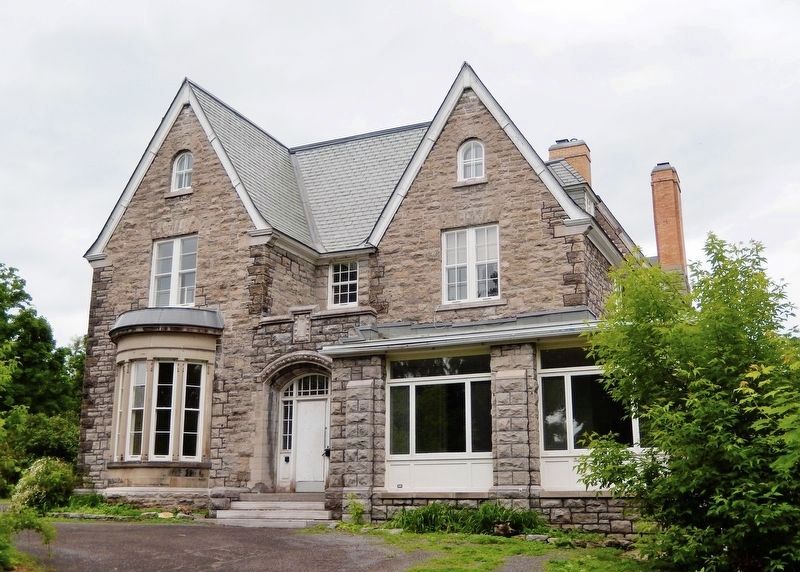

Photographed by Cosmos Mariner, May 27, 2024
7. La Maison Wright-Scott / The Wright-Scott House

Photographed by Cosmos Mariner, May 27, 2024
8. La Maison Wright-Scott / The Wright-Scott House
Credits. This page was last revised on June 15, 2026. It was originally submitted on June 8, 2026, by Cosmos Mariner of Cape Canaveral, Florida. This page has been viewed 16 times since then. Photos: 1, 2, 3, 4, 5, 6, 7, 8. submitted on June 11, 2026, by Cosmos Mariner of Cape Canaveral, Florida.
